El segundo más antiguo de los Antiguos Deberes. Une una historia de la geometría y de la masonería, desde los hijos de Lamec hasta la construcción del Templo, con los artículos y los puntos de la Orden. El manuscrito se conserva en la Biblioteca Británica (Additional MS 23198).
Texto publicado por Matthew Cooke, Londres, 1861. Las letras entre barras verticales marcan las abreviaturas del manuscrito.
Sobre este texto
El Manuscrito Cooke, conservado en la Biblioteca Británica como Additional MS 23198, es el segundo más antiguo de los Antiguos Deberes, después del Poema Regius. Fue publicado en Londres en 1861 por Matthew Cooke, de quien toma el nombre, y se data hacia 1450. Consta de dos partes: una historia del oficio, que sigue la geometría y la masonería desde los hijos de Lamec, pasando por la Torre de Babel y el Templo de Salomón, hasta Euclides, y un Libro de los Deberes con nueve artículos y nueve puntos para maestros y compañeros. Es la exposición más clara de la leyenda que los masones de la Edad Media contaban sobre su propio origen.
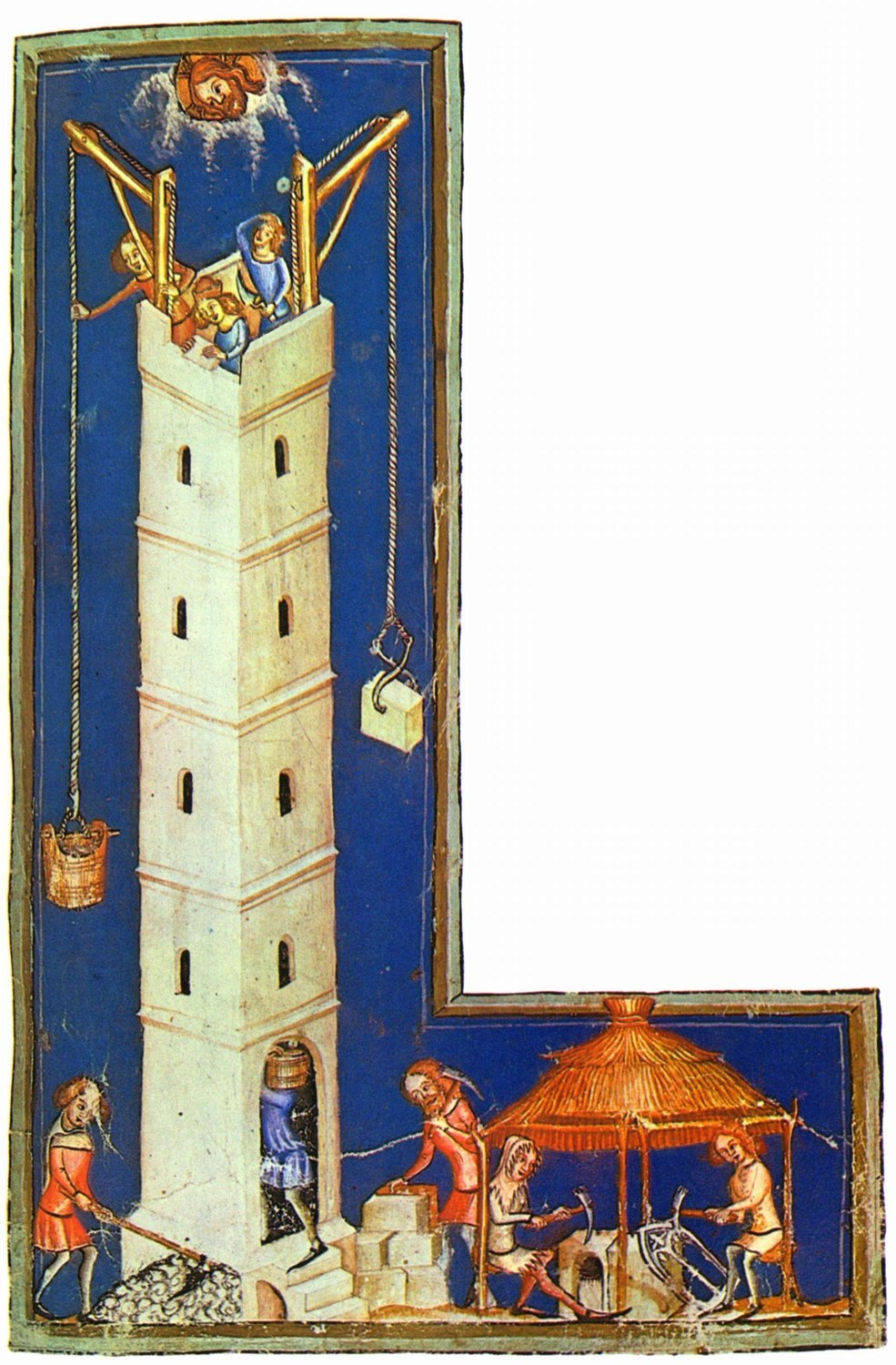
La construcción de la Torre de Babel, inicial de una crónica universal medieval · Dominio público
Manuscrito Cooke, 1410 e∴ v∴
Demos gracias a Dios, nuestro Padre Glorioso, creador del Cielo y de la Tierra y de todo lo que está en ellos y que Él conoce [en virtud] de Su Gloriosa Divinidad. Él hizo todas las cosas para ser obedecido, y muchas de ellas en beneficio de la Humanidad; les ordenó someterse al hombre, porque todas las cosas que son comestibles y de buena calidad [sirven] para el sostén del hombre. Y también ha dado al hombre inteligencia y habilidad en diversas cosas, y el Arte, por medio del cual podemos viajar por este Mundo para procurarnos la subsistencia, para hacer muchas cosas por la Gloria de Dios y también para nuestra tranquilidad y provecho. Si debiese enumerar todas estas cosas, sería demasiado largo de decir y de escribir.
Mostraré una de ellas, aunque me deje otras: esto es, de qué modo comenzó la Ciencia de la Geometría, y quiénes fueron los creadores de ella y de otras Artes, como se revela en la Biblia y en otras Historias. Voy a narrar, como he dicho, cómo y de qué modo comenzó esta digna Ciencia de la Geometría.
Has de saber que hay siete Ciencias Liberales, y luego sabrás por qué son llamadas de esta manera; y por qué de estas siete primeras derivan todas las Ciencias y Artes del Mundo, y especialmente por qué aquella, la Ciencia de la Geometría, es el origen de todas.
En cuanto a la primera, que es llamada el fundamento de la Ciencia, es la Gramática, que enseña al hombre a hablar y a escribir en modo justo. La segunda es la Retórica, que enseña al hombre a hablar decorosamente de manera justa. La tercera es la Dialéctica, y ella enseña al hombre a discernir lo verdadero de lo falso, y es llamada comúnmente Arte o [Filosofía]. La cuarta es llamada Aritmética, y enseña al hombre al Arte de los números, para calcular y contar todas las cosas. La quinta es la Geometría, que enseña al hombre los límites y la medida y la ponderación de los pesos de todas las Artes humanas. La sexta es la Música, que enseña al hombre el Arte del canto en las notas de la voz y del órgano, de la trompa, del arpa y de todos los demás instrumentos.
La séptima es la Astronomía, que enseña al hombre el curso del Sol y de la Luna y de las restantes Estrellas y Planetas del Cielo. Nuestro principal fin consiste en tratar del primer fundamento de la excelente Ciencia de la Geometría, y de quiénes fueron sus fundadores; como dije al principio, hay siete Ciencias Liberales, es decir, siete Ciencias o Artes que son libres en sí mismas, las cuales siete viven solamente por medio de la Geometría.
Y la Geometría es, como se dice, la medida de la Tierra: “Et sic dicitur a geoge pin Px ter a Latine e metrona quod est mensura. Unde Geometria i mensura terre vel Terrarum”, o sea, que la Geometría es, como he dicho, Geo, la tierra, y metron, medida, y, así, el nombre de Geometría es compuesto, y se llama medida de la Tierra.
No te maravilles de que haya dicho que todas las Ciencias viven sólo por la Ciencia de la Geometría, porque ninguna de ellas es artificial [que presuponga, como la Geometría, al artifex]. Ningún trabajo que el hombre haga es realizado sino por medio de la Geometría; una importante razón: si un hombre trabaja con las manos, trabaja entonces con cualquier tipo de utensilio, y no hay ningún instrumento hecho de cosas materiales de este Mundo que no provenga de la Tierra y a la Tierra retorne, y no existe instrumento, esto es, utensilio para trabajar, que no posea proporciones. Y proporción es medida, y utensilio, o instrumento, es Tierra. Por ello puede decirse que los hombres de este Mundo viven por el trabajo de sus manos.
Muchas otras pruebas te he dado sobre por qué la Geometría es la Ciencia de la que viven todos los hombres razonables, pero esta vez no lo dejaré al largo proceso de la Escritura.
Y ahora procederé con mi argumento; comprenderás que de entre todas las Artes del Mundo, [la más importante] es el Arte del Hombre; el Arte de la construcción tiene la mayor importancia y la mayor parte en la Ciencia de la Geometría, como está escrito y dicho en la Storia, en la Biblia, en el Polycronicon, una crónica ilustrada, y en la Historia de Beda, en De Immagine Mundi y en el Ethimologiarum de Isidoro, en Metodio, obispo y mártir, y en muchos otros; digo que la Masonería es el principal [Arte] de la Geometría, como pienso que bien puede decirse, porque fue la primera en ser creada; como se dice en la Biblia, en el libro I del Génesis, capítulo 4. Y también todos los Doctores mencionados lo dicen, y algunos de ellos más abierta y simplemente [respecto] a como está dicho en la Biblia.
El Hijo directo de la estirpe de Adán, descendiente de las siete generaciones de Adán, antes del Diluvio, fue un hombre llamado Lameth, que tenía dos mujeres; de la primera, Ada, tuvo dos hijos: uno llamado Jabal y otro Jubal. El mayor, Jubal, fue el primer fundador de la Geometría y de la Construcción y construyó casas y es llamado en la Biblia “pater habitancium in tentoriis atque pastorum”, es decir, padre de los hombres que viven en tiendas, o sea, en casas. Y fue maestro de Caín y jefe de todos sus trabajadores cuando hizo la Ciudad de Enoc, que fue la primera ciudad nunca construida y que Caín entregó a su hijo y la llamó Enoc. Y ahora es llamada Ephraim.
Y la Ciencia de la Geometría y de la Masonería fue por primera vez empleada e inventada como Ciencia y Arte, y por ello podríamos decir que fue el origen y el fundamento de todas las Artes y las Ciencias, y este hombre, Jabal, fue llamado “Pater pastorum”. El maestro de la Historia y Beda, De Immagine Mundi, Polycronicón y muchos otros dicen que por primera vez él hizo la repartición de la Tierra, de modo que cada hombre pudiera individuar (conocer) su campo y su trabajo. Y dividió también rebaños y ovejas, y por eso podemos decir que fue el primer fundador de esta Ciencia.
Y su hermano Jubal o Tubal fue el fundador de la Música y del canto, como afirma Pitágoras en el Polycronicón, y el mismo Isidoro en sus Etimologías; en su I libro dice que fue el primer fundador de la música y del canto, del órgano y de la trompa, y que encontró la ciencia del sonido por los golpes de los metales gracias a su hermano Jubalcaín.
La Biblia dice en verdad en el capítulo IV del Génesis que Lameth tuvo de otra mujer llamada Zillah un hijo y una hija. Sus nombres eran Tubalcaín, el hijo, y la hija fue llamada Naamah y, como dice el Polycronicón, fue la mujer de Noé; que esto sea o no verdad, no lo sabemos.
Te digo que este hijo, Tubalcaín, fue el fundador del Arte de la Herrería y de todas las Artes de los metales, esto es, del hierro, del oro y de la plata, como dicen algunos Doctores, y su hermana Naamah fue la fundadora del Arte del Tejido; hilaban el hilo y laboraban el hierro y se hacían vestidos como podían, pero la mujer Naamah encontró el Arte del tejido, que es ahora llamado el Arte de las mujeres; y estos tres hermanos sabían que Dios se vengaría del pecado, o con el fuego o con el agua, y pusieron el mayor cuidado para salvar las Ciencias que habían encontrado, y se aconsejaron entre ellos; y, gracias a su ingenio, se dijeron que había dos tipos de piedra de tal cualidad que la primera jamás podía ser quemada, y esta piedra es llamada mármol, y que la otra piedra no podía ser hundida, y esta piedra era llamada laterus. Y por ello idearon escribir todas las ciencias que habían encontrado en estas dos piedras, de manera que si Dios se vengaba con el fuego el mármol no fuera quemado, y si Dios se vengaba con el agua la otra piedra no se hundiera. Y por ello rogaron al hermano mayor de Jabal que construyera dos columnas con estas dos piedras, esto es, mármol y laterus, y que esculpiera en los dos pilares todas las Ciencias y las Artes que habían hallado. Y así se hizo, y por ello podemos decir que fueron muy hábiles en la ciencia que se inició y que persiguió su fin antes del Diluvio de Noé: sabiendo que la venganza de Dios se produciría, sea con el fuego o con el agua, los hermanos –como por una especie de profecía- sabían que Dios ordenaría una, y por ello escribieron en las dos piedras las siete Ciencias, pues pensaban que la venganza llegaría. Y ocurrió que Dios se vengó y hubo un tal Diluvio que todo el Mundo fue sumergido y murieron todos menos ocho personas. Y fueron Noé y su mujer y sus tres hijos y sus mujeres, y de estos hijos procede todo el Mundo. Y [los tres hijos] fueron llamados de este modo: Sem, Cam y Japhet. Y este Diluvio fue llamado el Diluvio de Noé, porque sólo se salvaron él y sus hijos.
Y muchos años después del Diluvio, como narra la Crónica, estas dos columnas fueron halladas y, como dice el Polycronicón, un gran doctor llamado Pitágoras encontró una, y Hermes, el filósofo, encontró la otra, y enseñaron las ciencias que en ellas hallaron escritas. Cualquier Crónica, la Storia y muchos otros doctos y principalmente la Biblia testimonian de la construcción de la Torre de Babel, y está escrito en la Biblia, Génesis, capítulo X, que Cam, hijo de Noé, generó a Nimrod, y que éste se convirtió en un hombre fuerte como un gigante y que fue un gran Rey. Y el inicio de su Reino fue el del verdadero Reino de Babilonia, de Arach y Archad y Calan y de la Tierra de Senaar. Y este mismo Nimrod inició la construcción de la Torre de Babilonia, y enseñó a sus obreros el Arte de la medida, y tenía muchos constructores, más de cuarenta mil. Y los amaba y los tenía en gran estima. Y esto está escrito en el Polycronicón y en otras Historias, y en parte atestiguado en la Biblia, en el capítulo X del Génesis, donde se dice que Asur, que era un pariente vecino de Nimrod, salió de la Tierra de Senaar y construyó la Ciudad de Nínive y de Plateas y muchas otras, y así dice: “De Terra illa i de Sennam egressus est Asure e edificauit Nunyven e Plateas civitatis e Cale e Jesen quoque inter Nunyven e hec est civitas magna”.
La razón quiere que digamos abiertamente cómo y de qué modo fue fundado el oficio de la construcción, y quién fue el primero en darle el nombre de Masonería. Y deberías saber lo que está dicho y escrito en el Polycronicón y en Metodio, obispo y mártir, que Asur, que fue digno Señor de Senaar, pidió al Rey Nimrod que le enviara masones y operarios del Oficio que pudieran ayudarle a construir la ciudad que deseaba edificar. Y Nimrod le envió trescientos masones. Y cuando debían partir, les llamó ante sí, y les dijo esto: “Debéis acudir ante mi primo Asur para ayudarle a construir una ciudad, pero vigilad de que esté bien dirigida; os voy a dar un encargo provechoso para vosotros y para mí. Cuando lleguéis ante este Señor, procurad ser tan leales hacia él como lo sois conmigo; haced como si fueseis hermanos, y permaneced lealmente unidos; y que aquel que tenga mayor habilidad enseñe a su compañero y se guarde de guiarle contra vuestro Señor, para que así yo pueda recibir mérito y agradecimiento por haberos enviado ante él y por haberle enseñado el Arte”. Y ellos recibieron el encargo de su patrón y Señor y llegaron ante Asur y construyeron la ciudad de Nínive, en el País de Plateas, y otras ciudades entre Cale y Nínive. Y de este modo, el Arte de la construcción fue engrandecido e impuesto como ciencia.
Los primeros antepasados de nosotros, los masones, tuvieron esta responsabilidad, como está escrito en nuestros Deberes, y también como lo hemos visto escrito ya en francés, ya en latín, y en la historia de Euclides; pero ahora diremos de qué manera Euclides llegó a tener conocimiento de la Geometría, así como está escrito en la Biblia y en otras historias. En el capítulo 12 del Génesis se dice que Abraham llegó a la Tierra de Canaan y nuestro Señor se le apareció y le dijo: “Os daré esta Tierra a ti y a tu descendencia”, pero hubo una gran carestía sobre la Tierra y Abraham tomó a Sara, su mujer, con él, y marchó hacia Egipto en peregrinación, y mientras duró la carestía ellos permanecieron allí. Y Abraham, como dice la Crónica, era un hombre sabio y un gran Doctor y conocía las siete Ciencias y enseñó a los egipcios la Ciencia de la Geometría. Y este digno Sabio Euclides fue su alumno y aprendió de él. Y ellos le dieron por primera vez el nombre de Geometría, pues antes no tenía este nombre. Así, se dice en las Ethimologiarum de Isidoro, en el libro 5, capítulo I, que Euclides fue uno de los fundadores de la Geometría, y que le dio este nombre porque en aquel tiempo había un río en Egipto, el Nilo, que creció hasta tal punto en la tierra que los hombres no podían habitarla.
Por eso, este digno estudioso, Euclides, les enseñó a hacer grandes muros y fosos para retener el agua, y ellos, con la Geometría, midieron la tierra y la dividieron en muchas partes, y cada uno cerró su parte con muros y fosos, y por eso la tierra se hizo fértil y dio todo tipo de frutos y de jóvenes, de hombres y de mujeres; pero eran tantos los jóvenes que no podían vivir bien. Y los gobernantes, Señores del País, se reunieron en Consejo para ver cómo ayudar a sus hijos que no habían encontrado sustento. Y en este Consejo estaba este digno Docto Euclides, y cuando vio que no podían decidir sobre la cuestión, les dijo: “Tomad a vuestros hijos y ponedlos bajo mi mando, y yo les enseñaré una ciencia tal que vivirán con ella de los Señores, a condición de jurar que me serán fieles, y yo haré esto por vosotros y por ellos”. Y el Rey y todos los Señores se lo garantizaron. Y ellos llevaron a sus hijos ante Euclides para que les dirigiese a su placer, y él les enseñó este Arte, la Masonería, y le dio el nombre de Geometría, a causa de la división del terreno que había enseñado a la gente en el tiempo de la construcción de las murallas y los fosos, e Isidoro dice, en el Ethimologiarum, que Euclides la llamó Geometría. Y él les dio el deber de llamarse uno a otro Compañero, y no de otra manera, porque pertenecían a un mismo Arte y eran de sangre noble e hijos de Señores. Y que el más hábil debía ser el guía en el trabajo, y ser llamado Maestro, y le atribuyó otros cometidos que están escritos en el Libro de los Deberes. Y así ellos trabajaron con los Señores de la Tierra, y construyeron Ciudades, Castillos, Templos y Palacios. En ese tiempo los hijos de Israel que habitaban en Egipto aprendieron el Arte de la Masonería. Y luego, cuando fueron conducidos fuera de Egipto, llegaron a la Tierra de Behest, que ahora se llama Jerusalén. Y el Rey David inició la construcción del Templo de Salomón. El Rey David amaba a los Masones, y les dio derechos como antes no tenían. Y en la construcción del Templo, en tiempos de Salomón, como se dice en la Biblia, en el 3º Libro Regum in tercio Regam, capítulo quinto, Salomón tenía ochenta mil constructores a su servicio. Y el hijo de Tiro era su jefe. Y en otras crónicas y en otros libros de Masonería se dice que Salomón les confirmó el encargo que David, su padre, había dado a los masones. Y el propio Salomón les enseñó en formas poco distintas de las usadas ahora. Y de allí esta importante ciencia fue llevada a Francia y a otras Regiones.
Hubo en un tiempo un digno Rey de Francia llamado Carolus Secundus, esto es, Carlos II, y este Carlos fue elegido Rey de Francia por la Gracia de Dios y por su estirpe. Y este mismo Rey Carlos era masón antes de ser Rey, y cuando llegó a Rey amó a los masones y les tuvo en gran estima, y les dio deberes y reglamentos conforme a su designio, y algunos de ellos todavía están en uso en Francia; y él mismo estableció que deberían reunirse en Asamblea una vez al año para hablar entre sí, Maestros y Compañeros, y para [deliberar quién] había de guiarles y [para enmendar] todas las cosas equivocadas.
Y poco después san Adabelio llegó a Inglaterra y convirtió a san Albano al Cristianismo. Y san Albano amaba a los masones y les dio por primera vez encargos y usos en Inglaterra. Y les fijó un tiempo conveniente para pagarles el trabajo. Y después hubo un importante Rey en Inglaterra llamado Athelstan, y su hijo más joven amaba la Ciencia de la Geometría, y sabía bien que el Arte manual del Oficio practicaba la Ciencia de la Geometría como los masones, por lo que los [reunió] en Consejo y adoptó la práctica de esta ciencia a la especulación, porque en la especulación era maestro y amaba a la Masonería y a los masones. Y él mismo se hizo masón y les dio encargos y nombres que todavía están en uso en Inglaterra y en otros Países. Y estableció que [los masones] deberían ser pagados razonablemente por su trabajo, y consiguió un decreto del Rey que [sancionó] el derecho a que se reunieran en Asamblea cuando creyeran que ha pasado un período razonable, y que vinieran [a escuchar] a sus Consejeros, como está escrito y se enseña en el Libro de nuestros encargos y deberes, por lo que dejo ya el argumento. Los Hombres de bien, por este motivo y de este modo, [hicieron así que] la Masonería comenzase.
Ocurría a veces que los grandes Señores no tenían grandes posesiones, así que no podían ayudar a sus hijos nacidos libres, porque tenían muchos, y por eso se aconsejaron sobre cómo podían ayudarles, y establecer que pudieran vivir honestamente. Y les enviaron a Sabios Maestros de la importante Ciencia de la Geometría, de modo que ellos, con su sabiduría, pudieran dar a los hijos una honesta manera de vivir. Por eso uno de ellos, llamado Englet, que fue un muy agudo y sabio fundador, estableció un Arte y lo llamó Masonería, y así, con su Arte, instruyó a los hijos de los grandes Señores a requerimiento de los padres y con la libre voluntad de los hijos; cuando fueron instruidos con gran cuidado, después de un cierto período, no todos fueron igualmente capaces, por lo que dicho Maestro Englet determinó que todos los que terminaran [el aprendizaje] con habilidad deberían ser admitidos [en el oficio] con honor, y llamó al maestro más hábil para instruir a los maestros menos hábiles, y fueron llamados maestros por la nobleza de su ingenio y por su habilidad en el Arte. De este modo, dicho Arte, iniciado en la Tierra de Egipto, se propagó de Tierra en Tierra, de Reino en Reino.
Después de muchos años, en el tiempo del Rey Athelstano, que fue Rey de Inglaterra, sus Consejeros y otros Grandes Señores, de común acuerdo, por graves culpas lanzadas contra los masones, establecieron una cierta regla para ellos; una vez al año, o cada tres años [si ello respondía] a los deseos del Rey y de los Grandes Señores del País y del pueblo, de provincia en provincia, y de país en país, se reunirían en Asamblea todos los masones y compañeros de dicho Arte, y en tales reuniones los Maestros serían examinados sobre los artículos [de la Constitución] que fueron luego escritos, y se estableció que fuese verificado si los maestros eran capaces y hábiles, para ventaja de su Soberano y para honor de su Arte. Y además se estableció que deberían cumplir bien su encargo de emplear los bienes, pequeños o grandes, de sus Señores, porque de ellos percibían la compensación por su servicio y su trabajo.
El primer artículo es éste: que cada maestro de este Arte debe ser sabio y leal hacia el Señor a quien sirve; y no pagar a ningún obrero más de lo que él piense que se merezca, distribuyendo sus beneficios verdaderamente como quisiera que fuesen dispensados los suyos, tras haber [tenido en cuenta] la escasez de grano y de víveres en el País, y no otorgando ningún favor, para que todos sean recompensados según su trabajo.
El segundo artículo es éste: que cada maestro de este Arte deberá ser informado antes de entrar en su Comunidad; que sean [recibidos] como conviene; que no puedan ser excusados [de su ausencia], sino sólo por algún motivo [válido]. Pero si son hallados rebeldes [frente a] tal Comunidad, o culpables, en cualquier modo, de daño hacia los propios Señores, los culpables en este Arte no serán perdonados de ningún modo [y serán juzgados, y se verificará] su expulsión, y aunque se hallen (en peligro de muerte), [o enfermos], sin riesgo de muerte, se avisará al maestro que sea el jefe de la Asamblea, [quien deberá juzgarle].
El tercer artículo es éste: que ningún maestro tome a un aprendiz por un período menor de siete años por lo menos, porque en un plazo menor no puede llegar propiamente a su Arte, y por consiguiente será incapaz de servir lealmente a su Señor y de comprender [el Arte] como un masón debe comprenderlo.
El cuarto artículo es éste: que ningún maestro tome para instruir, sin provecho, a algún aprendiz al que esté unido con vínculos de sangre, ya que, a causa de su Señor, al cual está ligado, lo distraerá de su Arte y podrá llamarlo ante sí fuera de su Logia y del lugar donde trabaja; porque sus compañeros quizá le ayuden y combatan por él, y de aquí podría derivarse un homicidio –lo que está prohibido- y también por motivo de que su Arte se inició con los hijos de Grandes Señores nacidos libres, como ya ha sido dicho.
El quinto artículo es éste: que ningún maestro envíe a su aprendiz, durante el tiempo de su aprendizaje, a otro, pues ningún provecho puede salir de ello, y aunque piense que pueda agradar a su nuevo Señor, más importante es el provecho que podrá sacar el Señor del lugar en el cual ha sido adiestrado en su enseñanza.
El sexto artículo es éste: que ningún maestro, por codicia o provecho, tome aprendices para enseñarles cosas imperfectas, y que tengan mutilaciones, por lo cual no puedan trabajar realmente como deberían.
El séptimo artículo es éste: que ningún maestro sea visto ayudando, o protegiendo, o siendo el sostenedor de ningún ladrón nocturno, por el cual [a causa del hurto] sus compañeros no puedan cumplir el trabajo diario y no puedan organizarse.
El octavo artículo es éste: que no ocurra que ningún masón, que sea perfecto y hábil, venga a buscar trabajo y encuentre un modo de trabajar imperfecto e incapaz; el maestro del lugar recibirá al masón perfecto y echará al imperfecto para ventaja de su Señor.
El noveno artículo es éste: que ningún maestro tomará el puesto de otro, porque se ha dicho, en el Arte de la construcción, que nadie deberá terminar un trabajo comenzado por otro, para ventaja de su Señor; así que quien lo ha iniciado [tiene el derecho de] terminarlo a su modo, y sean cuales sean sus métodos.
Esta resolución ha sido adoptada por varios Señores y maestros de diversas provincias y Asambleas de Masonería, y dice así:
El primer punto: es necesario que todos los que deseen ser Compañeros del mencionado Arte juren por Dios, por la Santa Iglesia y por todos los Santos, ante su maestro y sus Compañeros y hermanos.
El segundo punto: él [el Compañero] debe cumplir su trabajo diario en razón de lo que le sea pagado.
El tercer punto: él [debe aceptar] las resoluciones de sus compañeros en la Logia y en Cámara y en cualquier otro lugar.
El cuarto punto: no engañará a su Arte, ni lo perjudicará, o sostendrá afirmaciones contra el Arte o contra alguien del Arte, sino que lo mantendrá con dignidad, porque él puede.
El quinto punto: cuando reciba su paga, la tomará humildemente, ya que el maestro ha establecido el tiempo del trabajo, y el resto [por él] ordenado está permitido.
El sexto punto: si una discordia cualquiera surge entre él y sus compañeros, deberá obedecer humildemente y permanecer a las órdenes del maestro, o, en su ausencia, del Vigilante [designado] por el maestro; en la siguiente fiesta religiosa se pondrá a disposición de los Compañeros; no en un día laborable, dejando el trabajo y el provecho de su Señor.
El séptimo punto: Que no desee a la mujer ni a la hija de su maestro o de sus compañeros; y si está casado, que no tenga concubina, porque podrían surgir discordias entre ellos.
El octavo punto: si ocurre que es nombrado Vigilante por su maestro, que sea un seguro transmisor entre su maestro y sus compañeros; y, en ausencia de su maestro, que lo sustituya con empeño, por el honor del maestro y para ventaja del Señor a quien sirve.
El noveno punto: si fuese más sabio y agudo que el compañero que trabaja con él en la Logia o en cualquier otro sitio, y si percibe que el otro debe dejar la piedra sobre la que está trabajando por falta de habilidad, y que puede enseñarle a corregir la piedra, deberá instruirlo, para que el amor crezca entre ellos y el trabajo del Señor no se eche a perder.
Sobre la Asamblea de Justicia.
Cuando el maestro y los compañeros sean avisados y lleguen a tales Asambleas, si es preciso serán invitados a participar, junto a los compañeros y el maestro de la Asamblea, el sheriff del Condado, o el alcalde de la Ciudad, o el Consejero más anciano de la Ciudad en la que se celebra la Asamblea, para servir de ayuda contra los rebeldes y para mantener el derecho del Reino.
Al principio [entran en el Oficio] hombres nuevos que nunca han sido culpables, de modo que no sean nunca ladrones, o [cómplices] de los ladrones, y que desarrollen su trabajo diario por la recompensa que de su Señor reciben, y un verdadero resumen den a sus Compañeros de las cosas que deben ser explicadas y escuchadas, y les amen como a sí mismos. Y deben ser fieles al Rey de Inglaterra y al Reino, y atenerse, con todas sus fuerzas, a los artículos mencionados.
Después de esto se indagará si algún maestro o compañero, que haya sido instruido, ha infringido algún artículo, y allí se establecerá si ha hecho nunca tales cosas. Por ello, vale decir, si algún maestro o compañero, que haya sido avisado [de la acusación] antes de venir a tal Asamblea, se rebela y no acude, o bien haya transgredido algún artículo, si esto se demuestra, deberá renegar de su [pertenencia] a la Masonería, y no podrá usar jamás de su Arte. Y si osa practicarlo, el Sheriff del país en el que haya sido encontrado trabajando deberá meterlo en prisión y poner todos sus bienes en manos del Rey hasta que le sea mostrada y concedida la gracia.
Por este motivo, [los participantes] en esta Asamblea establecerán que tanto el más bajo como el más alto deben ser lealmente servidores de su Arte en todo el Reino de Inglaterra.
Amén. Así sea.
Texto original en inglés medio:
THonkyd be god [Fol. 4]
our glorious
ffadir and fo|un|
der and former of heuen
and of erthe and of all
thygis that in hym is
that he wolde foche|s|aue of
his glorius god hed for to
make |s|o mony thyngis of d
uers vertu for mankynd. [10]
ffor he mader all thyngis for
to be abedient & |s|oget to man
ffor all thyngis that ben come|s|
tible of hol|s|ome nature he
ordeyned hit for manys |s|usty [Fol.4 b.]
na|n|s. And all to be hath yif
to man wittys and cony|n|g
of dy|ver|s thyngys and craft
tys by the whiche we may
trauayle in this worlde to [20]
gete |wit| our lyuyg to make
diuers thingys to goddis ple
|s|ans and also for our e|s|e and
profyt. The whiche thingis
if I |s|cholde reher|s|e hem hit
wre to longe to telle and to
wryte. Wherfor I woll leue.
but I |s|chall |s|chew you |s|ome
that is to |s|ey ho and in what [Fol. 5]
wyse the |s|ciens of Gemetry [30]
fir|s|te be ganne and who |wer|
the founders therof and of
othur craftis mo as hit is no
tid in |the| bybill and in othur
|s|tories.
HOw and in what ma
ner |th|at this worthy
|s|ciens of Gemetry be gan I
wole tell you as I sayde bi
fore. ye |s|chall undirstonde [40]
|that| |ther| ben vi|i| |liberall |s|ciens
by the whiche vi|i| all |s|ciens
and craftis in the world were [Fol. 5 b.]
fyr|s|te founde. and in especiall
for he is causer of all. |that| is to
sey |the| |s|ciens of Gemetry of all
other that be. the whiche v|i|i sci
ens ben called thus. as for the
fir|s|t |that| is called fundament
of sciens his name is gra|mmer| [50]
he techith a man ry|g|thfully to
|s|peke and to write truly. The
|s|econde is rethorik. and he te
chith a man to |s|peke formabe
ly and fayre. The thrid is
dioletic|us|. and |that| |s|ciens techith
a man to discerne the trowthe [Fol. 6]
fro |the| fals and comenly it is
tellid art or |s|oph’stry. The fourth
ys callid ar|s|metryk |the| whiche [60]
techeth a man the crafte of
nowmbers for to rekyn and
to make a coun|t| of all th|y|ge
The ffte Gemetry the which
techith a man all the met|t|
and me|s|u|r|s and ponderat|o|n
of wy|g|htis of all mans craf|t|
The. vi. is musi|k| that techith
a man the crafte of |s|ong in
notys of voys and organ & [70]
trompe and harp and of all [Fol. 6 b.]
othur |p|teynyng to hem. The
vi|i| is a|s|tronomy that techith
man |the| cours of the |s|onne
and of |the| moune and of ot|her|
|s|terrys & planetys of heuen.
OWr entent is princi
pally to trete of fyrst
fundacion of |the| worthe |s|cy|en|s
of Gemetry and we were [80]
|the| founders |ther| of as I seyde
by fore there ben vi|i| liberall
|s|cyens |that| is to |s|ay vi|i| |s|ciens or
craftys that ben fre in hem
selfe the whiche vi|i|. lyuen [Fol. 7.]
only by Gemetry. And Ge
metry is as moche to |s|ey
as the me|s|ure of the erth
Et sic dici|t| a geo |ge| q|ui|n |R| ter
a latine & metro|n| quod |e| [90]
men|s|ura. U|na| Gemetria. i,
mens|u|r terre uel terra|rum|.
that is to |s|ay in englische that
Gemetria is I |s|eyd of geo |that| is
in gru. erthe, and metro|n| |that| is
to |s|ey me|s|ure. And thus is |this|
nam of Gemetria c|om|pounyd
as is|s|eyd the me|s|ur of |the| erthe.
MErvile ye not that I
|s|eyd that all |s|ciens lyu|e| [100]
all only by the |s|ciens of Geme
try. ffor there is none artifici|-|
all ne honcrafte that is wro|g|th
by manys hond bot hit is
wrou|g|ght by Gemetry. and a
notabull cau|s|e. for if a man
worche |wit| his hondis he wor
chyth |wit| so|m|e ma|nner| tole and
|ther| is none in|s|trument of ma|-|
teriall thingis in this worlde [110]
but hit come of |the| kynde of
erthe and to erthe hit wole
turne a yen. and ther is n|one| [Fol. 8.]
in|s|trument |that| is to |s|ay a tole
to wirche |wit| but hit hath
some p|ro|op|r|orcion more or la|s||s|e
And some proporcion is me|s|ure
the tole er the in|s|trment
is erthe. And Gemetry is
|s|aid the me|s|ure of erth|e| Whe|re|
fore I may |s|ey |that| men lyuen
all by Gemetry. ffor all
men here in this worlde lyue
by |the| labour of her hondys.
MOny mo pbacions I
wole telle yow why |that|
Gemetry is the |s|ciens |that| all re [Fol. 8 b.]
sonable m|e|n lyue by. but I
leue hit at |this| tyme for |the| l|o|ge
|pro|ce|s||s|e of wrytyng. And now [130]
I woll|prp|cede forthe|r| on me ma
ter. ye |s|chall under|s|tonde |that|
amonge all |the| craftys of |the|
worlde of mannes crafte
ma|s|onry hath the mo|s|te no
tabilite and mo|s|te |par|te of |this|
|s|ciens Gemetry as hit is
notid and |s|eyd in |s|toriall
as in the bybyll and in the
ma|s||ter| of |s|tories. And in poli/cronico [140]
a cronycle |pri|nyd and in the [Fol. 9.]
|s|tories |that| is named Beda
De Imagine m|un|di & Isodo|rus|
ethomologia|rum|. Methodius
epus & marti|rus|. And ot|her|
meny mo |s|eyd |that| ma|s|on|r|y is
principall of Gemetry as
me thenkyth hit may well
be |s|ayd for hit was |the| first
that was foundon as hit is [150]
notid in the bybull in |the| first
boke of Genesis in the iii|i|
chap|ter|. And al|s|o all the doc
tours afor|s|ayde acordeth |ther| to
And |s||u|me of hem |s|eythe hit [Fol. 9. b.]
more openly and playnly
ry|g|t as his |s|eithe in the by
bull Gene|s|is
ADam is line linyalle
|s|one de|s|cendyng doun|e| [160]
the vi|i| age of adam byfore
noes flode |ther| was a ma|n| |that|
was clepyd lameth the
whiche hadde i|i| wyffes |the|
on hyght ada & a nother
|s|ella by the fyr|s|t wyffe |th|at
hyght ada |he| be gate i|i| |s|onys
|that| one hyght Jobel and the o|ther|
height juball. The elder |s|one [Fol 10.]
Jobell he was the fists ma|n| [170]
|that| e|ver| found gemetry and
ma|s|onry. and he made how
|s|is & namyd in |the| bybull
Pa|ter| habitantci|um| in tento|-|
ris atq|ue| pasto|rum| That is to
|s|ay fader of men dwellyng
in tentis |that| is dwellyng
how|s|is. A. he was Cayin is
ma|s||ter| ma|s|on and go|ver|nor
of all his werkys whan [180]
he made |the| Cite of Enoch
that was the fir|s|te Cite
that was the fir|s|t Cite |th|at [Fol. 10 b.]
e|ver| was made and |that| made
Kayme Adam is |s|one. |an|d
yaf to his owne |s|one. Enoch
and yaff the Cyte the n|am|e
of his |s|one and kallyd hit
Enoch. and now hit is
callyd Effraym and |ther| wa|s| [190]
|s|ciens of Gemetry and ma
|s|onri fyr|s|t occupied and
c|on|trenyd for a |s|ciens and
for a crafte and |s|o we may
|s|ey |that| hit was cav|s|e & f|un|
dacion of all craftys and
|s|ciens. And al|s|o |this| ma|n| [Fol. 11.]
Jobell was called Pa|ter|
Pasto|rum|
THe mas|ter| of |s|tories [200]
|s|eith and beda de yma
gyna m|un|di policronicon &
other mo |s|eyn that he wa|s|
|th|e first that made de|per|ce|s|on
of lond |that| e|ver|y man myght
knowe his owne grounde
and labou|re| the|re| on as for
his owne. And also he de
|par|tid flockes of |s|chepe |that|
e|ver|y man myght know hi|s| [210]
owne |s|chepe and |s|o we may [Fol. 11 b.]
|s|ey that he was the fir|s|t
founder of |that| |sciens. And his
brother Juball. or tuball
was founder of my|s|yke &
|s|ong as pictogoras |s|eyth
in policronycon and the
|s|ame |s|eythe ylodou|re| in his
ethemologi|i| in the v|i| boke
there he |s|eythe that he was [220]
|the| fir|s|t foundere of my|s|yke
and |s|ong and of organ &
trompe and he founde |th|at
|s|ciens by the |s|oune of pon/deracion
of his brotheris hamers |that| [Fol. 12.]
was tubalcaym.
SOthely as |the| bybull
|s|eyth in the chapitre
|that| is to |s|ey the iii|i| of Gene|s|'
|that| he |s|eyth lameth gate apon [230]
his other wiffe |that| height |s|ella
a |s|one & a do|ou|c|ter| |the| names of
th|em| were clepid tubalcaym
|that| was |the| |s|one. & his doghter
hight neema & as the poli
cronycon |s|eyth |that| |s|ome men
|s|ey |that| |s|che was noes wyffe
we|ther| h|it| be |s|o o|ther| no we afferme/ hit nott
YE |s|chul|le| under|s|tonde
|that| |th|is |s|one tubalcaym [240]
was founder of |s|mythis
craft and o|ther| craft of
meteil |that| is to |s|ey of eyron
of braffe of golde & of |s|il|ver|
as |s|ome docturs |s|eyn & his
|s|ys|ter| neema was fynder of
we|ver|scraft. for by fore |that| time
was no cloth weuyn but
they did spynne yerne and
knytte hit & made h|em| |s|uch|e| [250]
clothyng as they couthe
but as |the| woman neema
founde |the| craft of weuyng [Fol. 13.]
& |ther|fore hit was kalled wo
menys craft. and |th|es ii|i|
brotheryn afore|s|ayd had know
lyche |that| god wold take ven
gans for |s|ynne o|ther| by fyre
or watir and they had gre|ter|
care how they my|s|t do to [260]
|s|aue |the| |s|ciens that |th|ey fo|un|de
and |th|ey toke her con|s|el|le|
to gedyr & by all her wit|ts
|th|ey |s|eyde |that| were. i|i| ma|ner| of
|s|tonn of |s|uche |ver|tu |that| |the| one
wolde ne|ver| brenne & |that| |s|to|ne|
is callyd marbyll. & |that| o|ther| sto|ne|
|that| woll not |s|ynke in wa|ter|. &
|that| stone is named la|tr|us. and
|s|o |th|ey deuy|s|yed to wryte all [270]
|the| |s|ciens |that| |th|ey had ffounde in
this i|i| |s|tonys if |that| god wol|de|
take vengns by fyre |that| |the|
marbyll |s|cholde not bren|ne|
And yf god |s|ende vengans
by wa|ter||that| |th|e o|ther| |s|cholde not
droune. & so |th|ey prayed |ther|
elder brother jobell |that| wold
make i|i|. pillers of |th|es. i|i|
|s|tones |that| is to |s|ey of marb|yll| [280]
and of la|tr|us and |that| he wold [Fol. 14.]
write in the i|i|. pylers al|l|
|the| |s|ciens & craf|ts| |that| al|l| |th|ey
had founde. and |s|o he did
and |ther|for we may |s|ey |that|
he was mo|s|t co|nn|yng in
|s|ciens for he fyr|s|t bygan
& |per|formed the end by for
noes flode.
KYndly knowyng of [290]
|that| venganns |that| god
wolde |s|end whether hit
|s|cholde be bi fyre or by wa|ter|
the bretherne hadde hit n|ot|
by a ma|ner| of a |pro|phecy they [Fol. 14 b.]
wi|s|t |that| god wold |s|end one |ther|
of. and |ther| for thei writen
he|re| |s|ciens in |the|. i|i|. pilers
of |s|tone. And |s||u|me men |s|ey
|that| |th|ey writen in |the|. |s|tonis [300]
all |th|e. vi|i| |s|ciens. but as
|th|ey in here mynde |that| a ven
ganns |s|cholde come. And
to hit was |that| god |s|entd ven
ganns |s|o |that| |ther| come |s|uche
a flode |th|at al|le| |the| worl was
drowned. and al|le| men w|er|
dede |ther| in |s|aue. vii|i|. |per|sonis
And |that| was noe and his [Fol. 15.]
wyffe. and his ii|i|. sonys & [310]
here wyffes. of whiche. ii|i|
sones a|ll| |the| world cam of.
and here namys were na
myd in this ma|ner|. Sem. Cam.
& Japhet. And |this| flode was
kalled noes flode ffor he &
his children were |s|auyed |ther|
in. And af|ter| this flode many
yeres as |the| cronycle telleth
thes. i|i| pillers were founde [320]
& as |the| polycronicon |s|eyth |that|
a grete clerke |that| callede puto|-|/goras
|f|onde |that| one and hermes |the|
philisophre fonde |that| other. &
thei tought forthe |the| |s|ciens |that|
thei fonde |ther| y wryten.
Every cronycle and |s|to
riall and meny other
clerkys and the bybull in |pri|nci
pall wittenes of the makyn|ge| [330]
of the toure of babilon and hit
is writen in |the| bibull Gene|sis
Cap|ter| |x| wo |that| Cam noes
|s|one gate nembrothe and he
war a myghty man apon |the|
erthe and he war a stron|ge|
man like a Gyant and he w|as| [Fol. 16.]
a grete Kyng. and the bygyn
yn|ge| of his kyngdom was
trew kyngd|om| of babilon and [340]
arach. and archad. & talan &
the lond if |s|ennare. And this
same CamNemroth be gan |the| towre
of babilon and he taught and
he taught to his werkemwn |the|
crafte of ma|s|uri and he had
|wit| h|ym| mony ma|s|onys mo |th||an|
|x|l |th|ou|s|and. and he louyd &
chere|s|ched them well. and hit
is wryten in policronicon and [350]
in |the| mas|ter| of |s|tories and in
other |s|tories mo. and |this| a part
wytnes bybull in the |s|ame
|x|. chap|ter| he |s|eyth |that| a
|s|ure |that| was nye kynne to
CamNembrothe yede owt of |the| londe of
|s|enare and he bylled the Cie
Nunyve and plateas and o|ther|
mo |th|us he |s|eyth. De tra illa
& de |s|ennare egreffus est a|s|u|re| [360]
& edificauit Nunyven & pla|-|
teas ciuiya|te| & cale & Jesu q|o|q|z|
in|ter| nunyven & hec |est| Ciuita|s|
magna.
RE|s|on wolde |that| we |s|chold [Fol. 17.]
tell opunly how & in
what ma|ner| that |the| charges
of ma|s|oncraft was fyr|s|t fo|un|
dyd & ho yaf fir|s|t |the| name
to hit of ma|s|onri and ye [370]
|s|chyll knaw well |that| hit told
and writen in policronicon &
in methodus ep|iscopu|s and mar|ter|
|that| a|s|ur |that| was a worthy lord
of |s|ennare |s|ende to nembroth
|the| kynge to |s|ende h|ym| ma|s|ons
and workemen of craft |that| myght
helpe hym to make his Cite
|that| he was in wyll to make. [Fol. 17 b.]
And nembroth |s|ende h|ym| |xxx| [380]
C. of masons. And whan |th|ey
|s|cholde go & |s|ende h|em| forth. he
callyd hem by for h|ym| and |s|eyd
to hem ye mo|s|t go to my co
|s|yn a|s|ure to helpe h|ym| to bilde
a cyte but loke |that| ye be well
go|uer|nyd and I |s|chall yeue
yov a charge |pro|fitable for
you & me.
WHen ye come to |that| lord [390]
loke |that| ye be trewe to
hym lyke as ye wolde be to
me. and truly do your labour [Fol. 18.]
and craft and takyt re|s|on|-|
abull your mede |ther|for as ye
may de|s|erue and al|s|o |that| ye
loue to gedyr as ye were
bre|th|eryn and holde to gedyr
truly. & he |that| hath most c|on||yn|g
teche hit to hys felaw and [400]
louke ye go|uer|ne you ayen|s|t
yowr lord and a monge
yowr selfe. |that| I may haue
worchyppe and thonke for
me |s|endyng and techyng
you the crafte. and |th|ey re|s|/ceyuyd
the charge of h|ym| |that| was here [Fol. 18 b.]
mai|s||ter| and here lorde. and
wente forthe to a|s|ure. &
bilde the cite of nunyve in [410]
|the| count|r|e of plateas and o|ther|
Cites mo |that| men call cale
and Jesen |that| is a gret Cite
bi twene Cale and nunyve
And in this ma|ner| |the| craft
of ma|s|onry was fyr|s|t |pre|fer
ryd & chargyd hit for a |s|ci|en|s.
ELders |that| we|re| bi for us
of ma|s|ons had te|s|e
charges wryten to hem as [420]
we haue now in owr char [Fol. 19.]
gys of |the| |s|tory of Enclidnis
as we have |s|eyn hem writ|en|
in latyn & in Fre|s|nche bothe
but ho |that| Enclyd come to ge|-|
metry re|s|on wolde we
|s|cholde telle yow as hit is
notid in the hybull & in other
|s|tories. In |xii| Capitl|or| Gene|sis|
he tellith how |that| abrah|am| com to [430]
the lond of Canan and owre
lord aperyd to h|ym| and |s|eyd I
|s|chall geue this lond to |th|i
|s|eed. but |ther| |s|yll a grete hun|ger|
in |that| lond. And abraham toke [Fol. 19 b.]
|s|ara his wiff |wit| him and
yed in to Egypte in pylgre|-|
mage whyle |the| hunger du
red he wolde hyde |ther|. And A
brah|am| as |the| cronycull |s|eyth [440]
he was a wy|s|e man and a
grete clerk. And covthe all
|the|vi|i| |s|ciens. and taughte
the egypeyans |the| |sciens of
Gemetry. And this worthy
clerk Enclidnis was his
clerke and lerned of hym.
And he yaue |the| fir|s|te name
of Gemetry all be |that| hit [Fol. 20.]
was ocupied bifor hit had [450]
no name of gemetry. But
hit is |s|eyd of ylodour Ethe
mologia|rum| in |the| v. boke. Ethe
mologia|rum| Cap|itolo| p'mo. |s|eyth
|that| Enclyde was on of |the| fir|s|t
founders of Gemetry &
he yaue hit name. ffor |in|
his tyme ther was a wa
ter in |that| lond of Egypt |that|
is callyd Nilo and hit flowid [460]
|so| ferre in to |the| londe |that| men
myght not dwelle |ther|in
THen this worthi
clerke Enclide taught
hem to make grete wallys
and diches to holde owt |the|
watyr. and he by Gemet'
me|s|ured |the| londe and de|par|
tyd hit in dy|ver|s |par|tys. &
mad e|ver|y man to clo|s|e his [470]
awne |par|te |wit| walles and
diches an |the|en hit be c|am|e
a plentuos c|on|untre of all
ma|ner| of freute and of yon|ge|
peple of men and women
that |ther| was |s|o myche pepull
of yonge frute |that| they couth'
not well lyue. And |the| lordys
of the countre drew hem to
gedyr and made a councell [480]
how they myght helpe her
childeryn |that| had no lyflode
c|om|potente & abull for to fyn|de|
hem selfe and here childron
for |th|ey had |s|o many. and
a mong hem all in councell
was |this| worthy clerke Encli
dnis and when he |s|a|we| |th|at
all they cou|th|e not btynge
a bout this mater. he |s|eyd [490]
to hem woll ye take y|our| |s|on|ys| [Fol. 21 b.]
in go|uer|nanns & I |s|chall tec|he|
hen |s|uche a sciens |that| they
|s|chall iyue ther by |j|entel
manly vnder condicion |that|
ye wyll be |s|wore to me to
|per|fourme the go|uer|na|nn|s |that|
I |s|chall |s|ette you too and
hem bothe and the kyng
of |the| londe and all |the| lordys [500]
by one a|ss|ent gra|un|tyd |ther| too.
REson wolde |that| e|uer|y m|an|
woulde graunte to |that|
thyng |that| were |pro|fetable to h|im|
|s|elf. and they toke here |s|o [Fol 22.]
nys to enclide to go|uer|ne
hem at his owne wylle &
he taught to hem the craft
Masonry and yaf hit |th|e
name of Gemetry by cav|s|e [510]
of |the| |par|tyng of |the| grounde |that|
he had taught to |the| peple
in the time of |the| makyng
of |the| wallys and diches a
for |s|ayd to claw|s|e out |the|
watyr. & I|s|odor |s|eyth in his
Ethemolegies |that| Enclide
callith the craft Gemetrya
And |ther| this worthye clerke [Fol. 22 b.]
yaf hit name and taught [520]
hitt the lordis |s|onys of |the|
londe |that| he had in his tech|in|g
And he yaf h|em| a charge |that|
they scholde calle here eche
other ffelowe & no nother
wise by cav|s|e |that| they were
all of one crafte & of one
gentyll berthe bore & lor|ds'|
|s|onys. And also he |that| we|re|
most of c|on|nyng scholde be [530]
go|uer|nour of |the| werke and
scholde be callyd mais|ter| &
other charges mo |that| ben [Fol. 23.]
wryten in |the| boke of char
gys. And |s|o they wrought
|with| lordys of |the| lond & made
cities and tounys ca|s|telis
& templis and lordis placis.
WHat tyme |that |the| chil
dren of i|s|rl dwellid [540]
|in| egypte they lernyd |the|
craft of masonry. And
afturward |th|ey were
dryuen ont of Egypte |th|ey
come in to |th|e lond of bihest
and is now callyd ierl|e|m
and hit was ocupied & char [Fol. 23 b.]
gys y holde. And |the| mak|yn|g
of |s|alomonis tempull |that|
Kyng Dauid be gan. k|yn|g [550]
dauid louyd well ma|s|ons
and he yaf hem ry|g|t nye
as |th|ey be nowe. And at |the|
makyng of |the| temple in
|s|alomonis tyme as hit
is seyd in |the| bibull in |the|
ii|i| boke of Regu in |ter|cio
Reg|um| Cap|itolo| quinto. That
Salomon had iii|i|. score
thow|s|and masons at [560]
his werke. And |the| kyngi|s| [Fol 24.]
|s|one of Tyry was |his| ma|s||ter|
ma|s|en. And other crony
clos hit is |s|eyd & in olde
bokys of ma|s|onry that
Salomon c|on|firmed |the| char
gys |that| dauid has fadir had
yeue to ma|s|ons. And |s|alo
mon hym |s|elf taught h|em|
here maners byt lityll [570]
differans fro the maners
that now ben u|s|yd. And fro
thens |this| worthy |s|ciens
was brought |in to fraunce
And in to many o|ther| regi|on|s [Fol. 24 b.]
SUmtyme ther w|as|
a worthye kyng in
ffrauns |that| was clepyd Ca
rolus |s|'c|undu|s |that| ys to |s|ey
Charlys |the| |s|ecunde. And |this| [580]
Charlys was elyte kyng
of ffrauns by the grace of
god & by lynage also. And
|s|u|mm|e men |s|ey |that| he was
elite by fortune ||the| whiche
is fals as by cronycle he
was of |the| kynges blode
Royal. And |this| |s|ame kyng
Charlys was a ma|s|on [Fol. 25.]
bi for |that| he was kyng. And [590]
af|ter| |that| he was kyng he louyd
ma|s|ons & cher|s|chid them
and yaf hem chargys and
ma|ner|ys at his deui|s|e |the| which|e|
|s||um| ben yet u|s|ed in fraunce
and he ordeynyd that |th|ey
|s|cholde haue a |s|emly onys
in |the| yere and come and
|s|peke to gedyr and for to be
reuled by ma|s|ters & felows [600]
of thynges a my|ss|e.
ANd |s||oo|ne af|ter| |that| come
|s|eynt ad habell in to Englond [Fol. 25 b.]
and he c|on||uer|tyd |s|eynt Albon
to cristendome. And |s|eynt
Albon lovyd well ma|s|ons
and he yaf hem fyr|s|t he|re|
charges & maners fyr|s|t
in Englond. And he or
deyned c|on|uenyent to pay [610]
for |the| trauayle. And af|ter|
|theat| was a worthy kyn|ge|
in Englond |that| was callyd
Athelstone and his yong
est |s|one lovyd well the
|s|ciens of Gemetry. and
he wy|s|t well|that| hand craft [Fol. 26.]
had the practyke of |the |s|ci
ens of Gemetry to well
as masons wherefore he [620]
drewe hym |to| c|on|sell and ler
nyd practyke of |that| |s|ciens
to his |s|peculatyf. For of |s|pec
culatyfe he was a ma|s||ter|
and he lovyd well ma
|s|onry and ma|s|ons. And
he bicome a mason hym
|s|elfe. And he yaf hem charg|es|
and names as hit is now
vsyd id Englond. and in [630]
othere countries. And he [Fol. 26 b.]
ordyned |that| |th|ey |s|chulde haue
re|s|onabull pay. And pur
cha|s|ed a fre patent of |the| k|y|ng
that they |s|choulde make a
|s|embly whan thei |s|awe re|-|
|s|onably tyme a c|u| to gedir to
he|re| counsel|le| of |the| whiche
Charges manors & |s|emble
as is write and taught |in| |th|e [640]
boke of our charges wher
for I leue hit at this tyme.
GOod men for this
cau|s|e and |this| man|er|
ma|s|onry toke fir|s|te begyn|-| [Fol 27.]
nyng. hit befyll |s||um|tyme
|that| grete lordis had not |s|o
grete po|s||s| e|s||s|ions |that| they
myghte not a vaunce here
fre bigeton childeryn for [650]
|th|ey had so many. Therefore
they toke coun|s|ell howe |th|ey
my|g|t here childeryn ava|n|ce
and ordeyn hem one|s|tly to
lyue. And |s|ende af|ter| wy|s|e
mai|s|ters of |the| worthy |s|ci
ens of Gemetry |that| |they| thorou
here wy|s|dome |s|chold ordey/ne
hem |s||um| hone|s|t lyuyng [Fol. 27 b.]
Then on of them |that| had |the| [660]
name whiche was callyd
Englet |that| was most |s|otell
& wi|s|e founder ordeyned
and art and callyd hit ma
|s|onry. and so |with| his art ho
nestly he tho|g|t |the| childeren
of get lordis bi |the| pray
er of |the| fathers and |the| fre
will of here children. |the|
wiche when thei tau|g|t |with| [670]
hie Cure bi a |s|erteyn ty|me|
|th|ey were not all ilyke ab/ull
for to take of |the| for|s|eyde art [Fol. 28.]
Wherefore |the| for|s|ayde mai|s||ter|
Englet ordeynet thei were
pa|s||s|ing of conyng |s|chold
be pa|s||s|ing honoured. And
ded to call |the| c|on|nyn|ger| mai|s|ter|
for to enforme |the| la|s||s|e of c|on|
nyng ma|s|ters of |the| wiche [680]
were callyd ma|s|ters of no
bilite of witte and c|on|nyng
of |that| art. Ne|ver||th|ele|s||s|e |th|ei c|om|
maundid |that| thei |that| were la|s||s|e
of witte |s|chold not be callyd
|s|eruan|ter| ner |s|ogett but felau
ffor nobilite of here gentyll [Fol. 28 b.]
nlode. In this ma|n|e|r| was |the|
for|s|ayde art begunne |i|n |the|
lond of Egypte by |the| for|s|ayde [690]
mai|s||ter| Englat & so hit went
fro lond to londe and fro k|yn|g
dome to kyngdome af|ter| |that| ma|-|
ny yeris in |the| tyme of kyng
adhel|s|tone wiche was |s|um
tyme kynge of Englonde bi
his co|un|n|s|el|ler| and other gre|ter|
lordys of |the| lond bi c|om|yn
a|s||s|ent for grete defavt y
fennde amon|ger| ma|s|ons |th|ei [700]
ordeyned a certayne reule [Fol 29.]
a mongys hom on tyme of
|the| yere or in ii|i| yere as nede
were to |the| kyn|g| and gret
lordys of |the| londe and all |the|
comente fro |pr|oynce to |pr|o|yn|ce
and fro co|u|ntre to co|u|ntre
c|on|gregacions |s|cholde be made
by mai|s|ters of all mai|s||ter|s
ma|s|ons and felaus in the [710]
for|s|ayd art. And |s|o at |s|uche
c|on|gregac|o|ns they |that| be mad
ma|s|ters |s|chold be examined
of |the| articuls af|ter| writen. &
be ran|s|akyd whether thei be [Fol. 29 b.]
abull and kunnyn|g| to |the| |pr|
fyte of |the| lordys hem to serue
and to |the| honour of |the| for|s|aid
art and more o|uer| they |s|chulde
receyue here charge |that| they [720]
|s|chuld well and trewly di|s|
pende |the| goodys of here lordis
and as well |the| lowi|s|t as |the|
hie|s|t for they ben her lordys
for |the| tyme of whom |h|ei take
here pay for here cervyce
and for here trauayle. The
fir|s|te article ys this |that| e|uer|y
mai|s||ter| of |th|is art |s|chulde be
wy|s||s|e and trewe to |the| lord |that| he [730]
|s|eruyth di|s|pendyng his godis
trule as he wolde his awne
were di|s|pendyd. and not yefe
more pay to no ma|s|on than
he wot he may di|s|erue af|ter| |the|
derthe of korne & vytayl in |the|
c|o|ntry no fauour |with| stond|y|g
for e|uer|y ma|n| to be rewardyd
af|ter| his trauayle. The se|c|nd
article is this |that| e|uer|y ma|s||ter| [740]
of |this| art |s|cholde be warned
by fore to cum to his cogrega|t|
|that| thei com dewly but yf thei [Fol. 30 b.]
may a|s||s|cu|s|yd by |s|ume ma|ner|
cause. But ne|uer|le|s||s|e if |th|ey
be founde rebell at |s|uche c|on|
gregacions or fauty in eny
ma|ner| harme of here lordys
and reprene of this art thei
|s|chulde not be excu|s|yd in no [750]
ma|ner|e out take |per|ell of dethe
and thow they be in |per|yll of
dethe they |s|call warne |the|
mai|s||ter| |that| is pryncipall of |the|
gederyng of his de|s||s|e|s|e. |the|
article is this |that| no ma|s||ter|
take noprentes for la|s||s|e terme [Fol. 31.]
than vi|i| yer at |the| le|s|t. by
caus|e| whi |s|uche as ben |with| |i|
la|s||s|e terme may not |pro|fitely [760]
come to his art. nor abull
to serue truly his lorde to
take as a mason |s|chulde
take. The iii|i| article is |this|
|that| no ma|s||ter| for no |pro|fyte take
no prentis for to be lernyd
that is bore of bonde blode
fore bi cau|s|e of his lorde to
whom he is bonde woll tak|e|
hym as he well may fro [770]
his art & lede hym |with| h|ym| out
of his logge or out of his
place |that| he worchyth in for
his felaus |per|auen|ter| wold help
hym and debte for h|ym|. and
thereoff man|s|laughter my|g|t
ry|s|e hit is forbede. And also
for a nother cau|s|e of his art
hit toke begynnyng of grete
lordis children frely beget|yn| [780]
as hit is |i|seyd bi for. The
v. article is thys |that| no ma|s|ter|
yef more to his prentis in
tyme of his prenti|s|hode for
no |pro|phite to be take than he [Fol 32.]
note well he may di|s||s|erue
of |the| lorde |that| he |s|eruith |nor| not
|s|o moche |that| |the| lorde of |the| place
|that| he is taught |i|nne may
haue |s|um |pro|fyte bi his te|-| [790]
chyng. The v|i|. article is
this |that| no ma|s||ter| for no coue
ty|s|e ne|r| |pro|fite take no p|re|n
tis to teche |that| is un|per|fyte |that|
is to |s|ey havyng eny ma|ym|
for |the| whiche he may not
trewely worche as hym
ought for to do. The vi|i|.
article is this |that| np mai|s||ter| be [Fol. 32 b.]
y founde wittyngly or help [800]
or |pro|cure to be maynte|ner| &
|s|u|s|tey|ner| any comyn ny|g|twal
ker to robbe bi the whiche
ma|ner| of ny|g|twalkin|g|
thei may not fulfyll |ther| day|s|
werke and traueyell thorow
|the|c|on|dicion he|r| felaus my|g|t
be made wrowthe. The vii|i|
article is this |that| yf hit befall
|that| any ma|s|on |that| be |per|fyte and [810]
c|on|nyng come for to |s|eche
werke and fynde any vn|per|fit
and vnkunnyng worchyng [Fol. 33.]
|the| ma|s||ter| of |the| place |s|chall re
ceyue |the| |per|fite and do a wey |the|
vn|per|fite to |the| |pro|fite of his lord
The ix. article is this |th|at
no mai|s||ter| |s|chall supplant
a nother for hit is |s|eyd in |the|
art of ma|s|onry |that| no man [820]
|s|cholde make ende |s|o well
of werke bigonne bi a no
ther to |the| |pro|fite of his lorde
as he bigan hit for to end
hit bi his maters or to wh|om|e
he |s|cheweth his maters.
This councell ys made bi dy [Fol. 33 b.]
uers lordis & mai|s|ters of
dyvers |pro|vynces and di|uer|s
c|on|gregacions of ma|s|onry [830]
and hit is to wyte |that| who |that|
covetyth for to come to the
|s|tate of |that| for|s|eyd art hit be
hoveth hem fyrst |pri|ncypally
to god and holy chyrche &
all halowis and his mas|ter|
and his felowis as his a|wn|e
brotheryn. The |s|econde poynt
he mo|s|t fulfylle his dayes
werke truly |that| he takyth for [840]
his pay. The. ii|i|. |point| he can [Fol. 34.]
hele the councell of his felo|ws|
in logge and in chambere
and in e|uer|y place |ther| as ma|s||on|s
beth. The iii|i|. poynt |that| he be
no di|s||s|eyver of |the| for|s|eyd art
ne do no |pre|iudice ne |s|u|s|teyne
none articles ayen|s|t |the| art
ne a yen|s|t none of |the| art
but he |s|chall |s|u|s|teyne hit [850]
in all honovre in as moche
as he may. The. v. poynt
whan he schall take his
pay |that| he take hit mekely
as the tyme ys ordeynyd bi [Fol. 34 b.]
the mai|s||ter| to be done and |that|
he fulfylle the accepcions
of trauayle and of his re|s|t
y ordeyned and |s|ette by |the|
mai|s||ter|. The. v|i|. poynt yf [860]
eny di|s|corde |s|chall be bitwe
ne hym & his felows he
|s|chall a bey hym mekely &
be stylle at |the| byddyng of
his ma|s||ter| or of |the| wardeyne
of his ma|s||ter| in his ma|s||ter|s
absens to |the| holy day fo|-|
lowyng and |that| he accorde
then at |the| di|s|pocion of his
felaus and not upon |the| wer [870]
keday for lettyng of here
werke and |pro|fyte of his lord
The. vi|i|. poynt |that| he covet
not |the| wyfe ne |the| doughter
of his ma|s|ters no|ther| of his
felaws but yf hit be in ma|-|
tuge nor holde c|on|cubines
for dy|s|cord |that| my|g|t fall a
monges them. The. vii|i|
poynt yf hit befalle hym [880]
ffor to be wardeyne vndyr
his ma|s||ter| |that| he be trewe mene
bitwene his ma|s||ter| & his [Fol. 35 b.]
felaws and |that| he be be|s|y in
the ab|s|ence of his ma|s||ter| to
|the| honor of his ma|s||ter| and |pro||-|
fit to |the| lorde |that he |s|erueth
The. iX. poynt yf he be wy|s|er
and |s|otellere |th|an his felawe
worchyng |with| hym in his [890]
logge or in eny other place
and he |per||s|eyue hit |that| he |s|chold
lefe the stone |that| he worchyt a|-|
pon for defawte of c|on|nyng
and can teche hym and a
mende |the| |s|tone he |s|chall en/forme
hym and helpe h|im| |that| the more
loue may encre|s|e among h|em|
and |that| |the| werke of |the| lorde be not [900]
lo|s|t. Whan the ma|s||ter| and |the| fe
lawes be for warned ben y
come to |s|uche c|on|gregac|on|ns
if nede be |the| Schereffe of |the|
countre or the mayer of |the|
Cyte or alderman of |the| town|e|
in wyche the c|on|gregac|on|s ys
hold|en| |s|chall be felaw and so
ciat to |the| ma|s||ter| of the c|on|gre
gacion in helpe of h|ym| ayenst re [910]
belles and vpberyng |the| ry|g|t
of the reme. At |the| fyrst beg|yn| [Fol. 36 b.]
nyng new men |that| ne|uer| we|re|
chargyd bi fore beth charged
in |th|is manere that |s|chold
neuer be theuys nor |th|euys
meynteners and |that| |s|chuld
tryuly fulfyll he|re| dayes
werke and truayle for he|re|
pay that |th|ey |s|chull take of [920]
here lord and trewe a coun|t|
yeue to here felaus in th|yn|
gys |that| be to be a countyd of
hem and to here and hem
loue as hem |s|elfe and they
|s|chall be trew to the kynge
of englond and to the reme
and that they kepe |with| all |ther|
my|g|t and all the articles
a for |s|ayd. Af|ter| that hit |s|chall [930]
be enqueryd if ony ma|s||ter| or
felaw that is y warnyd haue
y broke ony article be for|s|ayd
the whiche if they haue done
hit schall be de termyned |ther|.
Therefore hit is to wyte if
eny ma|s||ter| or felawe that is
warnyd bifore to come to
|s|uche c|on|gregac|on|ns and be
rebell and woll not come or [Fol. 37 b.]
els haue tre|s|pa|s||s|ed a yen|s|t
any article befor|s|ayd if hit
may be |pro|uyd he |s|chall for|-|
|s|were his ma|s|onri and |s|chal
no more v|s|e his craft. The
whiche if he |pre||s|ume for to do
|the| Sc|her|efe of |the| countre |in| |the| which
he may be founde worchyn|ge|
he |s|chall |pri||s|on h|im| & take all
his godys |in| to |the| kynges hond [950]
tyll his |gra|ce be |gra|ntyd h|im| & y |s|che
wed for |this| cau|s|e |pri|ncipally w|her|
|th|es c|on|gregat|on|ns ben y ordeyned
that as well the lowist as [Fol 38.]
as the hie|s|t |s|chuld be well
and trewely y |s|eruyd in
his art bifore|s|ayd thorow
owt all the kyngdom of
Englond. Amen |s|o mote
hit be [960]