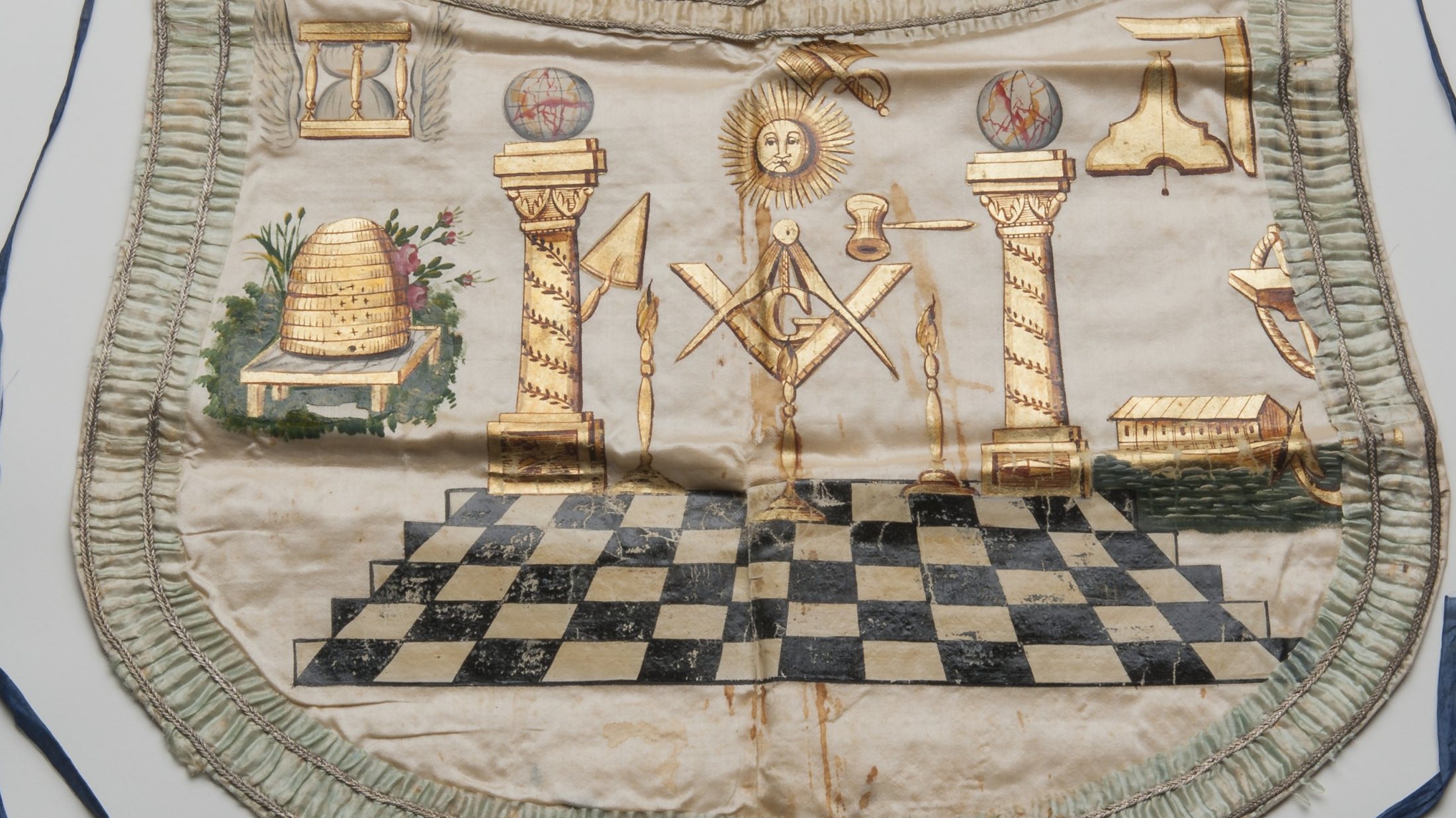
A tradução em português é a da Grande Loja do Cazaquistão, feita a partir do inglês moderno de Cooke, 1861.
O original em inglês médio
Tradução em português
THonkyd be god [Fol. 4]
our glorious
ffadir and fo|un|
der and former of heuen
and of erthe and of all
thygis that in hym is
that he wolde foche|s|aue of
his glorius god hed for to
make |s|o mony thyngis of d
uers vertu for mankynd. [10]
ffor he mader all thyngis for
to be abedient & |s|oget to man
ffor all thyngis that ben come|s|
tible of hol|s|ome nature he
ordeyned hit for manys |s|usty [Fol.4 b.]
na|n|s. And all to be hath yif
to man wittys and cony|n|g
of dy|ver|s thyngys and craft
tys by the whiche we may
trauayle in this worlde to [20]
gete |wit| our lyuyg to make
diuers thingys to goddis ple
|s|ans and also for our e|s|e and
profyt. The whiche thingis
if I |s|cholde reher|s|e hem hit
wre to longe to telle and to
wryte. Wherfor I woll leue.
but I |s|chall |s|chew you |s|ome
that is to |s|ey ho and in what [Fol. 5]
wyse the |s|ciens of Gemetry [30]
fir|s|te be ganne and who |wer|
the founders therof and of
othur craftis mo as hit is no
tid in |the| bybill and in othur
|s|tories.
Graças sejam dadas a Deus, nosso glorioso Pai, Fundador e Criador do céu e da terra e de todas as coisas que neles existem, por Se ter dignado, em Sua gloriosa Divindade, fazer tantas coisas de diversas virtudes para o gênero humano; pois fez todas as coisas para que fossem obedientes e sujeitas ao homem, e tudo o que é comestível e de natureza salutar ordenou-o para o sustento do homem.
E deu também ao homem engenho e saber em diversas coisas e ofícios, pelos quais podemos trabalhar neste mundo para ganhar o nosso sustento e fazer diversas coisas para o agrado de Deus, e também para o nosso conforto e proveito. Se eu houvesse de enumerá-las, seria longo demais para contar e para escrever. Por isso as deixarei, mas mostrar-vos-ei algumas, isto é, como e de que modo a ciência da Geometria começou primeiro, e quem foram os seus fundadores, e os de outros ofícios mais, conforme está registrado na Bíblia e em outras histórias.
HOw and in what ma
ner |th|at this worthy
|s|ciens of Gemetry be gan I
wole tell you as I sayde bi
fore. ye |s|chall undirstonde [40]
|that| |ther| ben vi|i| |liberall |s|ciens
by the whiche vi|i| all |s|ciens
and craftis in the world were [Fol. 5 b.]
fyr|s|te founde. and in especiall
for he is causer of all. |that| is to
sey |the| |s|ciens of Gemetry of all
other that be. the whiche v|i|i sci
Como e de que maneira começou esta digna ciência da geometria, vo-lo direi, como disse antes. Haveis de saber que existem 7 ciências liberais, por meio das quais 7 foram primeiro encontradas todas as ciências e ofícios do mundo, e em especial porque ela é a causa de todas, isto é,
a ciência da geometria, de todas as outras que existem; e essas 7 ciências chamam-se assim.
ens ben called thus. as for the
fir|s|t |that| is called fundament
of sciens his name is gra|mmer| [50]
he techith a man ry|g|thfully to
|s|peke and to write truly. The
|s|econde is rethorik. and he te
chith a man to |s|peke formabe
ly and fayre. The thrid is
dioletic|us|. and |that| |s|ciens techith
a man to discerne the trowthe [Fol. 6]
fro |the| fals and comenly it is
tellid art or |s|oph’stry. The fourth
ys callid ar|s|metryk |the| whiche [60]
techeth a man the crafte of
nowmbers for to rekyn and
to make a coun|t| of all th|y|ge
The ffte Gemetry the which
techith a man all the met|t|
and me|s|u|r|s and ponderat|o|n
of wy|g|htis of all mans craf|t|
The. vi. is musi|k| that techith
a man the crafte of |s|ong in
notys of voys and organ & [70]
trompe and harp and of all [Fol. 6 b.]
othur |p|teynyng to hem. The
vi|i| is a|s|tronomy that techith
man |the| cours of the |s|onne
and of |the| moune and of ot|her|
|s|terrys & planetys of heuen.
A primeira, que é chamada [o] fundamento da ciência, tem por nome gramática; ela ensina o homem a falar corretamente e a escrever com verdade.
A segunda é a retórica, e ela ensina o homem a falar com forma e com beleza.
A terceira é a dialética, e essa ciência ensina o homem a discernir a verdade da falsidade, e comumente é chamada arte ou sofística.
A quarta chama-se aritmética, a qual ensina o homem o ofício dos números, para calcular e fazer a conta de todas as coisas.
A quinta [é] a geometria, a qual ensina o homem todas as medidas, e dimensões, e a ponderação dos pesos, em todo ofício do homem.
A 6.ª é a música, que ensina o homem o ofício do canto, nas notas da voz, e do órgão, e da trombeta, e da harpa, e de todos os outros que lhes pertencem.
A 7.ª é a astronomia, que ensina o homem o curso do sol, e da lua, e das outras estrelas e planetas do céu.
OWr entent is princi
pally to trete of fyrst
fundacion of |the| worthe |s|cy|en|s
of Gemetry and we were [80]
|the| founders |ther| of as I seyde
by fore there ben vi|i| liberall
|s|cyens |that| is to |s|ay vi|i| |s|ciens or
craftys that ben fre in hem
selfe the whiche vi|i|. lyuen [Fol. 7.]
only by Gemetry. And Ge
metry is as moche to |s|ey
as the me|s|ure of the erth
Et sic dici|t| a geo |ge| q|ui|n |R| ter
a latine & metro|n| quod |e| [90]
men|s|ura. U|na| Gemetria. i,
mens|u|r terre uel terra|rum|.
that is to |s|ay in englische that
Gemetria is I |s|eyd of geo |that| is
in gru. erthe, and metro|n| |that| is
to |s|ey me|s|ure. And thus is |this|
nam of Gemetria c|om|pounyd
as is|s|eyd the me|s|ur of |the| erthe.
A nossa intenção é tratar principalmente do primeiro fundamento da digna ciência da geometria, e de quem foram os seus fundadores, como disse antes. Há 7 ciências liberais, isto é, 7 ciências, ou ofícios, que são livres em si mesmos, os quais 7 vivem somente da geometria. E geometria quer dizer o mesmo que medida da terra: “E assim se diz a partir de geo, que em latim é terra, e metron, que é medida. Geometria é a medida da terra, ou das terras”, isto é, em inglês: geometria, como disse, vem de geo, que em gru é terra, e metron, isto é, medida, e assim este nome de Geometria é composto e diz-se [ser] a medida da terra.
MErvile ye not that I
|s|eyd that all |s|ciens lyu|e| [100]
all only by the |s|ciens of Geme
try. ffor there is none artifici|-|
all ne honcrafte that is wro|g|th
by manys hond bot hit is
wrou|g|ght by Gemetry. and a
notabull cau|s|e. for if a man
worche |wit| his hondis he wor
chyth |wit| so|m|e ma|nner| tole and
|ther| is none in|s|trument of ma|-|
teriall thingis in this worlde [110]
but hit come of |the| kynde of
erthe and to erthe hit wole
turne a yen. and ther is n|one| [Fol. 8.]
in|s|trument |that| is to |s|ay a tole
to wirche |wit| but hit hath
some p|ro|op|r|orcion more or la|s||s|e
And some proporcion is me|s|ure
the tole er the in|s|trment
is erthe. And Gemetry is
|s|aid the me|s|ure of erth|e| Whe|re|
fore I may |s|ey |that| men lyuen
all by Gemetry. ffor all
men here in this worlde lyue
by |the| labour of her hondys.
Não vos admireis de eu ter dito que todas as ciências vivem somente da ciência da geometria, pois não há nenhuma [delas] que não seja artificial. Nenhum ofício manual é feito pela mão do homem que não seja feito por meio da geometria, e a razão é notável: se um homem trabalha com as suas mãos, trabalha com alguma espécie de ferramenta, e não há instrumento algum, entre as coisas materiais deste mundo, que não venha da natureza da terra, e para a terra há de voltar; e não há instrumento algum, isto é, ferramenta com que se trabalha, que não tenha alguma proporção, maior ou menor. E proporção é medida; a ferramenta, ou o instrumento, é terra. E a geometria diz-se [ser] a medida da terra. Por isso posso dizer que todos os homens vivem da geometria, pois todos os homens aqui, neste mundo, vivem do trabalho das suas mãos.
MOny mo pbacions I
wole telle yow why |that|
Gemetry is the |s|ciens |that| all re [Fol. 8 b.]
sonable m|e|n lyue by. but I
leue hit at |this| tyme for |the| l|o|ge
|pro|ce|s||s|e of wrytyng. And now [130]
I woll|prp|cede forthe|r| on me ma
ter. ye |s|chall under|s|tonde |that|
amonge all |the| craftys of |the|
worlde of mannes crafte
ma|s|onry hath the mo|s|te no
tabilite and mo|s|te |par|te of |this|
|s|ciens Gemetry as hit is
notid and |s|eyd in |s|toriall
as in the bybyll and in the
ma|s||ter| of |s|tories. And in poli/cronico [140]
a cronycle |pri|nyd and in the [Fol. 9.]
|s|tories |that| is named Beda
De Imagine m|un|di & Isodo|rus|
ethomologia|rum|. Methodius
epus & marti|rus|. And ot|her|
meny mo |s|eyd |that| ma|s|on|r|y is
principall of Gemetry as
me thenkyth hit may well
be |s|ayd for hit was |the| first
that was foundon as hit is [150]
notid in the bybull in |the| first
boke of Genesis in the iii|i|
chap|ter|. And al|s|o all the doc
tours afor|s|ayde acordeth |ther| to
And |s||u|me of hem |s|eythe hit [Fol. 9. b.]
more openly and playnly
ry|g|t as his |s|eithe in the by
bull Gene|s|is
Muitas outras provas vos darei de por que a geometria é a ciência de que vivem todos os homens razoáveis, mas deixo-as por ora, pela longa extensão do escrito. E agora prosseguirei na minha matéria. Haveis de saber que, entre todos os ofícios do mundo, dos ofícios do homem, a Maçonaria tem a maior notabilidade e a maior parte desta ciência, a geometria, como está registrado e dito na história, como na Bíblia, e no Mestre das Histórias. E no Policronicon, crônica impressa, e nas histórias que se chamam Beda, “De Imagine Mundi”; e Isidoro, “Etimologias”; Metódio, bispo e mártir, e outros muitos, disseram que a maçonaria é o principal da geometria, como me parece que bem se pode dizer, pois foi a primeira que foi fundada, como está registrado na Bíblia, no primeiro livro do Gênesis, no 4.º capítulo; e também todos os doutores acima referidos concordam nisso, e alguns deles o dizem mais abertamente e claramente, tal como diz a Bíblia, Gênesis.
ADam is line linyalle
|s|one de|s|cendyng doun|e| [160]
the vi|i| age of adam byfore
noes flode |ther| was a ma|n| |that|
was clepyd lameth the
whiche hadde i|i| wyffes |the|
on hyght ada & a nother
|s|ella by the fyr|s|t wyffe |th|at
hyght ada |he| be gate i|i| |s|onys
|that| one hyght Jobel and the o|ther|
height juball. The elder |s|one [Fol 10.]
Jobell he was the fists ma|n| [170]
|that| e|ver| found gemetry and
ma|s|onry. and he made how
|s|is & namyd in |the| bybull
Pa|ter| habitantci|um| in tento|-|
ris atq|ue| pasto|rum| That is to
|s|ay fader of men dwellyng
in tentis |that| is dwellyng
how|s|is. A. he was Cayin is
ma|s||ter| ma|s|on and go|ver|nor
of all his werkys whan [180]
he made |the| Cite of Enoch
that was the fir|s|te Cite
that was the fir|s|t Cite |th|at [Fol. 10 b.]
e|ver| was made and |that| made
Kayme Adam is |s|one. |an|d
yaf to his owne |s|one. Enoch
and yaff the Cyte the n|am|e
of his |s|one and kallyd hit
Enoch. and now hit is
callyd Effraym and |ther| wa|s| [190]
|s|ciens of Gemetry and ma
|s|onri fyr|s|t occupied and
c|on|trenyd for a |s|ciens and
for a crafte and |s|o we may
|s|ey |that| hit was cav|s|e & f|un|
dacion of all craftys and
|s|ciens. And al|s|o |this| ma|n| [Fol. 11.]
Jobell was called Pa|ter|
Pasto|rum|
Descendente direto da linhagem de Adão, descendo até a 7.ª geração a partir de Adão, antes do dilúvio de Noé, houve um homem chamado Lameque, o qual teve 2 mulheres, uma chamada Ada e outra Zilá; da primeira mulher, chamada Ada, gerou 2 filhos, um chamado Jabal e o outro Jubal. O filho mais velho, Jabal, foi o primeiro homem que jamais encontrou a geometria e a Maçonaria, e fez casas, e [é] nomeado na Bíblia “Pater habitancium in tentoris atque pastorum”, isto é, pai dos homens que habitam em tendas, isto é, em casas de morada. E foi o mestre maçom de Caim e governador de todas as suas obras, quando este fez a cidade de Enoque, que foi a primeira cidade; essa foi a primeira cidade que jamais foi feita, e fê-la Caim, filho de Adão, e deu-a ao seu próprio filho Enoque, e deu à cidade o nome de seu filho, e chamou-a Enoque. E agora chama-se Efraim, e foi ali que a ciência da Geometria e da maçonaria foram primeiro exercidas e ordenadas, como ciência e como ofício, e assim podemos dizer que foi a causa e o fundamento de todos os ofícios e ciências; e também este homem, Jabal, foi chamado “pater pastorum”.
THe mas|ter| of |s|tories [200]
|s|eith and beda de yma
gyna m|un|di policronicon &
other mo |s|eyn that he wa|s|
|th|e first that made de|per|ce|s|on
of lond |that| e|ver|y man myght
knowe his owne grounde
and labou|re| the|re| on as for
his owne. And also he de
|par|tid flockes of |s|chepe |that|
e|ver|y man myght know hi|s| [210]
owne |s|chepe and |s|o we may [Fol. 11 b.]
|s|ey that he was the fir|s|t
founder of |that| |sciens. And his
brother Juball. or tuball
was founder of my|s|yke &
|s|ong as pictogoras |s|eyth
in policronycon and the
|s|ame |s|eythe ylodou|re| in his
ethemologi|i| in the v|i| boke
there he |s|eythe that he was [220]
|the| fir|s|t foundere of my|s|yke
and |s|ong and of organ &
trompe and he founde |th|at
|s|ciens by the |s|oune of pon/deracion
of his brotheris hamers |that| [Fol. 12.]
was tubalcaym.
O Mestre das Histórias diz, e Beda, De Imagine Mundi, o Policronicon e outros mais dizem que ele foi o primeiro que fez a partilha da terra, para que cada homem conhecesse o seu próprio terreno e trabalhasse nele como seu. E também separou os rebanhos de ovelhas, para que cada homem conhecesse as suas próprias ovelhas, e assim podemos dizer que foi o primeiro fundador dessa ciência. E seu irmão Jubal, ou Tubal, foi o fundador da música e do canto, como diz Pitágoras no Policronicon, e o mesmo diz Isidoro nas suas Etimologias, no 6.º livro, onde diz que foi o primeiro fundador da música e do canto, e do órgão e da trombeta, e que achou essa ciência pelo som da ponderação dos martelos de seu irmão, que era Tubalcaim.
SOthely as |the| bybull
|s|eyth in the chapitre
|that| is to |s|ey the iii|i| of Gene|s|'
|that| he |s|eyth lameth gate apon [230]
his other wiffe |that| height |s|ella
a |s|one & a do|ou|c|ter| |the| names of
th|em| were clepid tubalcaym
|that| was |the| |s|one. & his doghter
hight neema & as the poli
cronycon |s|eyth |that| |s|ome men
|s|ey |that| |s|che was noes wyffe
we|ther| h|it| be |s|o o|ther| no we afferme/ hit nott
Na verdade, como diz a Bíblia no capítulo, isto é, o 4.º do Gênesis, ela diz que Lameque gerou da sua outra mulher, chamada Zilá, um filho e uma filha; os nomes deles eram Tubalcaim, que era o filho, e sua filha [era] chamada Naamá, e, como diz o Policronicon, alguns homens dizem que ela era a mulher de Noé: se é assim ou não, nós não o afirmamos.
YE |s|chul|le| under|s|tonde
|that| |th|is |s|one tubalcaym [240]
was founder of |s|mythis
craft and o|ther| craft of
meteil |that| is to |s|ey of eyron
of braffe of golde & of |s|il|ver|
as |s|ome docturs |s|eyn & his
|s|ys|ter| neema was fynder of
we|ver|scraft. for by fore |that| time
was no cloth weuyn but
they did spynne yerne and
knytte hit & made h|em| |s|uch|e| [250]
clothyng as they couthe
but as |the| woman neema
founde |the| craft of weuyng [Fol. 13.]
& |ther|fore hit was kalled wo
menys craft. and |th|es ii|i|
brotheryn afore|s|ayd had know
lyche |that| god wold take ven
gans for |s|ynne o|ther| by fyre
or watir and they had gre|ter|
care how they my|s|t do to [260]
|s|aue |the| |s|ciens that |th|ey fo|un|de
and |th|ey toke her con|s|el|le|
to gedyr & by all her wit|ts
|th|ey |s|eyde |that| were. i|i| ma|ner| of
|s|tonn of |s|uche |ver|tu |that| |the| one
wolde ne|ver| brenne & |that| |s|to|ne|
is callyd marbyll. & |that| o|ther| sto|ne|
|that| woll not |s|ynke in wa|ter|. &
|that| stone is named la|tr|us. and
|s|o |th|ey deuy|s|yed to wryte all [270]
|the| |s|ciens |that| |th|ey had ffounde in
this i|i| |s|tonys if |that| god wol|de|
take vengns by fyre |that| |the|
marbyll |s|cholde not bren|ne|
And yf god |s|ende vengans
by wa|ter||that| |th|e o|ther| |s|cholde not
droune. & so |th|ey prayed |ther|
elder brother jobell |that| wold
make i|i|. pillers of |th|es. i|i|
|s|tones |that| is to |s|ey of marb|yll| [280]
and of la|tr|us and |that| he wold [Fol. 14.]
write in the i|i|. pylers al|l|
|the| |s|ciens & craf|ts| |that| al|l| |th|ey
had founde. and |s|o he did
and |ther|for we may |s|ey |that|
he was mo|s|t co|nn|yng in
|s|ciens for he fyr|s|t bygan
& |per|formed the end by for
noes flode.
Haveis de saber que este filho, Tubalcaim, foi o fundador do ofício de ferreiro, e dos outros ofícios do metal, isto é, do ferro, do bronze, do ouro e da prata, como dizem alguns doutores, e sua irmã Naamá foi a inventora do ofício de tecelão, pois antes daquele tempo não se tecia pano algum, mas fiavam fio e o atavam, e faziam para si vestes como podiam; mas como a mulher Naamá achou o ofício de tecer, por isso foi chamado ofício de mulheres; e estes 3 irmãos, acima referidos, tinham conhecimento de que Deus tomaria vingança pelo pecado, ou pelo fogo, ou pela água, e tinham grande cuidado de como poderiam fazer para salvar as ciências que [tinham] achado, e tomaram conselho entre si e, com todo o seu engenho, disseram que [havia] 2 espécies de pedra de tal virtude que uma nunca arderia, e essa pedra
chama-se mármore, e que a outra pedra, que não afunda na água, e essa pedra é chamada latres, e assim determinaram escrever todas as ciências que tinham achado nessas 2 pedras, [para que] se Deus tomasse vingança pelo fogo, o mármore não ardesse.
E se Deus enviasse vingança pela água, a outra não se afogasse, e assim rogaram a seu
irmão mais velho, Jabal, que [ele] fizesse 2 colunas dessas 2 pedras, isto é, de mármore
e de latres, e que escrevesse nas 2 colunas todas as ciências e ofícios que todos eles tinham achado, e assim fez; e, por isso, podemos dizer que foi o mais sábio na
ciência, pois foi ele que primeiro a começou e a levou a cabo antes do dilúvio de Noé.
KYndly knowyng of [290]
|that| venganns |that| god
wolde |s|end whether hit
|s|cholde be bi fyre or by wa|ter|
the bretherne hadde hit n|ot|
by a ma|ner| of a |pro|phecy they [Fol. 14 b.]
wi|s|t |that| god wold |s|end one |ther|
of. and |ther| for thei writen
he|re| |s|ciens in |the|. i|i|. pilers
of |s|tone. And |s||u|me men |s|ey
|that| |th|ey writen in |the|. |s|tonis [300]
all |th|e. vi|i| |s|ciens. but as
|th|ey in here mynde |that| a ven
ganns |s|cholde come. And
to hit was |that| god |s|entd ven
ganns |s|o |that| |ther| come |s|uche
a flode |th|at al|le| |the| worl was
drowned. and al|le| men w|er|
dede |ther| in |s|aue. vii|i|. |per|sonis
And |that| was noe and his [Fol. 15.]
wyffe. and his ii|i|. sonys & [310]
here wyffes. of whiche. ii|i|
sones a|ll| |the| world cam of.
and here namys were na
myd in this ma|ner|. Sem. Cam.
& Japhet. And |this| flode was
kalled noes flode ffor he &
his children were |s|auyed |ther|
in. And af|ter| this flode many
yeres as |the| cronycle telleth
thes. i|i| pillers were founde [320]
& as |the| polycronicon |s|eyth |that|
a grete clerke |that| callede puto|-|/goras
|f|onde |that| one and hermes |the|
philisophre fonde |that| other. &
thei tought forthe |the| |s|ciens |that|
thei fonde |ther| y wryten.
Conhecendo naturalmente aquela vingança que Deus enviaria, se seria pelo fogo ou pela água, os irmãos não a tinham por modo de profecia, sabiam que Deus enviaria uma delas, e por isso escreveram a sua ciência nas 2 colunas de pedra, e alguns homens dizem
que escreveram nas pedras todas as 7 ciências, mas como [tinham] em seu espírito que uma vingança haveria de vir. E assim foi que Deus enviou vingança, de modo que veio um dilúvio tal que todo o mundo foi afogado e todos os homens nele morreram, salvo 8 pessoas, e essas eram Noé, e sua mulher, e seus três filhos, e as mulheres deles, dos quais 3 filhos veio todo o mundo, e os seus nomes eram estes: Sem, Cam e Jafé. E este dilúvio foi
chamado o dilúvio de Noé, pois ele e seus filhos foram nele salvos. E depois deste dilúvio, muitos
anos depois, como conta a crônica, essas 2 colunas foram achadas, e, como diz o Policronicon, um grande letrado chamado Pitágoras achou uma, e Hermes, o filósofo, achou a outra, e ensinaram adiante as ciências que nelas acharam escritas.
Every cronycle and |s|to
riall and meny other
clerkys and the bybull in |pri|nci
pall wittenes of the makyn|ge| [330]
of the toure of babilon and hit
is writen in |the| bibull Gene|sis
Cap|ter| |x| wo |that| Cam noes
|s|one gate nembrothe and he
war a myghty man apon |the|
erthe and he war a stron|ge|
man like a Gyant and he w|as| [Fol. 16.]
a grete Kyng. and the bygyn
yn|ge| of his kyngdom was
trew kyngd|om| of babilon and [340]
arach. and archad. & talan &
the lond if |s|ennare. And this
same CamNemroth be gan |the| towre
of babilon and he taught and
he taught to his werkemwn |the|
crafte of ma|s|uri and he had
|wit| h|ym| mony ma|s|onys mo |th||an|
|x|l |th|ou|s|and. and he louyd &
chere|s|ched them well. and hit
is wryten in policronicon and [350]
in |the| mas|ter| of |s|tories and in
other |s|tories mo. and |this| a part
wytnes bybull in the |s|ame
|x|. chap|ter| he |s|eyth |that| a
|s|ure |that| was nye kynne to
CamNembrothe yede owt of |the| londe of
|s|enare and he bylled the Cie
Nunyve and plateas and o|ther|
mo |th|us he |s|eyth. De tra illa
& de |s|ennare egreffus est a|s|u|re| [360]
& edificauit Nunyven & pla|-|
teas ciuiya|te| & cale & Jesu q|o|q|z|
in|ter| nunyven & hec |est| Ciuita|s|
magna.
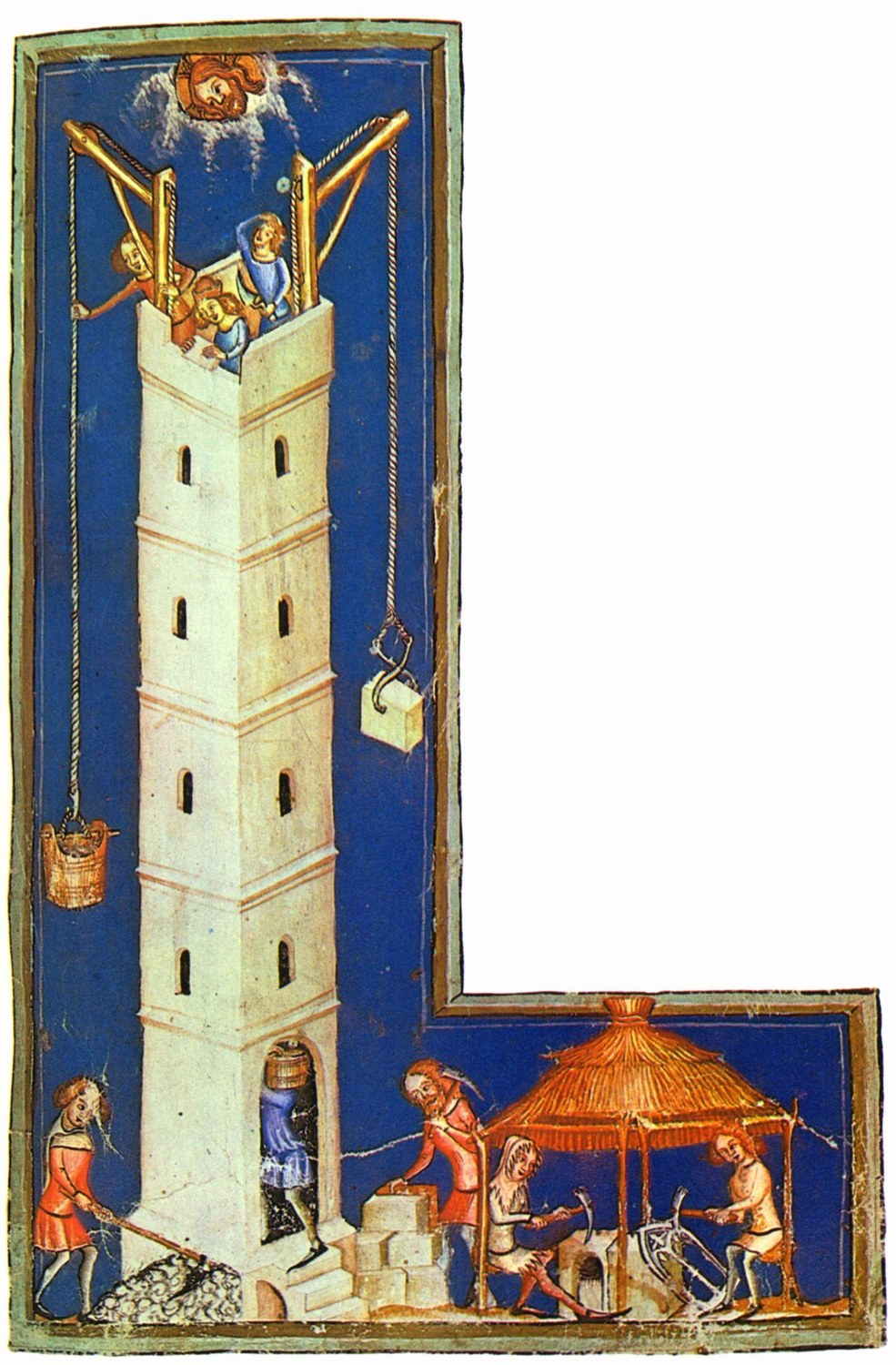
Toda crônica e história, e muitos outros letrados, e a Bíblia em primeiro lugar, dão testemunho da construção da torre de Babel, e está escrito na Bíblia, Gênesis, capítulo x, como Cam, filho de Noé, gerou Ninrode, e ele tornou-se um homem poderoso sobre a terra, e tornou-se um homem forte, como um gigante, e foi um grande rei. E o princípio do seu reino foi [o] verdadeiro reino de Babilônia, e Arach, e Archad, e Calan, e a terra de Senaar. E este mesmo Ninrode começou a torre de Babilônia… e ensinou aos seus obreiros o ofício das medidas, e tinha consigo muitos maçons, mais de 40 mil. E amava-os e prezava-os bem. E está escrito no Policronicon, e no Mestre das Histórias, e em outras histórias mais, e isto em parte testemunha [a] Bíblia, no mesmo capítulo x [do Gênesis,] onde diz que Assur, que era parente próximo de Ninrode, [e] saiu da terra de Senaar e edificou a cidade [de] Nínive, e Plateas, e outras mais; assim diz: “de tra illa et de Sennare egressus est Asur, et edificavit Nineven et Plateas civitatum et Cale et Jesu quoque, inter Nineven et hoec est Civitas magna”, isto é: “Daquela terra, de Senaar, saiu Assur e edificou Nínive, e Plateas das cidades, e Cale e também Jesu, entre Nínive e esta; e esta é a cidade grande”.
RE|s|on wolde |that| we |s|chold [Fol. 17.]
tell opunly how & in
what ma|ner| that |the| charges
of ma|s|oncraft was fyr|s|t fo|un|
dyd & ho yaf fir|s|t |the| name
to hit of ma|s|onri and ye [370]
|s|chyll knaw well |that| hit told
and writen in policronicon &
in methodus ep|iscopu|s and mar|ter|
|that| a|s|ur |that| was a worthy lord
of |s|ennare |s|ende to nembroth
|the| kynge to |s|ende h|ym| ma|s|ons
and workemen of craft |that| myght
helpe hym to make his Cite
|that| he was in wyll to make. [Fol. 17 b.]
And nembroth |s|ende h|ym| |xxx| [380]
C. of masons. And whan |th|ey
|s|cholde go & |s|ende h|em| forth. he
callyd hem by for h|ym| and |s|eyd
to hem ye mo|s|t go to my co
|s|yn a|s|ure to helpe h|ym| to bilde
a cyte but loke |that| ye be well
go|uer|nyd and I |s|chall yeue
yov a charge |pro|fitable for
you & me.
A razão quer que digamos abertamente como, e de que maneira, os Deveres do ofício de maçom foram primeiro fundados e quem primeiro lhe deu o nome de maçonaria. E sabereis bem que está contado e escrito no Policronicon e em Metódio, bispo e mártir, que Assur, que era um digno senhor de Senaar, enviou ao rei Ninrode pedindo que lhe enviasse maçons e obreiros do ofício que o pudessem ajudar a fazer a sua cidade, que tinha vontade de fazer.
E Ninrode enviou-lhe 30 centenas de maçons. E quando haviam de partir e [ele] os havia de enviar, chamou-os diante de si e disse-lhes: “Haveis de ir a meu primo Assur, para ajudá-lo a construir uma cidade; mas olhai [que] sejais bem governados, e dar-vos-ei um Dever proveitoso para vós e para mim.
WHen ye come to |that| lord [390]
loke |that| ye be trewe to
hym lyke as ye wolde be to
me. and truly do your labour [Fol. 18.]
and craft and takyt re|s|on|-|
abull your mede |ther|for as ye
may de|s|erue and al|s|o |that| ye
loue to gedyr as ye were
bre|th|eryn and holde to gedyr
truly. & he |that| hath most c|on||yn|g
teche hit to hys felaw and [400]
louke ye go|uer|ne you ayen|s|t
yowr lord and a monge
yowr selfe. |that| I may haue
worchyppe and thonke for
me |s|endyng and techyng
you the crafte. and |th|ey re|s|/ceyuyd
the charge of h|ym| |that| was here [Fol. 18 b.]
mai|s||ter| and here lorde. and
wente forthe to a|s|ure. &
bilde the cite of nunyve in [410]
|the| count|r|e of plateas and o|ther|
Cites mo |that| men call cale
and Jesen |that| is a gret Cite
bi twene Cale and nunyve
And in this ma|ner| |the| craft
of ma|s|onry was fyr|s|t |pre|fer
ryd & chargyd hit for a |s|ci|en|s.
Quando chegardes àquele senhor, olhai que lhe sejais fiéis como o seríeis a mim, e façais verdadeiramente o vosso trabalho e ofício, e recebais razoavelmente o vosso salário por ele, como o mereceis, e também que vos ameis uns aos outros como se fôsseis irmãos, e vos mantenhais unidos com fidelidade; e aquele que tiver mais saber, ensine-o ao seu companheiro; e olhai que vos governeis perante o vosso senhor e entre vós mesmos, para que eu tenha honra e agradecimento por vos ter enviado e ensinado o ofício.” E receberam o Dever daquele que era o seu mestre e o seu senhor, e foram a Assur, e
construíram a cidade de Nínive, na região de Plateas, e outras cidades mais que os homens chamam Cale
e Jesen, que é uma grande cidade entre Cale e Nínive. E desta maneira o ofício da maçonaria foi primeiro estimado e posto sob Deveres como ciência.
ELders |that| we|re| bi for us
of ma|s|ons had te|s|e
charges wryten to hem as [420]
we haue now in owr char [Fol. 19.]
gys of |the| |s|tory of Enclidnis
as we have |s|eyn hem writ|en|
in latyn & in Fre|s|nche bothe
but ho |that| Enclyd come to ge|-|
metry re|s|on wolde we
|s|cholde telle yow as hit is
notid in the hybull & in other
|s|tories. In |xii| Capitl|or| Gene|sis|
he tellith how |that| abrah|am| com to [430]
the lond of Canan and owre
lord aperyd to h|ym| and |s|eyd I
|s|chall geue this lond to |th|i
|s|eed. but |ther| |s|yll a grete hun|ger|
in |that| lond. And abraham toke [Fol. 19 b.]
|s|ara his wiff |wit| him and
yed in to Egypte in pylgre|-|
mage whyle |the| hunger du
red he wolde hyde |ther|. And A
brah|am| as |the| cronycull |s|eyth [440]
he was a wy|s|e man and a
grete clerk. And covthe all
|the|vi|i| |s|ciens. and taughte
the egypeyans |the| |sciens of
Gemetry. And this worthy
clerk Enclidnis was his
clerke and lerned of hym.
And he yaue |the| fir|s|te name
of Gemetry all be |that| hit [Fol. 20.]
was ocupied bifor hit had [450]
no name of gemetry. But
hit is |s|eyd of ylodour Ethe
mologia|rum| in |the| v. boke. Ethe
mologia|rum| Cap|itolo| p'mo. |s|eyth
|that| Enclyde was on of |the| fir|s|t
founders of Gemetry &
he yaue hit name. ffor |in|
his tyme ther was a wa
ter in |that| lond of Egypt |that|
is callyd Nilo and hit flowid [460]
|so| ferre in to |the| londe |that| men
myght not dwelle |ther|in
Os anciãos de entre os maçons, que viveram antes de nós, tinham estes Deveres escritos para eles, como temos agora nos nossos Deveres da história de Euclides, como os vimos escritos em latim e em francês; mas como Euclides chegou [ao conhecimento] da geometria, a razão quer que vo-lo contemos, como está registrado na Bíblia e em outras histórias. No capítulo doze do Gênesis conta como Abraão veio à terra de Canaã, e Nosso Senhor lhe apareceu e disse: Darei esta terra à tua semente; mas veio uma grande fome naquela terra, e Abraão tomou consigo Sara, sua mulher, e foi ao Egito em peregrinação, [e] enquanto durou a fome quis ficar ali. E Abraão, como diz a crônica, era um homem sábio e um grande letrado, e conhecia todas as 7 ciências e ensinou aos egípcios a ciência da geometria. E este digno letrado, Euclides, era seu discípulo e aprendeu com ele. E foi ele que deu o primeiro nome de geometria, embora fosse praticada antes, não tinha o nome de geometria. Mas diz-se de Isidoro, Ethemologiarum, no 5.º livro das Ethemologiarum, capitolo primo, que Euclides foi um dos primeiros fundadores da geometria, e ele lhe deu esse nome, pois no
seu tempo havia uma água naquela terra do Egito que se chama [o] Nilo, e ela inundava tão longe terra adentro que os homens não podiam habitar nela.
THen this worthi
clerke Enclide taught
hem to make grete wallys
and diches to holde owt |the|
watyr. and he by Gemet'
me|s|ured |the| londe and de|par|
tyd hit in dy|ver|s |par|tys. &
mad e|ver|y man to clo|s|e his [470]
awne |par|te |wit| walles and
diches an |the|en hit be c|am|e
a plentuos c|on|untre of all
ma|ner| of freute and of yon|ge|
peple of men and women
that |ther| was |s|o myche pepull
of yonge frute |that| they couth'
not well lyue. And |the| lordys
of the countre drew hem to
gedyr and made a councell [480]
how they myght helpe her
childeryn |that| had no lyflode
c|om|potente & abull for to fyn|de|
hem selfe and here childron
for |th|ey had |s|o many. and
a mong hem all in councell
was |this| worthy clerke Encli
dnis and when he |s|a|we| |th|at
all they cou|th|e not btynge
a bout this mater. he |s|eyd [490]
to hem woll ye take y|our| |s|on|ys| [Fol. 21 b.]
in go|uer|nanns & I |s|chall tec|he|
hen |s|uche a sciens |that| they
|s|chall iyue ther by |j|entel
manly vnder condicion |that|
ye wyll be |s|wore to me to
|per|fourme the go|uer|na|nn|s |that|
I |s|chall |s|ette you too and
hem bothe and the kyng
of |the| londe and all |the| lordys [500]
by one a|ss|ent gra|un|tyd |ther| too.
Então este digno letrado, Euclides, ensinou-os a fazer grandes muralhas e fossos para reter a água; e ele, pela geometria, mediu a terra, e dividiu-a em diversas partes, e fez que cada homem cercasse a sua parte com muralhas e fossos, e então tornou-se uma terra abundante de toda espécie de fruto e de gente jovem, de homens e mulheres, de modo que havia tanta gente de jovem fruto que não podiam viver bem. E os senhores da terra reuniram-se e fizeram conselho sobre como poderiam ajudar os seus filhos, que não tinham sustento, conveniente e capaz, para se manterem a si mesmos e aos seus filhos, pois tinham muitos. E entre todos eles, em conselho, estava este digno letrado Euclides, e quando viu que todos eles não podiam levar a cabo este assunto, disse-lhes: “Quereis entregar-me os vossos filhos para governá-los, e ensinar-lhes-ei tal ciência que viverão dela com fidalguia, com a condição de que me jureis cumprir o governo que eu vos impuser a vós e a eles?” E o rei da terra e todos os senhores, de comum acordo, o concederam.
REson wolde |that| e|uer|y m|an|
woulde graunte to |that|
thyng |that| were |pro|fetable to h|im|
|s|elf. and they toke here |s|o [Fol 22.]
nys to enclide to go|uer|ne
hem at his owne wylle &
he taught to hem the craft
Masonry and yaf hit |th|e
name of Gemetry by cav|s|e [510]
of |the| |par|tyng of |the| grounde |that|
he had taught to |the| peple
in the time of |the| makyng
of |the| wallys and diches a
for |s|ayd to claw|s|e out |the|
watyr. & I|s|odor |s|eyth in his
Ethemolegies |that| Enclide
callith the craft Gemetrya
And |ther| this worthye clerke [Fol. 22 b.]
yaf hit name and taught [520]
hitt the lordis |s|onys of |the|
londe |that| he had in his tech|in|g
And he yaf h|em| a charge |that|
they scholde calle here eche
other ffelowe & no nother
wise by cav|s|e |that| they were
all of one crafte & of one
gentyll berthe bore & lor|ds'|
|s|onys. And also he |that| we|re|
most of c|on|nyng scholde be [530]
go|uer|nour of |the| werke and
scholde be callyd mais|ter| &
other charges mo |that| ben [Fol. 23.]
wryten in |the| boke of char
gys. And |s|o they wrought
|with| lordys of |the| lond & made
cities and tounys ca|s|telis
& templis and lordis placis.
A razão quer que todo homem conceda aquilo que lhe é proveitoso, e entregaram os seus filhos a Euclides para que os governasse segundo a sua própria vontade, e ele ensinou-lhes o ofício, a Maçonaria, e deu-lhe o nome de geometria, por causa da divisão do terreno que ensinara ao povo, no tempo da construção das muralhas e fossos acima referidos, para deixar a água de fora; e Isidoro diz, nas suas Etimologias, que Euclides chama ao ofício geometria; e foi este digno letrado que lhe deu o nome e o ensinou aos filhos dos senhores da
terra que tinha sob o seu ensino. E impôs-lhes um Dever: que se chamassem uns
aos outros companheiros, e de nenhum outro modo, porque eram todos de um só ofício e de um só nobre nascimento, e filhos de senhores. E também que aquele que tivesse mais saber fosse governador da obra, e fosse chamado mestre, e outros Deveres mais que estão escritos no livro dos Deveres. E assim trabalharam com os senhores da terra, e fizeram cidades e vilas, castelos e templos, e palácios de senhores.
WHat tyme |that |the| chil
dren of i|s|rl dwellid [540]
|in| egypte they lernyd |the|
craft of masonry. And
afturward |th|ey were
dryuen ont of Egypte |th|ey
come in to |th|e lond of bihest
and is now callyd ierl|e|m
and hit was ocupied & char [Fol. 23 b.]
gys y holde. And |the| mak|yn|g
of |s|alomonis tempull |that|
Kyng Dauid be gan. k|yn|g [550]
dauid louyd well ma|s|ons
and he yaf hem ry|g|t nye
as |th|ey be nowe. And at |the|
makyng of |the| temple in
|s|alomonis tyme as hit
is seyd in |the| bibull in |the|
ii|i| boke of Regu in |ter|cio
Reg|um| Cap|itolo| quinto. That
Salomon had iii|i|. score
thow|s|and masons at [560]
his werke. And |the| kyngi|s| [Fol 24.]
|s|one of Tyry was |his| ma|s||ter|
ma|s|en. And other crony
clos hit is |s|eyd & in olde
bokys of ma|s|onry that
Salomon c|on|firmed |the| char
gys |that| dauid has fadir had
yeue to ma|s|ons. And |s|alo
mon hym |s|elf taught h|em|
here maners byt lityll [570]
differans fro the maners
that now ben u|s|yd. And fro
thens |this| worthy |s|ciens
was brought |in to fraunce
And in to many o|ther| regi|on|s [Fol. 24 b.]
No tempo em que os filhos de Israel habitaram no Egito, aprenderam o ofício da maçonaria. E depois, [quando] foram expulsos do Egito, vieram à terra da promessa, que agora se chama Jerusalém, e ali foi exercido e os Deveres foram mantidos. E a construção do templo de Salomão, que o rei Davi começou. (O rei Davi amava muito os maçons, e deu-lhes quase como eles são agora.) E na construção do templo, no tempo de Salomão, como se diz na Bíblia, no 3.º livro dos Reis, in tercio Regum, capítulo quinto, Salomão tinha 80 mil maçons na sua obra. E o filho do rei de Tiro era o seu mestre maçom. E [em] outras crônicas se diz, e em velhos livros de maçonaria, que Salomão confirmou os Deveres que Davi, seu pai, tinha dado aos maçons. E o próprio Salomão lhes ensinou ali os seus costumes, [com] pouca diferença dos costumes que agora se usam. E dali esta digna ciência
foi levada para a França e para muitas outras regiões.
SUmtyme ther w|as|
a worthye kyng in
ffrauns |that| was clepyd Ca
rolus |s|'c|undu|s |that| ys to |s|ey
Charlys |the| |s|ecunde. And |this| [580]
Charlys was elyte kyng
of ffrauns by the grace of
god & by lynage also. And
|s|u|mm|e men |s|ey |that| he was
elite by fortune ||the| whiche
is fals as by cronycle he
was of |the| kynges blode
Royal. And |this| |s|ame kyng
Charlys was a ma|s|on [Fol. 25.]
bi for |that| he was kyng. And [590]
af|ter| |that| he was kyng he louyd
ma|s|ons & cher|s|chid them
and yaf hem chargys and
ma|ner|ys at his deui|s|e |the| which|e|
|s||um| ben yet u|s|ed in fraunce
and he ordeynyd that |th|ey
|s|cholde haue a |s|emly onys
in |the| yere and come and
|s|peke to gedyr and for to be
reuled by ma|s|ters & felows [600]
of thynges a my|ss|e.
ANd |s||oo|ne af|ter| |that| come
|s|eynt ad habell in to Englond [Fol. 25 b.]
and he c|on||uer|tyd |s|eynt Albon
to cristendome. And |s|eynt
Albon lovyd well ma|s|ons
and he yaf hem fyr|s|t he|re|
charges & maners fyr|s|t
in Englond. And he or
deyned c|on|uenyent to pay [610]
for |the| trauayle. And af|ter|
|theat| was a worthy kyn|ge|
in Englond |that| was callyd
Athelstone and his yong
est |s|one lovyd well the
|s|ciens of Gemetry. and
he wy|s|t well|that| hand craft [Fol. 26.]
had the practyke of |the |s|ci
ens of Gemetry to well
as masons wherefore he [620]
drewe hym |to| c|on|sell and ler
nyd practyke of |that| |s|ciens
to his |s|peculatyf. For of |s|pec
culatyfe he was a ma|s||ter|
and he lovyd well ma
|s|onry and ma|s|ons. And
he bicome a mason hym
|s|elfe. And he yaf hem charg|es|
and names as hit is now
vsyd id Englond. and in [630]
othere countries. And he [Fol. 26 b.]
ordyned |that| |th|ey |s|chulde haue
re|s|onabull pay. And pur
cha|s|ed a fre patent of |the| k|y|ng
that they |s|choulde make a
|s|embly whan thei |s|awe re|-|
|s|onably tyme a c|u| to gedir to
he|re| counsel|le| of |the| whiche
Charges manors & |s|emble
as is write and taught |in| |th|e [640]
boke of our charges wher
for I leue hit at this tyme.
Houve outrora um digno rei na França que se chamava Carolus secundus, isto é, Carlos II, e este Carlos foi eleito rei da França pela graça de Deus e também por linhagem. E alguns homens dizem que foi eleito pela fortuna, o que é falso, pois, segundo a crônica, era do sangue real. E este mesmo rei, Carlos, foi maçom antes de ser rei, e depois de ser rei amou os maçons e prezou-os, e deu-lhes Deveres e costumes segundo a sua determinação, [dos quais] alguns ainda se usam na França; e ordenou que tivessem [uma] assembleia uma vez por ano, e viessem e falassem juntos, e fossem governados por mestres e companheiros em todas as coisas que andassem mal. E logo depois disso veio Santo Adabel à Inglaterra e converteu Santo Albano ao cristianismo. E Santo Albano amava muito os maçons, e foi ele quem primeiro lhes deu os seus Deveres e costumes na Inglaterra. E ordenou [tempos] convenientes para pagar o trabalho. E depois disso houve um digno rei na Inglaterra que se chamava Athelstan, e seu filho mais novo amava muito a ciência da geometria, e sabia bem que o ofício manual tinha a prática da ciência da geometria tão bem como os maçons, pelo que se chegou ao conselho e aprendeu a prática dessa ciência para a sua especulativa, pois da especulativa era mestre, e amava muito a maçonaria e os maçons. E fez-se maçom ele mesmo, e deu-lhes Deveres e nomes como agora se usa na Inglaterra e em outros países. E ordenou que tivessem paga razoável e obteve do rei uma patente livre para que fizessem [uma] assembleia quando vissem tempo razoável e se reunissem com os seus conselheiros, dos quais Deveres, costumes e assembleia, como está escrito e ensinado no livro dos nossos Deveres, por isso o deixo por ora.
GOod men for this
cau|s|e and |this| man|er|
ma|s|onry toke fir|s|te begyn|-| [Fol 27.]
nyng. hit befyll |s||um|tyme
|that| grete lordis had not |s|o
grete po|s||s| e|s||s|ions |that| they
myghte not a vaunce here
fre bigeton childeryn for [650]
|th|ey had so many. Therefore
they toke coun|s|ell howe |th|ey
my|g|t here childeryn ava|n|ce
and ordeyn hem one|s|tly to
lyue. And |s|ende af|ter| wy|s|e
mai|s|ters of |the| worthy |s|ci
ens of Gemetry |that| |they| thorou
here wy|s|dome |s|chold ordey/ne
hem |s||um| hone|s|t lyuyng [Fol. 27 b.]
Then on of them |that| had |the| [660]
name whiche was callyd
Englet |that| was most |s|otell
& wi|s|e founder ordeyned
and art and callyd hit ma
|s|onry. and so |with| his art ho
nestly he tho|g|t |the| childeren
of get lordis bi |the| pray
er of |the| fathers and |the| fre
will of here children. |the|
wiche when thei tau|g|t |with| [670]
hie Cure bi a |s|erteyn ty|me|
|th|ey were not all ilyke ab/ull
for to take of |the| for|s|eyde art [Fol. 28.]
Wherefore |the| for|s|ayde mai|s||ter|
Englet ordeynet thei were
pa|s||s|ing of conyng |s|chold
be pa|s||s|ing honoured. And
ded to call |the| c|on|nyn|ger| mai|s|ter|
for to enforme |the| la|s||s|e of c|on|
nyng ma|s|ters of |the| wiche [680]
were callyd ma|s|ters of no
bilite of witte and c|on|nyng
of |that| art. Ne|ver||th|ele|s||s|e |th|ei c|om|
maundid |that| thei |that| were la|s||s|e
of witte |s|chold not be callyd
|s|eruan|ter| ner |s|ogett but felau
ffor nobilite of here gentyll [Fol. 28 b.]
nlode. In this ma|n|e|r| was |the|
for|s|ayde art begunne |i|n |the|
lond of Egypte by |the| for|s|ayde [690]
mai|s||ter| Englat & so hit went
fro lond to londe and fro k|yn|g
dome to kyngdome af|ter| |that| ma|-|
ny yeris in |the| tyme of kyng
adhel|s|tone wiche was |s|um
tyme kynge of Englonde bi
his co|un|n|s|el|ler| and other gre|ter|
lordys of |the| lond bi c|om|yn
a|s||s|ent for grete defavt y
fennde amon|ger| ma|s|ons |th|ei [700]
ordeyned a certayne reule [Fol 29.]
a mongys hom on tyme of
|the| yere or in ii|i| yere as nede
were to |the| kyn|g| and gret
lordys of |the| londe and all |the|
comente fro |pr|oynce to |pr|o|yn|ce
and fro co|u|ntre to co|u|ntre
c|on|gregacions |s|cholde be made
by mai|s|ters of all mai|s||ter|s
ma|s|ons and felaus in the [710]
for|s|ayd art. And |s|o at |s|uche
c|on|gregac|o|ns they |that| be mad
ma|s|ters |s|chold be examined
of |the| articuls af|ter| writen. &
be ran|s|akyd whether thei be [Fol. 29 b.]
abull and kunnyn|g| to |the| |pr|
fyte of |the| lordys hem to serue
and to |the| honour of |the| for|s|aid
art and more o|uer| they |s|chulde
receyue here charge |that| they [720]
|s|chuld well and trewly di|s|
pende |the| goodys of here lordis
and as well |the| lowi|s|t as |the|
hie|s|t for they ben her lordys
for |the| tyme of whom |h|ei take
here pay for here cervyce
and for here trauayle. The
fir|s|te article ys this |that| e|uer|y
mai|s||ter| of |th|is art |s|chulde be
wy|s||s|e and trewe to |the| lord |that| he [730]
|s|eruyth di|s|pendyng his godis
trule as he wolde his awne
were di|s|pendyd. and not yefe
more pay to no ma|s|on than
he wot he may di|s|erue af|ter| |the|
derthe of korne & vytayl in |the|
c|o|ntry no fauour |with| stond|y|g
for e|uer|y ma|n| to be rewardyd
af|ter| his trauayle. The se|c|nd
article is this |that| e|uer|y ma|s||ter| [740]
of |this| art |s|cholde be warned
by fore to cum to his cogrega|t|
|that| thei com dewly but yf thei [Fol. 30 b.]
may a|s||s|cu|s|yd by |s|ume ma|ner|
cause. But ne|uer|le|s||s|e if |th|ey
be founde rebell at |s|uche c|on|
gregacions or fauty in eny
ma|ner| harme of here lordys
and reprene of this art thei
|s|chulde not be excu|s|yd in no [750]
ma|ner|e out take |per|ell of dethe
and thow they be in |per|yll of
dethe they |s|call warne |the|
mai|s||ter| |that| is pryncipall of |the|
gederyng of his de|s||s|e|s|e. |the|
article is this |that| no ma|s||ter|
take noprentes for la|s||s|e terme [Fol. 31.]
than vi|i| yer at |the| le|s|t. by
caus|e| whi |s|uche as ben |with| |i|
la|s||s|e terme may not |pro|fitely [760]
come to his art. nor abull
to serue truly his lorde to
take as a mason |s|chulde
take. The iii|i| article is |this|
|that| no ma|s||ter| for no |pro|fyte take
no prentis for to be lernyd
that is bore of bonde blode
fore bi cau|s|e of his lorde to
whom he is bonde woll tak|e|
hym as he well may fro [770]
his art & lede hym |with| h|ym| out
of his logge or out of his
place |that| he worchyth in for
his felaus |per|auen|ter| wold help
hym and debte for h|ym|. and
thereoff man|s|laughter my|g|t
ry|s|e hit is forbede. And also
for a nother cau|s|e of his art
hit toke begynnyng of grete
lordis children frely beget|yn| [780]
as hit is |i|seyd bi for. The
v. article is thys |that| no ma|s|ter|
yef more to his prentis in
tyme of his prenti|s|hode for
no |pro|phite to be take than he [Fol 32.]
note well he may di|s||s|erue
of |the| lorde |that| he |s|eruith |nor| not
|s|o moche |that| |the| lorde of |the| place
|that| he is taught |i|nne may
haue |s|um |pro|fyte bi his te|-| [790]
chyng. The v|i|. article is
this |that| no ma|s||ter| for no coue
ty|s|e ne|r| |pro|fite take no p|re|n
tis to teche |that| is un|per|fyte |that|
is to |s|ey havyng eny ma|ym|
for |the| whiche he may not
trewely worche as hym
ought for to do. The vi|i|.
article is this |that| np mai|s||ter| be [Fol. 32 b.]
y founde wittyngly or help [800]
or |pro|cure to be maynte|ner| &
|s|u|s|tey|ner| any comyn ny|g|twal
ker to robbe bi the whiche
ma|ner| of ny|g|twalkin|g|
thei may not fulfyll |ther| day|s|
werke and traueyell thorow
|the|c|on|dicion he|r| felaus my|g|t
be made wrowthe. The vii|i|
article is this |that| yf hit befall
|that| any ma|s|on |that| be |per|fyte and [810]
c|on|nyng come for to |s|eche
werke and fynde any vn|per|fit
and vnkunnyng worchyng [Fol. 33.]
|the| ma|s||ter| of |the| place |s|chall re
ceyue |the| |per|fite and do a wey |the|
vn|per|fite to |the| |pro|fite of his lord
The ix. article is this |th|at
no mai|s||ter| |s|chall supplant
a nother for hit is |s|eyd in |the|
art of ma|s|onry |that| no man [820]
|s|cholde make ende |s|o well
of werke bigonne bi a no
ther to |the| |pro|fite of his lorde
as he bigan hit for to end
hit bi his maters or to wh|om|e
he |s|cheweth his maters.
This councell ys made bi dy [Fol. 33 b.]
uers lordis & mai|s|ters of
dyvers |pro|vynces and di|uer|s
c|on|gregacions of ma|s|onry [830]
and hit is to wyte |that| who |that|
covetyth for to come to the
|s|tate of |that| for|s|eyd art hit be
hoveth hem fyrst |pri|ncypally
to god and holy chyrche &
all halowis and his mas|ter|
and his felowis as his a|wn|e
brotheryn. The |s|econde poynt
he mo|s|t fulfylle his dayes
werke truly |that| he takyth for [840]
his pay. The. ii|i|. |point| he can [Fol. 34.]
hele the councell of his felo|ws|
in logge and in chambere
and in e|uer|y place |ther| as ma|s||on|s
beth. The iii|i|. poynt |that| he be
no di|s||s|eyver of |the| for|s|eyd art
ne do no |pre|iudice ne |s|u|s|teyne
none articles ayen|s|t |the| art
ne a yen|s|t none of |the| art
but he |s|chall |s|u|s|teyne hit [850]
in all honovre in as moche
as he may. The. v. poynt
whan he schall take his
pay |that| he take hit mekely
as the tyme ys ordeynyd bi [Fol. 34 b.]
the mai|s||ter| to be done and |that|
he fulfylle the accepcions
of trauayle and of his re|s|t
y ordeyned and |s|ette by |the|
mai|s||ter|. The. v|i|. poynt yf [860]
eny di|s|corde |s|chall be bitwe
ne hym & his felows he
|s|chall a bey hym mekely &
be stylle at |the| byddyng of
his ma|s||ter| or of |the| wardeyne
of his ma|s||ter| in his ma|s||ter|s
absens to |the| holy day fo|-|
lowyng and |that| he accorde
then at |the| di|s|pocion of his
felaus and not upon |the| wer [870]
keday for lettyng of here
werke and |pro|fyte of his lord
The. vi|i|. poynt |that| he covet
not |the| wyfe ne |the| doughter
of his ma|s|ters no|ther| of his
felaws but yf hit be in ma|-|
tuge nor holde c|on|cubines
for dy|s|cord |that| my|g|t fall a
monges them. The. vii|i|
poynt yf hit befalle hym [880]
ffor to be wardeyne vndyr
his ma|s||ter| |that| he be trewe mene
bitwene his ma|s||ter| & his [Fol. 35 b.]
felaws and |that| he be be|s|y in
the ab|s|ence of his ma|s||ter| to
|the| honor of his ma|s||ter| and |pro||-|
fit to |the| lorde |that he |s|erueth
The. iX. poynt yf he be wy|s|er
and |s|otellere |th|an his felawe
worchyng |with| hym in his [890]
logge or in eny other place
and he |per||s|eyue hit |that| he |s|chold
lefe the stone |that| he worchyt a|-|
pon for defawte of c|on|nyng
and can teche hym and a
mende |the| |s|tone he |s|chall en/forme
hym and helpe h|im| |that| the more
loue may encre|s|e among h|em|
and |that| |the| werke of |the| lorde be not [900]
lo|s|t. Whan the ma|s||ter| and |the| fe
lawes be for warned ben y
come to |s|uche c|on|gregac|on|ns
if nede be |the| Schereffe of |the|
countre or the mayer of |the|
Cyte or alderman of |the| town|e|
in wyche the c|on|gregac|on|s ys
hold|en| |s|chall be felaw and so
ciat to |the| ma|s||ter| of the c|on|gre
gacion in helpe of h|ym| ayenst re [910]
belles and vpberyng |the| ry|g|t
of the reme. At |the| fyrst beg|yn| [Fol. 36 b.]
nyng new men |that| ne|uer| we|re|
chargyd bi fore beth charged
in |th|is manere that |s|chold
neuer be theuys nor |th|euys
meynteners and |that| |s|chuld
tryuly fulfyll he|re| dayes
werke and truayle for he|re|
pay that |th|ey |s|chull take of [920]
here lord and trewe a coun|t|
yeue to here felaus in th|yn|
gys |that| be to be a countyd of
hem and to here and hem
loue as hem |s|elfe and they
|s|chall be trew to the kynge
of englond and to the reme
and that they kepe |with| all |ther|
my|g|t and all the articles
a for |s|ayd. Af|ter| that hit |s|chall [930]
be enqueryd if ony ma|s||ter| or
felaw that is y warnyd haue
y broke ony article be for|s|ayd
the whiche if they haue done
hit schall be de termyned |ther|.
Therefore hit is to wyte if
eny ma|s||ter| or felawe that is
warnyd bifore to come to
|s|uche c|on|gregac|on|ns and be
rebell and woll not come or [Fol. 37 b.]
els haue tre|s|pa|s||s|ed a yen|s|t
any article befor|s|ayd if hit
may be |pro|uyd he |s|chall for|-|
|s|were his ma|s|onri and |s|chal
no more v|s|e his craft. The
whiche if he |pre||s|ume for to do
|the| Sc|her|efe of |the| countre |in| |the| which
he may be founde worchyn|ge|
he |s|chall |pri||s|on h|im| & take all
his godys |in| to |the| kynges hond [950]
tyll his |gra|ce be |gra|ntyd h|im| & y |s|che
wed for |this| cau|s|e |pri|ncipally w|her|
|th|es c|on|gregat|on|ns ben y ordeyned
that as well the lowist as [Fol 38.]
as the hie|s|t |s|chuld be well
and trewely y |s|eruyd in
his art bifore|s|ayd thorow
owt all the kyngdom of
Englond. Amen |s|o mote
hit be [960]
Bons homens, por esta causa e desta maneira a Maçonaria teve o seu primeiro começo. Aconteceu por vezes que grandes senhores não tinham posses tão grandes que não pudessem fazer avançar os seus
filhos legítimos, pois tinham muitos; por isso tomaram conselho sobre como poderiam fazer avançar os seus filhos e ordená-los a viver honestamente. E mandaram buscar sábios mestres da digna ciência da geometria para que, pela sua sabedoria, lhes ordenassem alguma vida honesta. Então um deles, que tinha o nome chamado Englet, que era o mais sutil e sábio fundador, ordenou uma arte e chamou-a Maçonaria, e assim com a sua arte, honestamente, ensinou os filhos dos grandes senhores, a pedido dos pais e por livre vontade dos filhos, os quais, quando [foram] ensinados com elevado cuidado, durante certo tempo, não eram todos igualmente capazes de receber a [a]cima referida arte, pelo que o [a]cima referido mestre, Englet, ordenou [que] os que [fossem] superiores em saber fossem superiormente honrados, e mandou chamar mestre ao mais sabedor para instruir os menos sabedores, dos quais foram chamados mestres, pela nobreza de engenho e saber daquela arte. Contudo, mandaram que os que fossem menos de engenho não fossem chamados servidores, nem súditos, mas companheiros, pela nobreza do seu sangue fidalgo. Desta maneira começou a [a]cima referida arte na terra do Egito, pelo [a]cima referido mestre Englet, e assim passou de terra em terra, e de reino em reino. Depois disso, muitos anos, no tempo do rei Athelstan, que foi outrora rei da Inglaterra, por seus conselheiros e outros maiores senhores da terra, por comum assentimento, por grande falta achada entre os maçons, ordenaram uma certa regra entre eles: uma vez por ano, ou de 3 em 3 anos, conforme fosse necessário ao rei e aos grandes senhores da terra, e a toda a comunidade, de província em província, e de país em país, que se fizessem congregações, por mestres, de todos os mestres, Maçons e companheiros na [a]cima referida arte, e assim, em tais congregações, os que fossem feitos mestres fossem examinados, dos artigos escritos adiante, e investigados se são capazes e sabedores para proveito dos senhores [que] os têm a seu serviço e para honra da [a]cima referida arte. E, além disso, receberiam o seu Dever de que bem e verdadeiramente despenderiam os bens dos seus senhores, tanto do mais baixo como do mais alto, pois são os seus senhores, por aquele tempo, de quem recebem a sua paga pelo seu serviço e pelo seu trabalho.
O primeiro Artigo é este: — Que todo mestre desta arte seja sábio e fiel ao senhor a quem serve, despendendo os bens dele com verdade como quereria que fossem despendidos os seus próprios, e não dê mais paga a nenhum maçom do que sabe que ele pode merecer, segundo a carestia do trigo e dos mantimentos no país, sem favor algum, pois cada homem deve ser recompensado segundo o seu trabalho.
O segundo Artigo é este: — Que todo mestre desta arte seja avisado, antes, para vir à sua congregação, que venham devidamente, a menos que possam [ser] escusados por alguma espécie de causa. Mas, não obstante, se forem achados rebeldes em tais congregações, ou culpados de qualquer espécie de dano aos seus senhores, e de descrédito desta arte, não serão escusados de modo algum sem correr perigo de morte, e ainda que estejam em perigo de morte, avisarão o mestre que é o principal da reunião do seu falecimento.
O [terceiro] Artigo é este: — Que nenhum mestre tome nenhum aprendiz por menos tempo que 7 anos, no mínimo, porque os que estão por menos tempo não podem, com proveito, chegar à sua arte nem ser capazes de servir, com verdade, o seu senhor [e] de receber como um maçom deve receber.
O 4.º Artigo é este: — Que nenhum mestre, por nenhum proveito, tome nenhum aprendiz, para ser ensinado, que seja nascido de sangue servil, pois, por causa do seu senhor, a quem está sujeito, o levará, como bem pode, da sua arte e o conduzirá consigo para fora da sua loja, ou do lugar em que trabalha, porque os seus companheiros, talvez, o ajudariam e discutiriam por ele, e daí poderia [sur]gir homicídio; é proibido. E também por outra causa da sua arte, que teve começo nos filhos dos grandes senhores, legitimamente gerados, como se disse antes.
O 5.º Artigo é este: — Que nenhum mestre dê mais ao seu aprendiz, no tempo do seu aprendizado, por nenhum proveito que se possa tirar, do que ele nota bem que ele pode merecer do senhor a quem serve, nem tanto que o senhor do lugar em que é ensinado não possa ter algum proveito do seu ensino.
O 6.º Artigo é este: — Que nenhum mestre, por nenhuma cobiça, nem proveito, tome nenhum aprendiz para ensinar que seja imperfeito, isto é, que tenha qualquer defeito pelo qual não possa trabalhar verdadeiramente como deve fazer.
O 7.º Artigo é este: — Que nenhum mestre seja achado, sabendo-o, ou ajudando ou procurando ser mantenedor e sustentador de qualquer vagabundo noturno para roubar, pela qual espécie de vadiagem noturna não possam cumprir o seu trabalho e labor do dia, [e] por essa condição os seus companheiros possam ser feitos irados.
O 8.º Artigo é este: — Que, se acontecer que algum maçom que seja perfeito e sabedor venha buscar trabalho e achar um trabalhador imperfeito e não sabedor, o mestre do lugar receberá o perfeito e despedirá o imperfeito, em proveito do seu senhor.
O 9.º Artigo é este: — Que nenhum mestre suplantará outro, pois se diz, na arte da maçonaria, que nenhum homem poderia dar tão bom fim à obra começada por outro, em proveito do seu senhor, como aquele [que] a começou, para a acabar pelos seus assuntos, ou aquele a quem mostra os seus assuntos.
Este conselho é feito por diversos senhores e mestres de diversas províncias e diversas congregações de maçonaria, e é, a saber, que quem cobiça chegar ao estado da [a]cima referida arte
convém-lhe primeiro, principalmente, a Deus e à santa igreja, e a todos os santos, e ao seu mestre e aos seus companheiros como aos seus próprios irmãos.
O segundo Ponto: — Deve cumprir com verdade o seu trabalho do dia, pelo qual recebe a sua paga.
O 3.º [Ponto]: — Que saiba guardar o conselho dos seus companheiros na loja, e na câmara, e em todo lugar onde estiverem Maçons.
O 4.º Ponto: — Que não seja enganador da [a]cima referida arte, nem faça prejuízo algum, nem sustente artigo algum contra a arte, nem contra nenhum da arte, mas a sustentará em toda a honra, na medida em que puder.
O 5.º Ponto: — Quando receber a sua paga, que a receba com mansidão, como o tempo é ordenado pelo mestre para se fazer, e que cumpra as disposições de trabalho, e de descanso, ordenadas e fixadas pelo mestre.
O 6.º Ponto: — Se houver alguma discórdia entre ele e os seus companheiros, obedecer-lhe-á com mansidão, e estará calado à ordem do seu mestre, ou do vigilante do seu mestre, na ausência do seu mestre, até o dia santo seguinte, e que então se acorde segundo a disposição dos seus companheiros, e não em dia de trabalho, para não impedir a sua obra e o proveito do seu senhor.
O 7.º Ponto: — Que não cobice a mulher, nem a filha, dos seus mestres, nem dos seus companheiros, a não ser em casamento, nem tenha concubinas, por causa da discórdia que poderia cair entre eles.
O 8.º Ponto: — Se lhe acontecer ser vigilante sob o seu mestre, que seja fiel intermediário entre o seu mestre e os seus companheiros, e que se ocupe, na ausência do seu mestre, da honra do seu mestre e do proveito do senhor a quem serve.
O 9.º Ponto: — Se for mais sábio e mais sutil que o seu companheiro que trabalha com ele na sua loja, ou em qualquer outro lugar, e perceber que este deixaria a pedra em que trabalha, por falta de saber, e puder ensiná-lo e emendar a pedra, instruí-lo-á e ajudá-lo-á, para que o amor aumente mais entre eles, e que a obra do senhor não se perca.
Quando o mestre e os companheiros, previamente avisados, [tiverem] vindo a tais congregações, se for preciso, o Xerife do Condado, ou o Prefeito da Cidade, ou o Vereador da Vila, em que a congregação é realizada, será companheiro e associado do mestre da congregação, em ajuda dele, contra rebeldes e [para] o sustento do direito do reino. No primeiro começo, homens novos, que nunca foram antes instruídos sob Dever, serão instruídos desta maneira: — Que [eles] nunca sejam ladrões, nem mantenedores de ladrões, e que cumpram com verdade o seu trabalho do dia, e labor, pela paga que receberem do seu senhor, e deem [uma] conta verdadeira aos seus companheiros, nas coisas de que lhes deva ser prestada conta, e as ouçam, e os amem como a si mesmos. E serão fiéis ao Rei da Inglaterra e ao reino, e guardarão isso, com todas as suas forças, e todos os Artigos acima referidos. Depois disso se inquirirá se algum mestre, ou companheiro, que esteja avisado, quebrou algum Artigo acima referido, o que, se tiverem feito, ali será determinado. Portanto, é a saber, se algum mestre, ou companheiro, que esteja previamente avisado para vir a tais congregações e seja rebelde, e não queira vir, ou então tiver transgredido contra algum Artigo acima referido, se
puder ser provado, renegará a sua Maçonaria e não usará mais o seu ofício; o que, se presumir fazer, o Xerife do Condado em que for achado a trabalhar o [en]carcerará e tomará todos os seus bens para a mão do rei até que lhe seja concedida e mostrada a sua graça. Por esta causa, principalmente, foram ordenadas estas congregações, para que tanto o mais baixo como o mais alto fosse bem e verdadeiramente servido na sua arte acima referida, por todo o reino da Inglaterra. Amém. Assim seja.