The modern English beside the original is Cooke’s own rendering of 1861.
The Middle English original
Modern English
THonkyd be god [Fol. 4]
our glorious
ffadir and fo|un|
der and former of heuen
and of erthe and of all
thygis that in hym is
that he wolde foche|s|aue of
his glorius god hed for to
make |s|o mony thyngis of d
uers vertu for mankynd. [10]
ffor he mader all thyngis for
to be abedient & |s|oget to man
ffor all thyngis that ben come|s|
tible of hol|s|ome nature he
ordeyned hit for manys |s|usty [Fol.4 b.]
na|n|s. And all to be hath yif
to man wittys and cony|n|g
of dy|ver|s thyngys and craft
tys by the whiche we may
trauayle in this worlde to [20]
gete |wit| our lyuyg to make
diuers thingys to goddis ple
|s|ans and also for our e|s|e and
profyt. The whiche thingis
if I |s|cholde reher|s|e hem hit
wre to longe to telle and to
wryte. Wherfor I woll leue.
but I |s|chall |s|chew you |s|ome
that is to |s|ey ho and in what [Fol. 5]
wyse the |s|ciens of Gemetry [30]
fir|s|te be ganne and who |wer|
the founders therof and of
othur craftis mo as hit is no
tid in |the| bybill and in othur
|s|tories.
Thanked be God, our glorius father and founder and former of Heaven and of earth and of all things that in him is, that he would vouchsafe, of his glorious God-head, for to make so many things of divers virtue for mankind; for He made all things for to be obedient and subject to man, for all things that are comestible of wholsome nature he ordained it for mans sustenance.
And also he hath given to man wits and cunning of divers things, and crafts, by the which we may travel in this world to get with our living to make divers things to God's pleasure, and also for our ease and profit. The which things if I should rehearse them it were too long to tell, and to write. Wherefore I will leave (them), but I shall shew you some, that is to say how, and in what wise, the science of Geometry first began, and who were the founders thereof, and of other crafts more, as it is noted in the Bible and in other stories.
HOw and in what ma
ner |th|at this worthy
|s|ciens of Gemetry be gan I
wole tell you as I sayde bi
fore. ye |s|chall undirstonde [40]
|that| |ther| ben vi|i| |liberall |s|ciens
by the whiche vi|i| all |s|ciens
and craftis in the world were [Fol. 5 b.]
fyr|s|te founde. and in especiall
for he is causer of all. |that| is to
sey |the| |s|ciens of Gemetry of all
other that be. the whiche v|i|i sci
How and in what manner that this worthy science of geometry began, I will tell you, as I said before. Ye shall understand that there be 7 liberal sciences, by the which 7 all sciences and crafts, in the world, were first found, and in especially for he is causer of all, that is to
say the science of geometry of all other that be, the which 7 sciences are called thus.
ens ben called thus. as for the
fir|s|t |that| is called fundament
of sciens his name is gra|mmer| [50]
he techith a man ry|g|thfully to
|s|peke and to write truly. The
|s|econde is rethorik. and he te
chith a man to |s|peke formabe
ly and fayre. The thrid is
dioletic|us|. and |that| |s|ciens techith
a man to discerne the trowthe [Fol. 6]
fro |the| fals and comenly it is
tellid art or |s|oph’stry. The fourth
ys callid ar|s|metryk |the| whiche [60]
techeth a man the crafte of
nowmbers for to rekyn and
to make a coun|t| of all th|y|ge
The ffte Gemetry the which
techith a man all the met|t|
and me|s|u|r|s and ponderat|o|n
of wy|g|htis of all mans craf|t|
The. vi. is musi|k| that techith
a man the crafte of |s|ong in
notys of voys and organ & [70]
trompe and harp and of all [Fol. 6 b.]
othur |p|teynyng to hem. The
vi|i| is a|s|tronomy that techith
man |the| cours of the |s|onne
and of |the| moune and of ot|her|
|s|terrys & planetys of heuen.
As for the first, that is called [the] fundament of science, his name is grammar, he teacheth a man rightfully to speak and to write truly.
The second is rhetoric, and he teacheth a man to speak formably and fair.
The third is dialecticus, and that science teacheth a man to discern the truth from the false, and commonly it is called art or sophistry.
The fourth is called arithmetic, the which teacheth a man the craft of numbers, for to reckon and to make account of all things.
The fifth [is] geometry, the which teacheth a man all the metcon, and measures, and ponderacion, of weights of all mans craft.
The 6th is music, that teacheth a man the craft of song, in notes of voice and organ, and trumpet, and harp, and of all others pertaining to them.
The 7th is astronomy, that teacheth man the course of the sun, and of the moon, and of other stars and planets of heaven.
OWr entent is princi
pally to trete of fyrst
fundacion of |the| worthe |s|cy|en|s
of Gemetry and we were [80]
|the| founders |ther| of as I seyde
by fore there ben vi|i| liberall
|s|cyens |that| is to |s|ay vi|i| |s|ciens or
craftys that ben fre in hem
selfe the whiche vi|i|. lyuen [Fol. 7.]
only by Gemetry. And Ge
metry is as moche to |s|ey
as the me|s|ure of the erth
Et sic dici|t| a geo |ge| q|ui|n |R| ter
a latine & metro|n| quod |e| [90]
men|s|ura. U|na| Gemetria. i,
mens|u|r terre uel terra|rum|.
that is to |s|ay in englische that
Gemetria is I |s|eyd of geo |that| is
in gru. erthe, and metro|n| |that| is
to |s|ey me|s|ure. And thus is |this|
nam of Gemetria c|om|pounyd
as is|s|eyd the me|s|ur of |the| erthe.
Our intent is principally to treat of [the] first foundation of the worthy science of geometry, and we were the foundes thereof, as I said before. There are 7 liberal sciences, that is to say, 7 sciences, or crafts, that are free in themselves, the which 7 live only by geometry. And geometry is as much to say as the measure of the earth, "Et sic dicitur a geo ge quin R tera latin et metron quod est mensura. Una Geometria in mensura terra vel terrarum," that is to say in English, that gemetria is, I said, of geo that is in gru, earth, and metron, that is to say measure, and thus is this name of Gemetria comounded and is said [to be] the measure of the earth.
MErvile ye not that I
|s|eyd that all |s|ciens lyu|e| [100]
all only by the |s|ciens of Geme
try. ffor there is none artifici|-|
all ne honcrafte that is wro|g|th
by manys hond bot hit is
wrou|g|ght by Gemetry. and a
notabull cau|s|e. for if a man
worche |wit| his hondis he wor
chyth |wit| so|m|e ma|nner| tole and
|ther| is none in|s|trument of ma|-|
teriall thingis in this worlde [110]
but hit come of |the| kynde of
erthe and to erthe hit wole
turne a yen. and ther is n|one| [Fol. 8.]
in|s|trument |that| is to |s|ay a tole
to wirche |wit| but hit hath
some p|ro|op|r|orcion more or la|s||s|e
And some proporcion is me|s|ure
the tole er the in|s|trment
is erthe. And Gemetry is
|s|aid the me|s|ure of erth|e| Whe|re|
fore I may |s|ey |that| men lyuen
all by Gemetry. ffor all
men here in this worlde lyue
by |the| labour of her hondys.
Marvel ye not that I said, that all sciences live all only, by the science of geometry, for there is none [of them] artificial. No handicraft that is wrought by mans hand but it is wrought by geometry, and a notable cause, for if a man work with his hands he worketh with some manner [of] tool, and there is none instrument, of material things, in this world but it come[s] of the kind of earth, and to earth it will turn again, and there is none instrument, that is to say a tool to work with, but it hath some proportion, more or less. And proportion is measure, the tool, or the instrument, is earth. And geometry is said [to be] the measure of [the] earth, Wherefore, I may say that men live all by geometry, for all men here in this world live by the labour of their hands.
MOny mo pbacions I
wole telle yow why |that|
Gemetry is the |s|ciens |that| all re [Fol. 8 b.]
sonable m|e|n lyue by. but I
leue hit at |this| tyme for |the| l|o|ge
|pro|ce|s||s|e of wrytyng. And now [130]
I woll|prp|cede forthe|r| on me ma
ter. ye |s|chall under|s|tonde |that|
amonge all |the| craftys of |the|
worlde of mannes crafte
ma|s|onry hath the mo|s|te no
tabilite and mo|s|te |par|te of |this|
|s|ciens Gemetry as hit is
notid and |s|eyd in |s|toriall
as in the bybyll and in the
ma|s||ter| of |s|tories. And in poli/cronico [140]
a cronycle |pri|nyd and in the [Fol. 9.]
|s|tories |that| is named Beda
De Imagine m|un|di & Isodo|rus|
ethomologia|rum|. Methodius
epus & marti|rus|. And ot|her|
meny mo |s|eyd |that| ma|s|on|r|y is
principall of Gemetry as
me thenkyth hit may well
be |s|ayd for hit was |the| first
that was foundon as hit is [150]
notid in the bybull in |the| first
boke of Genesis in the iii|i|
chap|ter|. And al|s|o all the doc
tours afor|s|ayde acordeth |ther| to
And |s||u|me of hem |s|eythe hit [Fol. 9. b.]
more openly and playnly
ry|g|t as his |s|eithe in the by
bull Gene|s|is
Many more probations I will tell you, why that geometry is the science that all reasonable men live by, but I leave it, at this time, for the long process of writing. And now I will proceed further on my matter. Ye shall understand that among all the crafts of the world, of man's craft, Masonry hath the most notability and most part of this science, geometry, as it is noted and said in history, as in the Bible, and in the master of history. And in [the] Policronicon a chronicle printed, and in the histories that is named Bede. "De Imagine Mundi;" et Isodorus "Ethomolegiarum." Methodius, Episcopus et Martiris, and others, many more, said that masonry is principal of geometry, as me thinketh it may well be said, for it was the first that was founded, as it is noted in the Bible, in the first book of Genesis in the 4th chapter; and also all the doctors aforesaid accordeth thereto, and some of them saith it more openly, and plainly, right as it saith in the Bible, Genesis.
ADam is line linyalle
|s|one de|s|cendyng doun|e| [160]
the vi|i| age of adam byfore
noes flode |ther| was a ma|n| |that|
was clepyd lameth the
whiche hadde i|i| wyffes |the|
on hyght ada & a nother
|s|ella by the fyr|s|t wyffe |th|at
hyght ada |he| be gate i|i| |s|onys
|that| one hyght Jobel and the o|ther|
height juball. The elder |s|one [Fol 10.]
Jobell he was the fists ma|n| [170]
|that| e|ver| found gemetry and
ma|s|onry. and he made how
|s|is & namyd in |the| bybull
Pa|ter| habitantci|um| in tento|-|
ris atq|ue| pasto|rum| That is to
|s|ay fader of men dwellyng
in tentis |that| is dwellyng
how|s|is. A. he was Cayin is
ma|s||ter| ma|s|on and go|ver|nor
of all his werkys whan [180]
he made |the| Cite of Enoch
that was the fir|s|te Cite
that was the fir|s|t Cite |th|at [Fol. 10 b.]
e|ver| was made and |that| made
Kayme Adam is |s|one. |an|d
yaf to his owne |s|one. Enoch
and yaff the Cyte the n|am|e
of his |s|one and kallyd hit
Enoch. and now hit is
callyd Effraym and |ther| wa|s| [190]
|s|ciens of Gemetry and ma
|s|onri fyr|s|t occupied and
c|on|trenyd for a |s|ciens and
for a crafte and |s|o we may
|s|ey |that| hit was cav|s|e & f|un|
dacion of all craftys and
|s|ciens. And al|s|o |this| ma|n| [Fol. 11.]
Jobell was called Pa|ter|
Pasto|rum|
Adam's line lineal son, descending down the 7th age of Adam before Noah's flood, there was a man that was named Lamech the which had 2 wives, the one hight Adah, and another Zillah; by the first wife, that hight Adah, he begat 2 sons that one hight Jabal, and the other hight Jubal. The elder son, Jabal, he was the first man that ever found geometry and Masonry, and he made houses, and [is] named in the Bible "Pater habitancium in tentoris atque pastorum," that is to say, father of men dwelling in tents, that is, dwelling houses. And he was Cain's master mason, and governor of all his works, when he made the city of Enock, that was the first city; That was the first city that ever was made, and that made Cain, Adam's son, and gave to his own son Enock, and gave the city the name of his son, and called it Enock. And now it is called Ephraim, and there was [the] science of Geometry, and masonry, first occupied, and contrenid, for a science and for a craft, and so we may say that it was [the] cause and foundation of all crafts, and sciences, and also this man, Jaball, was called "pater pastorum."
THe mas|ter| of |s|tories [200]
|s|eith and beda de yma
gyna m|un|di policronicon &
other mo |s|eyn that he wa|s|
|th|e first that made de|per|ce|s|on
of lond |that| e|ver|y man myght
knowe his owne grounde
and labou|re| the|re| on as for
his owne. And also he de
|par|tid flockes of |s|chepe |that|
e|ver|y man myght know hi|s| [210]
owne |s|chepe and |s|o we may [Fol. 11 b.]
|s|ey that he was the fir|s|t
founder of |that| |sciens. And his
brother Juball. or tuball
was founder of my|s|yke &
|s|ong as pictogoras |s|eyth
in policronycon and the
|s|ame |s|eythe ylodou|re| in his
ethemologi|i| in the v|i| boke
there he |s|eythe that he was [220]
|the| fir|s|t foundere of my|s|yke
and |s|ong and of organ &
trompe and he founde |th|at
|s|ciens by the |s|oune of pon/deracion
of his brotheris hamers |that| [Fol. 12.]
was tubalcaym.
The master of stories saith, and Bede, De Imagine Mundi, [the] Policronicon, and other more say that he was the first that made depercession of land, that every man might know his own ground, and labour thereon, as for his own. And also he departed flocks of sheep, that every man might know his own sheep, and so we may say that he was the first founder of that science. And his brother Jubal, or Tubal, was [the] founder of music and song, as Pythagoras saith in [the] Policronicon and the same saith Isodore in his Ethemologies, in the 6th book, there he saith that he was the first founder of music, and song, and of organ and trumpet, and he found that science by the sound of ponderation of his brother's hammers, that was Tubal Cain.
SOthely as |the| bybull
|s|eyth in the chapitre
|that| is to |s|ey the iii|i| of Gene|s|'
|that| he |s|eyth lameth gate apon [230]
his other wiffe |that| height |s|ella
a |s|one & a do|ou|c|ter| |the| names of
th|em| were clepid tubalcaym
|that| was |the| |s|one. & his doghter
hight neema & as the poli
cronycon |s|eyth |that| |s|ome men
|s|ey |that| |s|che was noes wyffe
we|ther| h|it| be |s|o o|ther| no we afferme/ hit nott
Soothly as the Bible saith in the chapter, that is to say, the 4th of Genesis, that he saith Lamech begot upon his other wife, that hight Zillah, a son and a daughter, the names of them were called Tubal Cain, that was the son, and his daughter [was] called Naamah, and as the Policronicon saith, that some men say that she was Noah's wife: whether it be so, or no, we affirm it not.
YE |s|chul|le| under|s|tonde
|that| |th|is |s|one tubalcaym [240]
was founder of |s|mythis
craft and o|ther| craft of
meteil |that| is to |s|ey of eyron
of braffe of golde & of |s|il|ver|
as |s|ome docturs |s|eyn & his
|s|ys|ter| neema was fynder of
we|ver|scraft. for by fore |that| time
was no cloth weuyn but
they did spynne yerne and
knytte hit & made h|em| |s|uch|e| [250]
clothyng as they couthe
but as |the| woman neema
founde |the| craft of weuyng [Fol. 13.]
& |ther|fore hit was kalled wo
menys craft. and |th|es ii|i|
brotheryn afore|s|ayd had know
lyche |that| god wold take ven
gans for |s|ynne o|ther| by fyre
or watir and they had gre|ter|
care how they my|s|t do to [260]
|s|aue |the| |s|ciens that |th|ey fo|un|de
and |th|ey toke her con|s|el|le|
to gedyr & by all her wit|ts
|th|ey |s|eyde |that| were. i|i| ma|ner| of
|s|tonn of |s|uche |ver|tu |that| |the| one
wolde ne|ver| brenne & |that| |s|to|ne|
is callyd marbyll. & |that| o|ther| sto|ne|
|that| woll not |s|ynke in wa|ter|. &
|that| stone is named la|tr|us. and
|s|o |th|ey deuy|s|yed to wryte all [270]
|the| |s|ciens |that| |th|ey had ffounde in
this i|i| |s|tonys if |that| god wol|de|
take vengns by fyre |that| |the|
marbyll |s|cholde not bren|ne|
And yf god |s|ende vengans
by wa|ter||that| |th|e o|ther| |s|cholde not
droune. & so |th|ey prayed |ther|
elder brother jobell |that| wold
make i|i|. pillers of |th|es. i|i|
|s|tones |that| is to |s|ey of marb|yll| [280]
and of la|tr|us and |that| he wold [Fol. 14.]
write in the i|i|. pylers al|l|
|the| |s|ciens & craf|ts| |that| al|l| |th|ey
had founde. and |s|o he did
and |ther|for we may |s|ey |that|
he was mo|s|t co|nn|yng in
|s|ciens for he fyr|s|t bygan
& |per|formed the end by for
noes flode.
Ye shall understand that this son Tubal Cain was [the] founder of smiths' craft, and of other crafts of metal, that is to say, of iron, of brass, of gold, and of silver, as some doctors say, and his sister Naamah was finder of weavers-craft, for before that time was no cloth woven, but they did spin yarn and knit it, and made them such clothing as they could, but as the woman Naamah found the craft of weaving, and therefore it was called women's craft, and these 3 brethren, aforesaid, had knowledge that God would take vengeance for sin, either by fire, or water, and they had greater care how they might do to save the sciences that they [had] found, and they took their counsel together and, by all their witts, they said that [there] were 2 manner of stone[s] of such virtue that the one would never burn, and that stone
is called marble, and that the other stone that will not sink in water and that stone is named latres, and so they devised to write all the sciences that they had found in these 2 stones, [so that] if that God would take vengeance, by fire, that the marble should not burn.
And if God sent vengeance, by water, that the other should not drown, and so they prayed their
elder brother Jabal that [he] would make 2 pillars of these 2 stones, that is to say of marble
and of latres, and that he would write in the 2 pillars all the science[s], and crafts, that all they had found, and so he did and, therefore, we may say that he was most cunning in
science, for he first began and performed the before Noah's flood.
KYndly knowyng of [290]
|that| venganns |that| god
wolde |s|end whether hit
|s|cholde be bi fyre or by wa|ter|
the bretherne hadde hit n|ot|
by a ma|ner| of a |pro|phecy they [Fol. 14 b.]
wi|s|t |that| god wold |s|end one |ther|
of. and |ther| for thei writen
he|re| |s|ciens in |the|. i|i|. pilers
of |s|tone. And |s||u|me men |s|ey
|that| |th|ey writen in |the|. |s|tonis [300]
all |th|e. vi|i| |s|ciens. but as
|th|ey in here mynde |that| a ven
ganns |s|cholde come. And
to hit was |that| god |s|entd ven
ganns |s|o |that| |ther| come |s|uche
a flode |th|at al|le| |the| worl was
drowned. and al|le| men w|er|
dede |ther| in |s|aue. vii|i|. |per|sonis
And |that| was noe and his [Fol. 15.]
wyffe. and his ii|i|. sonys & [310]
here wyffes. of whiche. ii|i|
sones a|ll| |the| world cam of.
and here namys were na
myd in this ma|ner|. Sem. Cam.
& Japhet. And |this| flode was
kalled noes flode ffor he &
his children were |s|auyed |ther|
in. And af|ter| this flode many
yeres as |the| cronycle telleth
thes. i|i| pillers were founde [320]
& as |the| polycronicon |s|eyth |that|
a grete clerke |that| callede puto|-|/goras
|f|onde |that| one and hermes |the|
philisophre fonde |that| other. &
thei tought forthe |the| |s|ciens |that|
thei fonde |ther| y wryten.
Kindly knowing of that vengeance, that God would send, whether it should be by fire, or by water, the brethren had it not by a manner of a prophecy, they wist that God would send one thereof, and therefore they wrote their science[s] in the 2 pillars of stone, and some men say
that they wrote in the stones all the 7 science[s], but as they [had] in their mind[s] that a vengeance should come. And so it was that God sent vengeance so that there came such a flood that all the world was drowned, and all men were dead therein, save 8 persons, And that was Noah, and his wife, and his three sons, and their wives, of which 3 sons all the world came of, and their names were named in this manner, Shem, Ham, and Japhet. And this flood was
called Noah's flood, for he, and his children, were saved therein. And after this flood many
years, as the chronicle telleth, these 2 pillars were found, and as the Pilicronicon saith, that a great clerk that [was] called Pythagoras found that one, and Hermes, the philosopher, found that other, and they taught forth the sciences that they found therein written.
Every cronycle and |s|to
riall and meny other
clerkys and the bybull in |pri|nci
pall wittenes of the makyn|ge| [330]
of the toure of babilon and hit
is writen in |the| bibull Gene|sis
Cap|ter| |x| wo |that| Cam noes
|s|one gate nembrothe and he
war a myghty man apon |the|
erthe and he war a stron|ge|
man like a Gyant and he w|as| [Fol. 16.]
a grete Kyng. and the bygyn
yn|ge| of his kyngdom was
trew kyngd|om| of babilon and [340]
arach. and archad. & talan &
the lond if |s|ennare. And this
same CamNemroth be gan |the| towre
of babilon and he taught and
he taught to his werkemwn |the|
crafte of ma|s|uri and he had
|wit| h|ym| mony ma|s|onys mo |th||an|
|x|l |th|ou|s|and. and he louyd &
chere|s|ched them well. and hit
is wryten in policronicon and [350]
in |the| mas|ter| of |s|tories and in
other |s|tories mo. and |this| a part
wytnes bybull in the |s|ame
|x|. chap|ter| he |s|eyth |that| a
|s|ure |that| was nye kynne to
CamNembrothe yede owt of |the| londe of
|s|enare and he bylled the Cie
Nunyve and plateas and o|ther|
mo |th|us he |s|eyth. De tra illa
& de |s|ennare egreffus est a|s|u|re| [360]
& edificauit Nunyven & pla|-|
teas ciuiya|te| & cale & Jesu q|o|q|z|
in|ter| nunyven & hec |est| Ciuita|s|
magna.
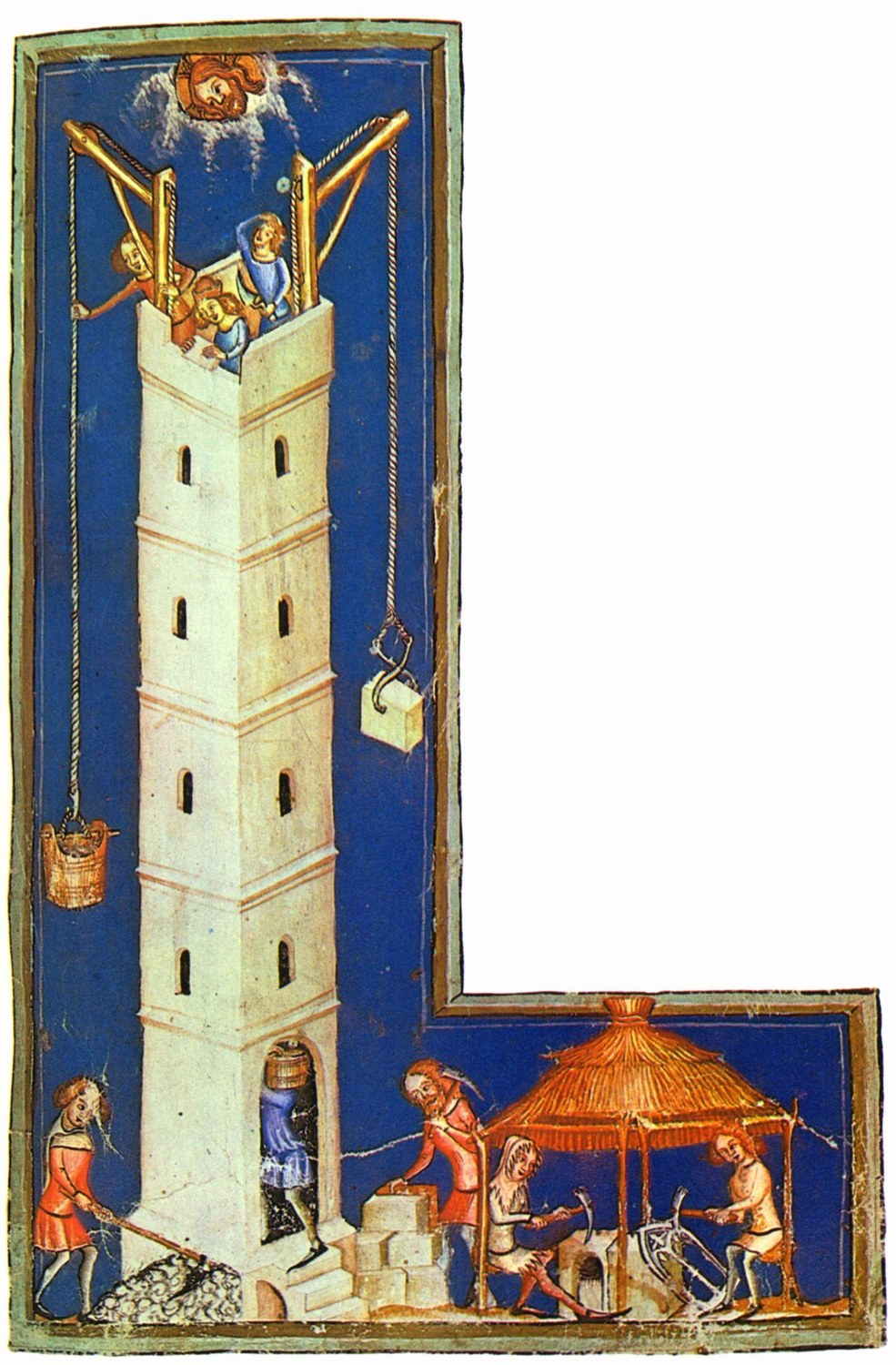
Every chronicle, and history, and many other clerks, and the Bible in principal, witnesses of the making of the tower of Babel, and it is written in the Bible, Genesis Chapter x., how that Ham, Noah's son begot Nimrod, and he waxed a mighty man upon the earth, and he waxed a strong man, like a giant, and he was a great king. And the beginning of his kingdom was [that of the] true kingdom of Babylon, and Arach, and Archad, and Calan, and the land of Sennare. And this same Nimrod began the tower of Babylon…and he taught to his workmen the craft of measures, and he had with him many masons, more than 40 thousand. And he loved and cherished them well. And it is written in [the] Policronicon, and in the master of stories, and in other stories more, and this in part witnesseth [the] Bible, in the same x. chapter [of Genesis,] where he saith that Asur, that was nigh [of] kin to Nimrod, [and] went out of the land of Senare and he built the city [of] Nineveh, and Plateas, and other more, this he saith "de tra illa et de Sennare egressus est Asur, et edificavit Nineven et Plateas civitatum et Cale et Jesu quoque, inter Nineven et hoec est Civitas magna."
RE|s|on wolde |that| we |s|chold [Fol. 17.]
tell opunly how & in
what ma|ner| that |the| charges
of ma|s|oncraft was fyr|s|t fo|un|
dyd & ho yaf fir|s|t |the| name
to hit of ma|s|onri and ye [370]
|s|chyll knaw well |that| hit told
and writen in policronicon &
in methodus ep|iscopu|s and mar|ter|
|that| a|s|ur |that| was a worthy lord
of |s|ennare |s|ende to nembroth
|the| kynge to |s|ende h|ym| ma|s|ons
and workemen of craft |that| myght
helpe hym to make his Cite
|that| he was in wyll to make. [Fol. 17 b.]
And nembroth |s|ende h|ym| |xxx| [380]
C. of masons. And whan |th|ey
|s|cholde go & |s|ende h|em| forth. he
callyd hem by for h|ym| and |s|eyd
to hem ye mo|s|t go to my co
|s|yn a|s|ure to helpe h|ym| to bilde
a cyte but loke |that| ye be well
go|uer|nyd and I |s|chall yeue
yov a charge |pro|fitable for
you & me.
Reason would that we should tell openly how, and in what manner, that the charges of mason-craft was first founded and who gave first the name of it of masonry. And ye shall know well that it [is] told and written in [the] Policronicon and in Methodius episcopus and Martyrus that Asure, that was a worthy lord of Sennare, sent to Nimrod the king, to send him masons and workmen of craft that might help him to make his city that he was in will to make.
And Nimrod sent him 30 hundred of masons. And when they should go and [he should] send them forth he called them before him and said to them—"Ye must go to my cousin Asur, to help him to build a city; but look [to it] that ye be well governed, and I shall give you a charge profitable for you and me.
WHen ye come to |that| lord [390]
loke |that| ye be trewe to
hym lyke as ye wolde be to
me. and truly do your labour [Fol. 18.]
and craft and takyt re|s|on|-|
abull your mede |ther|for as ye
may de|s|erue and al|s|o |that| ye
loue to gedyr as ye were
bre|th|eryn and holde to gedyr
truly. & he |that| hath most c|on||yn|g
teche hit to hys felaw and [400]
louke ye go|uer|ne you ayen|s|t
yowr lord and a monge
yowr selfe. |that| I may haue
worchyppe and thonke for
me |s|endyng and techyng
you the crafte. and |th|ey re|s|/ceyuyd
the charge of h|ym| |that| was here [Fol. 18 b.]
mai|s||ter| and here lorde. and
wente forthe to a|s|ure. &
bilde the cite of nunyve in [410]
|the| count|r|e of plateas and o|ther|
Cites mo |that| men call cale
and Jesen |that| is a gret Cite
bi twene Cale and nunyve
And in this ma|ner| |the| craft
of ma|s|onry was fyr|s|t |pre|fer
ryd & chargyd hit for a |s|ci|en|s.
When ye come to that lord look that ye be true to him like as ye would be to me, and truly do your labour and craft, and take reasonable your meed therefore as ye may deserve, and also that ye love together as ye were brethren, and hold together truly; and he that hath most cunning teach it to his fellow; and look ye govern you against your lord and among yourselves, that I may have worship and thanks for my sending, and teaching, you the craft." and they received the charge of him that was their master and their lord, and went forth to Asur, and
built the city of Ninevah, in the country of Plateas, and other cities more that men call Cale
and Jesen, that is a great city between Cale and Nineveh. And in this manner the craft of masonry was first preferred and charged it for a science.
ELders |that| we|re| bi for us
of ma|s|ons had te|s|e
charges wryten to hem as [420]
we haue now in owr char [Fol. 19.]
gys of |the| |s|tory of Enclidnis
as we have |s|eyn hem writ|en|
in latyn & in Fre|s|nche bothe
but ho |that| Enclyd come to ge|-|
metry re|s|on wolde we
|s|cholde telle yow as hit is
notid in the hybull & in other
|s|tories. In |xii| Capitl|or| Gene|sis|
he tellith how |that| abrah|am| com to [430]
the lond of Canan and owre
lord aperyd to h|ym| and |s|eyd I
|s|chall geue this lond to |th|i
|s|eed. but |ther| |s|yll a grete hun|ger|
in |that| lond. And abraham toke [Fol. 19 b.]
|s|ara his wiff |wit| him and
yed in to Egypte in pylgre|-|
mage whyle |the| hunger du
red he wolde hyde |ther|. And A
brah|am| as |the| cronycull |s|eyth [440]
he was a wy|s|e man and a
grete clerk. And covthe all
|the|vi|i| |s|ciens. and taughte
the egypeyans |the| |sciens of
Gemetry. And this worthy
clerk Enclidnis was his
clerke and lerned of hym.
And he yaue |the| fir|s|te name
of Gemetry all be |that| hit [Fol. 20.]
was ocupied bifor hit had [450]
no name of gemetry. But
hit is |s|eyd of ylodour Ethe
mologia|rum| in |the| v. boke. Ethe
mologia|rum| Cap|itolo| p'mo. |s|eyth
|that| Enclyde was on of |the| fir|s|t
founders of Gemetry &
he yaue hit name. ffor |in|
his tyme ther was a wa
ter in |that| lond of Egypt |that|
is callyd Nilo and hit flowid [460]
|so| ferre in to |the| londe |that| men
myght not dwelle |ther|in
Elders that were before us, of masons, had these charges written to them as we have now in our charges of the story of Euclid, as we have seen them written in Latin and in French both; but how that Euclid came to [the knowledge of] geometry reason would we should tell you as it is noted in the Bible and in other stories. In the twelfth chapter of Genesis he telleth how that Abraham came to the Land of Canaan, and our Lord appeared to him and said, I shall give this land to thy seed; but there fell a great hunger in that land, and Abraham took Sarah, his wife, with him and went into Egypt in pilgrimage, [and] while the hunger [en]dured he would bide there. And Abraham, as the chronicle saith, he was a wise man and a great clerk, and couthe all the 7 science[s] and taught the Egyptians the science of geometry. And thid worthy clerk, Euclid, was his clerk and learned of him. And he gave the first name of geometry, all be that it was occupied before it had no name of geometry. But it is said of Isodour, Ethemologiarum, in the 5th booke Ethemolegiarum, capitolo primo, saith that Euclid was one of the first founders of geometry, and he gave it [that] name, for in
his time that was a water in that land of Egypt that is called [the] Nile, and it flowed so far into the land that men might not dwell therein.
THen this worthi
clerke Enclide taught
hem to make grete wallys
and diches to holde owt |the|
watyr. and he by Gemet'
me|s|ured |the| londe and de|par|
tyd hit in dy|ver|s |par|tys. &
mad e|ver|y man to clo|s|e his [470]
awne |par|te |wit| walles and
diches an |the|en hit be c|am|e
a plentuos c|on|untre of all
ma|ner| of freute and of yon|ge|
peple of men and women
that |ther| was |s|o myche pepull
of yonge frute |that| they couth'
not well lyue. And |the| lordys
of the countre drew hem to
gedyr and made a councell [480]
how they myght helpe her
childeryn |that| had no lyflode
c|om|potente & abull for to fyn|de|
hem selfe and here childron
for |th|ey had |s|o many. and
a mong hem all in councell
was |this| worthy clerke Encli
dnis and when he |s|a|we| |th|at
all they cou|th|e not btynge
a bout this mater. he |s|eyd [490]
to hem woll ye take y|our| |s|on|ys| [Fol. 21 b.]
in go|uer|nanns & I |s|chall tec|he|
hen |s|uche a sciens |that| they
|s|chall iyue ther by |j|entel
manly vnder condicion |that|
ye wyll be |s|wore to me to
|per|fourme the go|uer|na|nn|s |that|
I |s|chall |s|ette you too and
hem bothe and the kyng
of |the| londe and all |the| lordys [500]
by one a|ss|ent gra|un|tyd |ther| too.
Then this worthy clerk, Euclid, taught them to make great walls and ditches to holde out the water; and he, by geometry, measured the land, and departed it in divers parts, and made every man close his own part with walls and ditches, and then it became a plenteous country of all manner of fruit and of young people, of men and women, that there was so much people of young fruit that they could not well live. And the lords of the country drew them [selves] together and made a council how they might help their children that had no livelihood, competent and able, for to find themselves and their children for thy had so many. And among them all in council was this worthy clerk Euclid, and when he saw that all they could not bring about this matter he said to them-"Will ye take your sons in governance, and I shall teach them such science that they shall live thereby gentlemanly, under condition that ye will be sworn to me to perform the governance that I shall set you to and them both." And the king of the land and all the lords, by one assent, granted thereto.
REson wolde |that| e|uer|y m|an|
woulde graunte to |that|
thyng |that| were |pro|fetable to h|im|
|s|elf. and they toke here |s|o [Fol 22.]
nys to enclide to go|uer|ne
hem at his owne wylle &
he taught to hem the craft
Masonry and yaf hit |th|e
name of Gemetry by cav|s|e [510]
of |the| |par|tyng of |the| grounde |that|
he had taught to |the| peple
in the time of |the| makyng
of |the| wallys and diches a
for |s|ayd to claw|s|e out |the|
watyr. & I|s|odor |s|eyth in his
Ethemolegies |that| Enclide
callith the craft Gemetrya
And |ther| this worthye clerke [Fol. 22 b.]
yaf hit name and taught [520]
hitt the lordis |s|onys of |the|
londe |that| he had in his tech|in|g
And he yaf h|em| a charge |that|
they scholde calle here eche
other ffelowe & no nother
wise by cav|s|e |that| they were
all of one crafte & of one
gentyll berthe bore & lor|ds'|
|s|onys. And also he |that| we|re|
most of c|on|nyng scholde be [530]
go|uer|nour of |the| werke and
scholde be callyd mais|ter| &
other charges mo |that| ben [Fol. 23.]
wryten in |the| boke of char
gys. And |s|o they wrought
|with| lordys of |the| lond & made
cities and tounys ca|s|telis
& templis and lordis placis.
Reason would that every man would grant to that thing that were profitable to himself, and they took their sons to Euclid to govern them at his own will, and he taught to them the craft, Masonry, and gave it the name of geometry, because of the parting of the ground that he had taught to the people, in the time of the making of the walls and ditches aforesaid, to close out the water, and Isodore saith, in his Ethemologies, that Euclid calleth the craft geometry; and there was this worthy clerk gave it name, and taught it the lords' sons of the
land that he had in his teaching. And he gave them a charge that they should call here each
other fellow, and no otherwise, because that they were all of one craft, and of one gentle birth born, and lords' sons. And also he that were most of cunning should be governor of the work, and should be called master, and other charges more that are written in the book of charges. And so they wrought with lords of the land, and made cities and towns, castles and temples, and lords' palaces.
WHat tyme |that |the| chil
dren of i|s|rl dwellid [540]
|in| egypte they lernyd |the|
craft of masonry. And
afturward |th|ey were
dryuen ont of Egypte |th|ey
come in to |th|e lond of bihest
and is now callyd ierl|e|m
and hit was ocupied & char [Fol. 23 b.]
gys y holde. And |the| mak|yn|g
of |s|alomonis tempull |that|
Kyng Dauid be gan. k|yn|g [550]
dauid louyd well ma|s|ons
and he yaf hem ry|g|t nye
as |th|ey be nowe. And at |the|
makyng of |the| temple in
|s|alomonis tyme as hit
is seyd in |the| bibull in |the|
ii|i| boke of Regu in |ter|cio
Reg|um| Cap|itolo| quinto. That
Salomon had iii|i|. score
thow|s|and masons at [560]
his werke. And |the| kyngi|s| [Fol 24.]
|s|one of Tyry was |his| ma|s||ter|
ma|s|en. And other crony
clos hit is |s|eyd & in olde
bokys of ma|s|onry that
Salomon c|on|firmed |the| char
gys |that| dauid has fadir had
yeue to ma|s|ons. And |s|alo
mon hym |s|elf taught h|em|
here maners byt lityll [570]
differans fro the maners
that now ben u|s|yd. And fro
thens |this| worthy |s|ciens
was brought |in to fraunce
And in to many o|ther| regi|on|s [Fol. 24 b.]
What time that the childrewn of Israel dwelt in Egypt they learned the craft of masonry. And afterward, [when] they were driven out of Egypt, they came into the land of behest, and is now called Jerusalem, and it was occupied and charges there held. And the making of Solomon's temple that king David began. (King David loved well masons, and he gave them right nigh as they be now.) And at the making of the temple in Solomon's time as it is said in te Bible, in the 3rd book of Regum in tercio Regum capitolo quinto, that Solomon had 4 score thousand masons at his work. And the king's son, of Tyre, was his master Mason. And [in] other chronicles it is said, and in old books of masonry, that Solomon confirmed the charges that David, his father, had given to masons. And Solomon himself taught them there manners [with] but little difference from the manners that now are used. And from thence this worthy science
was brought into France and into many other regions.
SUmtyme ther w|as|
a worthye kyng in
ffrauns |that| was clepyd Ca
rolus |s|'c|undu|s |that| ys to |s|ey
Charlys |the| |s|ecunde. And |this| [580]
Charlys was elyte kyng
of ffrauns by the grace of
god & by lynage also. And
|s|u|mm|e men |s|ey |that| he was
elite by fortune ||the| whiche
is fals as by cronycle he
was of |the| kynges blode
Royal. And |this| |s|ame kyng
Charlys was a ma|s|on [Fol. 25.]
bi for |that| he was kyng. And [590]
af|ter| |that| he was kyng he louyd
ma|s|ons & cher|s|chid them
and yaf hem chargys and
ma|ner|ys at his deui|s|e |the| which|e|
|s||um| ben yet u|s|ed in fraunce
and he ordeynyd that |th|ey
|s|cholde haue a |s|emly onys
in |the| yere and come and
|s|peke to gedyr and for to be
reuled by ma|s|ters & felows [600]
of thynges a my|ss|e.
ANd |s||oo|ne af|ter| |that| come
|s|eynt ad habell in to Englond [Fol. 25 b.]
and he c|on||uer|tyd |s|eynt Albon
to cristendome. And |s|eynt
Albon lovyd well ma|s|ons
and he yaf hem fyr|s|t he|re|
charges & maners fyr|s|t
in Englond. And he or
deyned c|on|uenyent to pay [610]
for |the| trauayle. And af|ter|
|theat| was a worthy kyn|ge|
in Englond |that| was callyd
Athelstone and his yong
est |s|one lovyd well the
|s|ciens of Gemetry. and
he wy|s|t well|that| hand craft [Fol. 26.]
had the practyke of |the |s|ci
ens of Gemetry to well
as masons wherefore he [620]
drewe hym |to| c|on|sell and ler
nyd practyke of |that| |s|ciens
to his |s|peculatyf. For of |s|pec
culatyfe he was a ma|s||ter|
and he lovyd well ma
|s|onry and ma|s|ons. And
he bicome a mason hym
|s|elfe. And he yaf hem charg|es|
and names as hit is now
vsyd id Englond. and in [630]
othere countries. And he [Fol. 26 b.]
ordyned |that| |th|ey |s|chulde haue
re|s|onabull pay. And pur
cha|s|ed a fre patent of |the| k|y|ng
that they |s|choulde make a
|s|embly whan thei |s|awe re|-|
|s|onably tyme a c|u| to gedir to
he|re| counsel|le| of |the| whiche
Charges manors & |s|emble
as is write and taught |in| |th|e [640]
boke of our charges wher
for I leue hit at this tyme.
Sometime there was a worthy king in France that was called Carolus secundus, that is to say, Charles the Second, and this Charles was elected king of France, by the grace of God and by lineage also. And some men say that he was elected by fortune, the which is false, as by [the] chronicle he was of the king's blood royal. And this same King, Charles, was a mason before that he was king, and after that he was king he loved Masons and cherished them, and gave them charges and manners at his device, [of] the which some are yet used in France; and he ordained that they should have [an] assembly once in the year, and come and speak together, and for to be ruled by masters and fellows of all things amiss. And soon after that came Saint Adhabell into England, and converted Saint Alban to Christianity. And Saint Alban loved well masons, and he gave them first their charges and manners first in England. And he ordained convenient [times] to pay for the travail. And after that was a worthy king in England that was called Athelstan, and his youngest son loved well the science of geometry, and he wist well that hand-craft had the practice of the science of geometry so well as masons, wherefore he drew him to council and learned [the] practice of that science to his speculative, for of speculative he was a master, and he loved well masonry and masons. And he became a mason himself, and he gave them charges and names as it is now used in England, and in other countries. And he ordained that they shouuld have reasonable pay and purchased a free patent of the king that they should make [an] assembly when they saw a reasonable time and come together to their councillors of which charges, manners, and assembly, as it is written and taught in the book of our charges, wherefore I leave it at this time.
GOod men for this
cau|s|e and |this| man|er|
ma|s|onry toke fir|s|te begyn|-| [Fol 27.]
nyng. hit befyll |s||um|tyme
|that| grete lordis had not |s|o
grete po|s||s| e|s||s|ions |that| they
myghte not a vaunce here
fre bigeton childeryn for [650]
|th|ey had so many. Therefore
they toke coun|s|ell howe |th|ey
my|g|t here childeryn ava|n|ce
and ordeyn hem one|s|tly to
lyue. And |s|ende af|ter| wy|s|e
mai|s|ters of |the| worthy |s|ci
ens of Gemetry |that| |they| thorou
here wy|s|dome |s|chold ordey/ne
hem |s||um| hone|s|t lyuyng [Fol. 27 b.]
Then on of them |that| had |the| [660]
name whiche was callyd
Englet |that| was most |s|otell
& wi|s|e founder ordeyned
and art and callyd hit ma
|s|onry. and so |with| his art ho
nestly he tho|g|t |the| childeren
of get lordis bi |the| pray
er of |the| fathers and |the| fre
will of here children. |the|
wiche when thei tau|g|t |with| [670]
hie Cure bi a |s|erteyn ty|me|
|th|ey were not all ilyke ab/ull
for to take of |the| for|s|eyde art [Fol. 28.]
Wherefore |the| for|s|ayde mai|s||ter|
Englet ordeynet thei were
pa|s||s|ing of conyng |s|chold
be pa|s||s|ing honoured. And
ded to call |the| c|on|nyn|ger| mai|s|ter|
for to enforme |the| la|s||s|e of c|on|
nyng ma|s|ters of |the| wiche [680]
were callyd ma|s|ters of no
bilite of witte and c|on|nyng
of |that| art. Ne|ver||th|ele|s||s|e |th|ei c|om|
maundid |that| thei |that| were la|s||s|e
of witte |s|chold not be callyd
|s|eruan|ter| ner |s|ogett but felau
ffor nobilite of here gentyll [Fol. 28 b.]
nlode. In this ma|n|e|r| was |the|
for|s|ayde art begunne |i|n |the|
lond of Egypte by |the| for|s|ayde [690]
mai|s||ter| Englat & so hit went
fro lond to londe and fro k|yn|g
dome to kyngdome af|ter| |that| ma|-|
ny yeris in |the| tyme of kyng
adhel|s|tone wiche was |s|um
tyme kynge of Englonde bi
his co|un|n|s|el|ler| and other gre|ter|
lordys of |the| lond bi c|om|yn
a|s||s|ent for grete defavt y
fennde amon|ger| ma|s|ons |th|ei [700]
ordeyned a certayne reule [Fol 29.]
a mongys hom on tyme of
|the| yere or in ii|i| yere as nede
were to |the| kyn|g| and gret
lordys of |the| londe and all |the|
comente fro |pr|oynce to |pr|o|yn|ce
and fro co|u|ntre to co|u|ntre
c|on|gregacions |s|cholde be made
by mai|s|ters of all mai|s||ter|s
ma|s|ons and felaus in the [710]
for|s|ayd art. And |s|o at |s|uche
c|on|gregac|o|ns they |that| be mad
ma|s|ters |s|chold be examined
of |the| articuls af|ter| writen. &
be ran|s|akyd whether thei be [Fol. 29 b.]
abull and kunnyn|g| to |the| |pr|
fyte of |the| lordys hem to serue
and to |the| honour of |the| for|s|aid
art and more o|uer| they |s|chulde
receyue here charge |that| they [720]
|s|chuld well and trewly di|s|
pende |the| goodys of here lordis
and as well |the| lowi|s|t as |the|
hie|s|t for they ben her lordys
for |the| tyme of whom |h|ei take
here pay for here cervyce
and for here trauayle. The
fir|s|te article ys this |that| e|uer|y
mai|s||ter| of |th|is art |s|chulde be
wy|s||s|e and trewe to |the| lord |that| he [730]
|s|eruyth di|s|pendyng his godis
trule as he wolde his awne
were di|s|pendyd. and not yefe
more pay to no ma|s|on than
he wot he may di|s|erue af|ter| |the|
derthe of korne & vytayl in |the|
c|o|ntry no fauour |with| stond|y|g
for e|uer|y ma|n| to be rewardyd
af|ter| his trauayle. The se|c|nd
article is this |that| e|uer|y ma|s||ter| [740]
of |this| art |s|cholde be warned
by fore to cum to his cogrega|t|
|that| thei com dewly but yf thei [Fol. 30 b.]
may a|s||s|cu|s|yd by |s|ume ma|ner|
cause. But ne|uer|le|s||s|e if |th|ey
be founde rebell at |s|uche c|on|
gregacions or fauty in eny
ma|ner| harme of here lordys
and reprene of this art thei
|s|chulde not be excu|s|yd in no [750]
ma|ner|e out take |per|ell of dethe
and thow they be in |per|yll of
dethe they |s|call warne |the|
mai|s||ter| |that| is pryncipall of |the|
gederyng of his de|s||s|e|s|e. |the|
article is this |that| no ma|s||ter|
take noprentes for la|s||s|e terme [Fol. 31.]
than vi|i| yer at |the| le|s|t. by
caus|e| whi |s|uche as ben |with| |i|
la|s||s|e terme may not |pro|fitely [760]
come to his art. nor abull
to serue truly his lorde to
take as a mason |s|chulde
take. The iii|i| article is |this|
|that| no ma|s||ter| for no |pro|fyte take
no prentis for to be lernyd
that is bore of bonde blode
fore bi cau|s|e of his lorde to
whom he is bonde woll tak|e|
hym as he well may fro [770]
his art & lede hym |with| h|ym| out
of his logge or out of his
place |that| he worchyth in for
his felaus |per|auen|ter| wold help
hym and debte for h|ym|. and
thereoff man|s|laughter my|g|t
ry|s|e hit is forbede. And also
for a nother cau|s|e of his art
hit toke begynnyng of grete
lordis children frely beget|yn| [780]
as hit is |i|seyd bi for. The
v. article is thys |that| no ma|s|ter|
yef more to his prentis in
tyme of his prenti|s|hode for
no |pro|phite to be take than he [Fol 32.]
note well he may di|s||s|erue
of |the| lorde |that| he |s|eruith |nor| not
|s|o moche |that| |the| lorde of |the| place
|that| he is taught |i|nne may
haue |s|um |pro|fyte bi his te|-| [790]
chyng. The v|i|. article is
this |that| no ma|s||ter| for no coue
ty|s|e ne|r| |pro|fite take no p|re|n
tis to teche |that| is un|per|fyte |that|
is to |s|ey havyng eny ma|ym|
for |the| whiche he may not
trewely worche as hym
ought for to do. The vi|i|.
article is this |that| np mai|s||ter| be [Fol. 32 b.]
y founde wittyngly or help [800]
or |pro|cure to be maynte|ner| &
|s|u|s|tey|ner| any comyn ny|g|twal
ker to robbe bi the whiche
ma|ner| of ny|g|twalkin|g|
thei may not fulfyll |ther| day|s|
werke and traueyell thorow
|the|c|on|dicion he|r| felaus my|g|t
be made wrowthe. The vii|i|
article is this |that| yf hit befall
|that| any ma|s|on |that| be |per|fyte and [810]
c|on|nyng come for to |s|eche
werke and fynde any vn|per|fit
and vnkunnyng worchyng [Fol. 33.]
|the| ma|s||ter| of |the| place |s|chall re
ceyue |the| |per|fite and do a wey |the|
vn|per|fite to |the| |pro|fite of his lord
The ix. article is this |th|at
no mai|s||ter| |s|chall supplant
a nother for hit is |s|eyd in |the|
art of ma|s|onry |that| no man [820]
|s|cholde make ende |s|o well
of werke bigonne bi a no
ther to |the| |pro|fite of his lorde
as he bigan hit for to end
hit bi his maters or to wh|om|e
he |s|cheweth his maters.
This councell ys made bi dy [Fol. 33 b.]
uers lordis & mai|s|ters of
dyvers |pro|vynces and di|uer|s
c|on|gregacions of ma|s|onry [830]
and hit is to wyte |that| who |that|
covetyth for to come to the
|s|tate of |that| for|s|eyd art hit be
hoveth hem fyrst |pri|ncypally
to god and holy chyrche &
all halowis and his mas|ter|
and his felowis as his a|wn|e
brotheryn. The |s|econde poynt
he mo|s|t fulfylle his dayes
werke truly |that| he takyth for [840]
his pay. The. ii|i|. |point| he can [Fol. 34.]
hele the councell of his felo|ws|
in logge and in chambere
and in e|uer|y place |ther| as ma|s||on|s
beth. The iii|i|. poynt |that| he be
no di|s||s|eyver of |the| for|s|eyd art
ne do no |pre|iudice ne |s|u|s|teyne
none articles ayen|s|t |the| art
ne a yen|s|t none of |the| art
but he |s|chall |s|u|s|teyne hit [850]
in all honovre in as moche
as he may. The. v. poynt
whan he schall take his
pay |that| he take hit mekely
as the tyme ys ordeynyd bi [Fol. 34 b.]
the mai|s||ter| to be done and |that|
he fulfylle the accepcions
of trauayle and of his re|s|t
y ordeyned and |s|ette by |the|
mai|s||ter|. The. v|i|. poynt yf [860]
eny di|s|corde |s|chall be bitwe
ne hym & his felows he
|s|chall a bey hym mekely &
be stylle at |the| byddyng of
his ma|s||ter| or of |the| wardeyne
of his ma|s||ter| in his ma|s||ter|s
absens to |the| holy day fo|-|
lowyng and |that| he accorde
then at |the| di|s|pocion of his
felaus and not upon |the| wer [870]
keday for lettyng of here
werke and |pro|fyte of his lord
The. vi|i|. poynt |that| he covet
not |the| wyfe ne |the| doughter
of his ma|s|ters no|ther| of his
felaws but yf hit be in ma|-|
tuge nor holde c|on|cubines
for dy|s|cord |that| my|g|t fall a
monges them. The. vii|i|
poynt yf hit befalle hym [880]
ffor to be wardeyne vndyr
his ma|s||ter| |that| he be trewe mene
bitwene his ma|s||ter| & his [Fol. 35 b.]
felaws and |that| he be be|s|y in
the ab|s|ence of his ma|s||ter| to
|the| honor of his ma|s||ter| and |pro||-|
fit to |the| lorde |that he |s|erueth
The. iX. poynt yf he be wy|s|er
and |s|otellere |th|an his felawe
worchyng |with| hym in his [890]
logge or in eny other place
and he |per||s|eyue hit |that| he |s|chold
lefe the stone |that| he worchyt a|-|
pon for defawte of c|on|nyng
and can teche hym and a
mende |the| |s|tone he |s|chall en/forme
hym and helpe h|im| |that| the more
loue may encre|s|e among h|em|
and |that| |the| werke of |the| lorde be not [900]
lo|s|t. Whan the ma|s||ter| and |the| fe
lawes be for warned ben y
come to |s|uche c|on|gregac|on|ns
if nede be |the| Schereffe of |the|
countre or the mayer of |the|
Cyte or alderman of |the| town|e|
in wyche the c|on|gregac|on|s ys
hold|en| |s|chall be felaw and so
ciat to |the| ma|s||ter| of the c|on|gre
gacion in helpe of h|ym| ayenst re [910]
belles and vpberyng |the| ry|g|t
of the reme. At |the| fyrst beg|yn| [Fol. 36 b.]
nyng new men |that| ne|uer| we|re|
chargyd bi fore beth charged
in |th|is manere that |s|chold
neuer be theuys nor |th|euys
meynteners and |that| |s|chuld
tryuly fulfyll he|re| dayes
werke and truayle for he|re|
pay that |th|ey |s|chull take of [920]
here lord and trewe a coun|t|
yeue to here felaus in th|yn|
gys |that| be to be a countyd of
hem and to here and hem
loue as hem |s|elfe and they
|s|chall be trew to the kynge
of englond and to the reme
and that they kepe |with| all |ther|
my|g|t and all the articles
a for |s|ayd. Af|ter| that hit |s|chall [930]
be enqueryd if ony ma|s||ter| or
felaw that is y warnyd haue
y broke ony article be for|s|ayd
the whiche if they haue done
hit schall be de termyned |ther|.
Therefore hit is to wyte if
eny ma|s||ter| or felawe that is
warnyd bifore to come to
|s|uche c|on|gregac|on|ns and be
rebell and woll not come or [Fol. 37 b.]
els haue tre|s|pa|s||s|ed a yen|s|t
any article befor|s|ayd if hit
may be |pro|uyd he |s|chall for|-|
|s|were his ma|s|onri and |s|chal
no more v|s|e his craft. The
whiche if he |pre||s|ume for to do
|the| Sc|her|efe of |the| countre |in| |the| which
he may be founde worchyn|ge|
he |s|chall |pri||s|on h|im| & take all
his godys |in| to |the| kynges hond [950]
tyll his |gra|ce be |gra|ntyd h|im| & y |s|che
wed for |this| cau|s|e |pri|ncipally w|her|
|th|es c|on|gregat|on|ns ben y ordeyned
that as well the lowist as [Fol 38.]
as the hie|s|t |s|chuld be well
and trewely y |s|eruyd in
his art bifore|s|ayd thorow
owt all the kyngdom of
Englond. Amen |s|o mote
hit be [960]
Good men for this cause and this manner Masonry took [its] first beginning. It befel sometime[s] that great lords had not so great possessions that they might not advance their
free begotten children, for thet had so many, therefore they took counsel how they might their children advance and ordain them honestly to live. And [they] sent after wise masters of the worthy science of geometry that they, through their wisdom, should ordain them some honest living. Then one of them, that had the name which was called Englet, that was most subtle and wise founder, ordained an art and called it Masonry, and so with his art, honestly, he taught the children of great lords, by the prayer of the fathers and the freewill of their children, the which when they [were] taught with high care, by a certain time, they were not all alike able for to take of the [a]foresaid art wherefore the [a]foresaid master, Englet, ordained [that] they [who] were passing of cunning should be passing honured, and did to call the cunninger master for to inform the less of cunning masters, of the which were called masters, of nobility of wit and cunning of that art. Nevertheless they commanded that they that were less of wit should not be called servant, nor subject, but fellow, for nobility of their gentle blood. In this manner was the [a]foresaid art begun in the land of Egypt, by the [a]foresaid master Englet, and so it went from land to land, and from kingdom to kingdom. After that, many years, in the time of King Athelstan, which was some time king of England, by his councillors, and other greater lords of the land, by common assent, for great default found among masons, they ordained a certain rule amongst them: one time of the year, or in 3 years as need were to the king and great lords of the land, and all the comonalty, from province to province, and from country to country, congregations should be made, by masters, of all masters, Masons, and fellows in the [a]foresaid art, and so, at such congregations, they that be made masters should be examined, of the articles after written, and be ransacked whether they be able and cunning to the profit of the lords [having] them to serve and to the honour of the [a]foresaid art. And, moreover, they should receive their charge that they should well and truly dispend the goods of their lords, as well the lowest as the highest, for they be their lords, for the time, of whom they take their pay for their service and for their travail.
The first Article is this,—That every master of this art should be wise and true to the lord that he serveth, dispending his goods truly as he would his own were dispensed, and not give more pay to no mason than he wot he may deserve, after the dearth of corn and victual in the country, no favour withstanding, for every man to be rewarded after his travail.
The second Article is this,—That every master of this art should be warned, before, to come to his congregation, that they come duly, but if they may [be] excused by some manner [of] cause. But, nevertheless, if they be found rebel[lious] at such congregations, or faulty in any manner [of] harm of their lords, and reproof of this art, they should not be excused in no manner [with]out taking peril of death, and though they be in peril of death, they shall warn the master that is principal of the gathering of his decease.
The [third] Article is this,—That no master take no [ap]prentice for [a] less term than 7 year[s] at the least, because such as be within [a] less term may not, profitably, come to his art nor able to serve, truly, his lord [and] to take as a mason should take.
The 4th Article is this,—That no master, for no profit, take no [ap]prentice, for to be learned, that is born of bond blood, for, because of his lord, to whom he is bond, will take him as he well may, from his art and lead him, with him, out of his lodge, or out of his place, that he worketh in, for his fellows, peradventure, would help him and debate for him, and thereof manslaughter might [a]rise, it is forbid[den.] And also for another cause of his art, it took beginning of great lords' children, freely begotten, as it is said before.
The 5th Article is this,—That no master give more to his [ap]prentice in time of his [ap]prenticehood, for no profit to be take[n], than he note[s] well he may deserve of the lord that he serveth, nor not so much that the lord, of the place that he is taught in, may have some profit of his teaching.
The 6th Article is this,—That no master for no coveteousness, nor profit, take no [ap]prentice to teach that is imperfect, that is to say, having any maim for the which he may not truly work as he ought for to do.
The 7th Article is this,—That no master be found wittingly, or help or procure. to be [a] maintainer and sustainer [of] any common night walker to rob, by the which manner of nightwalking they may not fulfil their day's work and travail, [and] through the condition their fellows might be made wroth.
The 8th Article is this,—That if it befal that any mason that be perfect, and cunning, come for to seek work and find an imperfect and uncunning working, the master of the place shall receive the perfect, and do away the imperfect, to the profit of his lord.
The 9th Article is this,—That no master shall supplant another for it is said, in the art of masonry, that no man should make end so well of work begun by another, to the profit of his lord, as he [that] began it, for to end it by his matters, or to whom he sheweth his matters.
This council is made by divers lords and masters of divers provinces and divers congregations of masonry and it is, to wit, that who that coveteth for to come to the state of the [a]foresaid art
it behoveth them first, principally, to God and holy church, and all-halows, and his master and his fellows as his own brethren.
The second Point,—He must fulfil his day's work truly that he taketh for his pay.
The 3rd [Point],—That he can hele the counsel of his fellows in lodge, and in chamber, and in every place there as Masons be.
The 4th Point,—That he be no deceiver of the [a]foresaid art, nor do no prejudice, nor sustain no articles, against the art, nor against none of the art, but he shall sustain it in all honour, inasmuch as he may.
The 5th Point,—When he shall take his pay, that he take it meekly, as the time is ordained by the master to be done, and that he fulfil the acceptations of travail, and of rest, ordained and set by the master.
The 6th Point,—If any discord shall be between him and his fellows he shall obey him meekly, and be still at the bidding of his master, or of the warden of his master, in his master's absence, to the holy-day following, and that he accord then at the disposition of his fellows, anot upon the workday for letting of their work and profit of his lord.
The 7th Point,—That he covet not the wife, not the daughter, of his masters, neither of his fellows, but if it be in marriage, nor hold concubines, for discord that might fall amongst them.
The 8th Point,—If it befal him for to be warden under his master, that he be true mean between his master and his fellows, and that he be busy in the absence of his master to the honour of his master and profit of the lord that he serveth.
The 9th Point,—If he be wiser, and subtler than his fellow working with him in his lodge, or any other place, and he perceive it that he should leave the stone that he worketh upon, for default of cunning, and can teach him and amend the stone, he shall inform him and help him, that the more love may increase among them, and that the work of the lord be not lost.
When the master and the fellows be forewarned [and] are come to such congregations, if need be, the Sheriff of the Country, or the Mayor of the City, or Alderman of the Town, in which the congregations is holden, shall be fellow, and [as] sociate, to the master of the congregation, in help of him, against rebels and [for the] up-bearing the right of the realm. At the first beginning new men, that never were charged before, be charged in this manner,—That [they] should never be thieves, nor thieves' maintainers, and that [they] should truly fulfil their day's work, and travail, for their pay that they shall take of their lord, and [a] true account give to their fellows, in things that be to be accounted of them, and to hear, and them love as themselves. And they shall be true to the King of England, and to the realm, and that they keep, with all their might, and all the Articles aforesaid. After that it shall be enquired if any master, or fellow, that is warned, have broke[n] any Article beforesaid, the which, if they have done, it shall be determined there. Therefore, it is to wit, if any master, or fellow, that is warned before to come to such congregations and be rebell[ious], and will not come, or else have trespassed against any Article beforesaid, if it
may be proved, he shall forswear his Masonry and shall no more use his craft; the which, if he presume for to do, the Sheriff of the Country, in which he may be found working, he shall [im]prison him and take all his goods into the king's hand till his grace be granted him and shewed. For this cause, principally, where these congregations ordained that as well the lowest, as the highest, should be well and truly served in his art, beforesaid, throughout all the kingdom of England. Amen: So Mote it be.