
Arms of the Grand Lodge of KazakhstanGrand Lodge of Kazakhstan
ENRUKZ

Home  /  Discover Freemasonry

The Regius Poem

about 1390

The oldest known document of the Craft: a poem of 794 lines in Middle English that sets out the legendary history of masonry and the fifteen articles and fifteen points that bound the master and the fellows. The manuscript belongs to the old Royal Library of England and is now in the British Library (Royal MS 17 A I).

Middle English text as printed by H. J. Whymper in 1889, after J. O. Halliwell’s first edition of 1840. Source: www.freemasonry.bcy.ca.

About this text

The Regius Poem, also called the Halliwell Manuscript, is the oldest known document of Freemasonry. The English antiquary James Orchard Halliwell identified it in the old Royal Library collection of the British Museum and published it in 1840. It is a poem in rhyming couplets, written in Middle English. It tells how geometry, which it identifies with masonry, was taught by Euclid in Egypt and brought to England under King Athelstan; it sets out the fifteen articles for the master and the fifteen points for the fellows that an assembly of lords and masons is said to have drawn up; it recalls the Four Crowned Martyrs, the seven liberal sciences and the Tower of Babel; and it ends with counsel on conduct in church and at table.
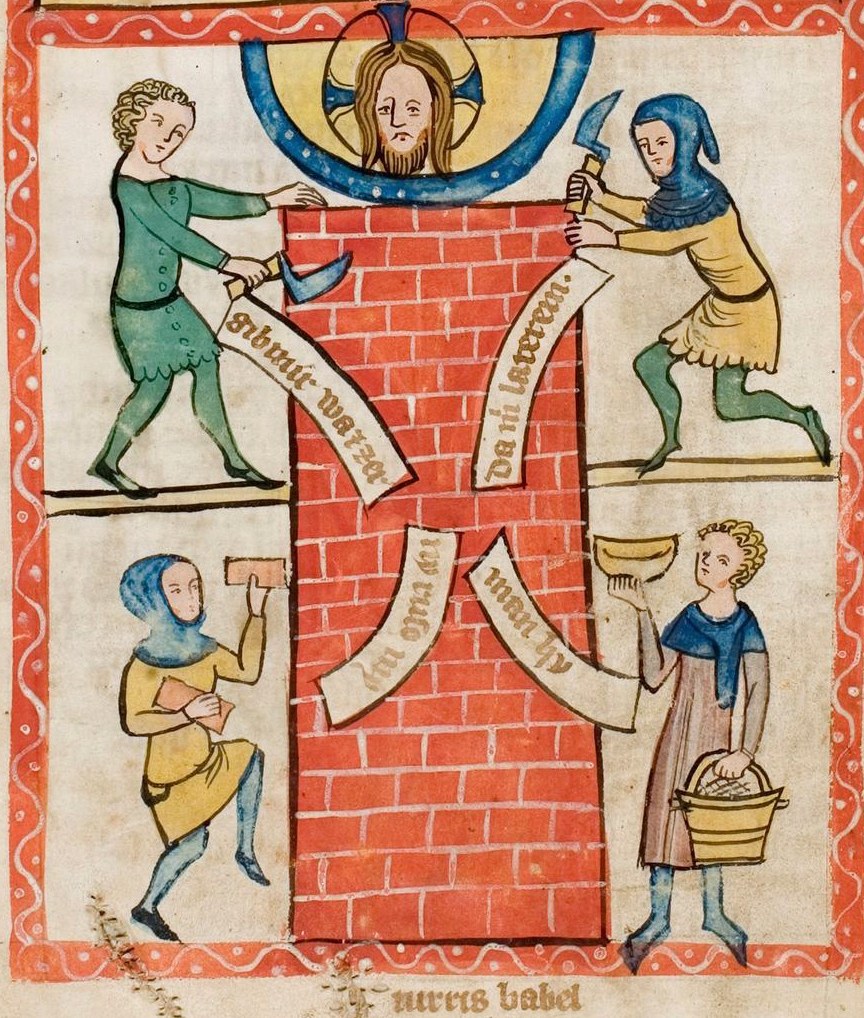
The building of the Tower of Babel
The building of the Tower of Babel, from the Speculum humanae salvationis, about 1360 · Public domain

The modern English beside the original is the Grand Lodge’s own rendering.

The Middle English original

Modern English

Hic incipiunt constituciones artis gemetriae secundum Eucyldem.

Here begin the constitutions of the art of geometry according to Euclid.

Whose wol bothe wel rede and loke, He may fynde wryte yn olde boke Of grete lordys and eke ladyysse, That hade mony chyldryn y-fere, y-wisse; And hade no rentys to fynde hem wyth, Nowther yn towne, ny felde, ny fryth: A cownsel togeder they cowthe hem take; To ordeyne for these chyldryn sake, How they my[g]th best lede here lyfe Withoute gret desese, care and stryfe; And most for the multytude that was comynge Of here chyldryn after here [g]yndynge.

Whoever will read and look well may find written in an old book of great lords and also ladies, who had many children together, truly, and had no income with which to provide for them, neither in town, nor in field, nor in woodland. They took counsel together to decide, for the sake of these children, how they might best lead their lives without great distress, care and strife, and most of all because of the multitude of children who were growing up after their begetting.

(They) sende thenne after grete clerkys, To techyn hem thenne gode werkys; And pray we hem, for our Lordys sake, To oure chyldryn sum werke to make, That they my[g]th gete here lyvynge therby, Bothe wel and onestlyche, ful sycurly.

Then they sent for great scholars to teach their children good works, and prayed them, for our Lord's sake, to make some work for their children, so that they might earn their living by it, both well and honestly, in full security.

Yn that tyme, thro[g]gh good gemetry, Thys onest craft of good masonry Wes ordeynt and made yn thys manere, Y-cownterfetyd of thys clerkys y-fere; At these lordys prayers they cownterfetyd gemetry, And [g]af hyt the name of masonry, For the moste oneste craft of alle. These lordys chyldryn therto dede falle, To lurne of hym the craft of gemetry, The wheche he made ful curysly; Thro[g]gh fadrys prayers and modrys also, Thys onest craft he putte hem to.

In that time, through good geometry, this honest craft of good masonry was ordained and made in this manner, fashioned by these scholars together. At these lords' prayers they fashioned geometry and gave it the name of masonry, for it is the most honest craft of all. These lords' children took it up, to learn from him the craft of geometry, which he had made with great skill. Through the prayers of fathers and of mothers also, he put them to this honest craft.

He that lerned best, and were of onesté, And passud hys felows yn curysté; [G]ef yn that craft he dede hym passe, He schulde have more worschepe then the lasse. Thys grete clerkys name was clept Euclyde, Hys name hyt spradde ful wondur wyde. Get thys grete clerke more ordeynt he To hym that was herre yn thys degré, That he schulde teche the synplyst of (wytte) Yn that onest craft to be parfytte; And so uchon schulle techyn othur, And love togeder as syster and brothur.

He who learned best, and was honest, and surpassed his fellows in skill, if he surpassed them in that craft, should have more honour than the lesser. This great scholar's name was Euclid, and his name spread very far and wide. Yet this great scholar ordained further, for him who was highest in this degree, that he should teach the simplest in wit in that honest craft until he was perfect, and so each should teach another, and love one another as sister and brother.

Forthermore [g]et that ordeynt he, Mayster y-called so schulde he be; So that he were most y-worschepede, Thenne sculde he be so y-clepede: But mason schulde never won other calle, Withynne the craft amongus hem alle, Ny soget, ny servand, my dere brother, Tha[g]ht he be not so perfyt as ys another; Uchon sculle calle other felows by cuthe, For cause they come of ladyes burthe. On thys maner, thro[g] good wytte of gemetry, Bygan furst the craft of masonry:

Furthermore he ordained that the one most honoured should be called Master, and that masons should never call one another, within the craft among themselves, subject or servant, my dear brother, though he be not as perfect as another. Each shall call the others fellow, out of courtesy, because they come of gentle birth. In this manner, through the good wit of geometry, the craft of masonry first began: the scholar Euclid found it in this way, this craft of geometry, in the land of Egypt.

The clerk Euclyde on thys wyse hyt fonde, Thys craft of gemetry yn Egypte londe. Yn Egypte he taw[g]hte hyt ful wyde, Yn dyvers londe on every syde; Mony erys afterwarde, y understonde, [G]er that the craft com ynto thys londe, Thys craft com ynto Englond, as y [g]ow say, Yn tyme of good kynge Adelstonus day; He made tho bothe halle and eke bowre, And hye templus of gret honowre, To sportyn hym yn bothe day and ny[g]th, An to worschepe hys God with alle hys my[g]th.

In Egypt he taught it far and wide, and in many lands on every side. Many years afterwards, I understand, before the craft came into this land, it came into England, as I tell you, in the days of the good King Athelstan. He then built both halls and bowers, and high temples of great honour, to amuse himself by day and by night, and to worship his God with all his might.

Thys goode lorde loved thys craft ful wel, And purposud to strenthyn hyt every del, For dyvers defawtys that yn the craft he fonde; He sende about ynto the londe After alle the masonus of the crafte, To come to hym ful evene stra[g]fte, For to amende these defautys alle By good consel, [g]ef hyt myt[g]th falle.

This good lord loved this craft very well and resolved to strengthen it in every part, because of the various faults he found in the craft. He sent throughout the land for all the masons of the craft to come to him straightaway, to amend all these faults by good counsel, if it might be done.

A semblé thenne he cowthe let make Of dyvers lordis, yn here state, Dukys, erlys, and barnes also, Kyn[g]thys, sqwyers, and mony mo, And the grete burges of that syté, They were ther alle yn here degré; These were ther uchon algate, To ordeyne for these masonus astate. Ther they sow[g]ton by here wytte, How they my[g]thyn governe hytte: Fyftene artyculus they ther sow[g]ton And fyftene poyntys they wro[g]ton.

He then caused an assembly to be made of various lords, each in his rank: dukes, earls and barons, knights, squires and many more, and the great burgesses of that city. They were all there, each in his degree, to ordain for the estate of these masons. There they sought, by their wit, how they might govern it, and they devised fifteen articles and fifteen points.

Hic incipit articulus primus. The furste artycul of thys gemetry:-- The mayster mason moste be ful securly Bothe stedefast, trusty, and trwe, Hyt schal hum never thenne arewe: And pay thy felows after the coste, As vytaylys goth thenne, wel thou woste; And pay them trwly, apon thy fay, What that they deserven may; And to her hure take no more, But what they mowe serve fore; And spare, nowther for love ny drede, Of nowther partys to take no mede; Of lord ny felow, whether he be, Of hem thou take no maner of fe; And as a jugge stonde upry[g]th, And thenne thou dost to bothe good ry[g]th; And trwly do thys whersever thou gost, Thy worschep, thy profyt, hyt shcal be most.

Here begins the first article.

The first article of this geometry: the master mason must be steadfast, trusty and true; he will never regret it. Pay your fellows according to the cost, as you well know what victuals cost then; pay them truly, upon your faith, what they may deserve; and take no more for their hire than they can serve for. Neither for love nor for fear accept a bribe from either party, from lord or fellow, whoever he may be; take no fee from them. Stand upright as a judge, and then you do right by both. Do this truly wherever you go, and your honour and your profit will be the greater.

Articulus secundus. The secunde artycul of good masonry, As [g]e mowe hyt here hyr specyaly, That every mayster, that ys a mason, Most ben at the generale congregacyon, So that he hyt resonably y-tolde Where that the semblé schal be holde; And to that semblé he most nede gon, But he have a resenabul skwsacyon, Or but he be unbuxom to that craft, Or with falssehed ys over-raft, Or ellus sekenes hath hym so stronge, That he may not com hem amonge; That ys a skwsacyon, good and abulle, To that semblé withoute fabulle.

The second article.

The second article of good masonry, as you may here hear in particular: every master who is a mason must attend the general congregation, so long as he has been reasonably told where the assembly is to be held. He must go to that assembly unless he has a reasonable excuse, or unless he is disobedient to the craft, or is overtaken by falsehood, or else sickness has taken such hold of him that he cannot come among them. That is a good and sufficient excuse for missing the assembly, without a word of fable.

Articulus tercius. The thrydde artycul for sothe hyt ysse, That the mayster take to no prentysse, but he have good seuerans to dwelle Seven [g]er with hym, as y [g]ow telle, Hys craft to lurne, that ys profytable; Withynne lasse he may not be able To lordys profyt, ny to his owne, As [g]e mowe knowe by good resowne.

The third article.

The third article, truly, is that the master take no apprentice unless he has good security that the apprentice will stay with him seven years, as I tell you, to learn his craft, which is profitable. In less time he cannot be of use either to the lord's profit or to his own, as you may know by good reason.

Articulus quartus. The fowrhe artycul thys moste be That the mayster hym wel be-se, That he no bondemon prentys make, Ny for no covetyse do hym take; For the lord that he ys bonde to, May fache the prentes whersever he go. Gef yn the logge he were y-take, Muche desese hyt mygth ther make, And suche case hyt mygth befalle, That hyt mygth greve summe or alle. For alle the masonus tht ben there Wol stonde togedur hol y-fere Gef suche won yn that craft schulde swelle, Of dyvers desesys ge mygth telle: For more gese thenne, and of honeste, Take a prentes of herre degre. By olde tyme wryten y fynde That the prenes schulde be of gentyl kynde; And so symtyme grete lordys blod Toke thys gemetry, that ys ful good.

The fourth article.

The fourth article must be this: that the master take good care not to make a bondman his apprentice, nor take him out of covetousness, for the lord to whom he is bound may fetch the apprentice wherever he goes. If he were taken in the lodge, it would cause much trouble, and such a case might befall as would grieve some or all, for all the masons who are there will stand together. If such a one were to dwell in that craft, you could tell of many troubles. For greater ease, then, and for honour, take an apprentice of higher degree. I find written from olden times that the apprentice should be of gentle kind, and so sometimes the blood of great lords took up this geometry, which is very good.

Articulus quintus. The fyfthe artycul ys swythe good, So that the prentes be of lawful blod; The mayster schal not, for no vantage, Make no prentes that ys outrage; Hyt ys to mene, as [g]e mowe here, That he have hys lymes hole alle y-fere; To the craft hyt were gret schame, To make an halt mon and a lame, For an unperfyt mon of suche blod Schulde do the craft but lytul good. Thus [g]e mowe knowe everychon, The craft wolde have a my[g]hty mon; A maymed mon he hath no my[g]ht, [G]e mowe hyt knowe long [g]er ny[g]ht.

The fifth article.

The fifth article is very good: that the apprentice be of lawful blood. The master shall not, for any advantage, take an apprentice who is deformed. That is to say, as you may hear, that he should have all his limbs whole. It would be a great shame to the craft to make a halting man and a lame one, for an imperfect man of such blood would do the craft little good. So you may all know that the craft would have a mighty man. A maimed man has no might; you may know it long before night.

Articulus sextus. The syxte artycul [g]e mowe not mysse, That the mayster do the lord no pregedysse, To take of the lord, for hyse prentyse, Also muche as hys felows don, yn alle vyse. For yn that craft they ben ful perfyt, So ys not he, [g]e mowe sen hyt. Also hyt were a[g]eynus good reson, To take hys, hure as hys felows don. Thys same artycul, yn thys casse, Juggythe the prentes to take lasse Thenne hys felows, that ben ful perfyt. Yn dyvers maters, conne qwyte hyt, The mayster may his prentes so enforme, That hys hure may crese ful [g]urne, And, ger hys terme come to an ende, Hys hure may ful wel amende.

The sixth article.

The sixth article you must not miss: that the master do the lord no wrong by taking from the lord, for his apprentice, as much as his fellows do in every way. For in that craft they are fully perfect, and he is not, as you can see. It would also be against good reason to take his hire as his fellows do. This same article, in this case, judges the apprentice to take less than his fellows, who are fully perfect. In various matters he can repay it: the master may so instruct his apprentice that his hire may increase quickly, and before his term comes to an end his hire may be much improved.

Articulus septimus. The seventhe artycul that ys now here, Ful wel wol telle gow, alle y-fere, That no mayster, for favour ny drede, Schal no thef nowther clothe ny fede. Theves he schal herberon never won, Ny hym that hath y-quellude a mon, Wy thylike that hath a febul name, Lest hyt wolde turne the craft to schame.

The seventh article.

The seventh article, which is now here, will tell you all together: no master shall, for favour or fear, clothe or feed any thief. He shall never harbour thieves, nor a man who has killed a man, nor anyone with a bad name, lest it turn the craft to shame.

Articulus octavus. The eghte artycul schewt [g]ow so, That the mayster may hyt wel do, [G]ef that he have any mon of crafte, And be not also perfyt as he au[g]te, He may hym change sone anon, And take for hym a perfytur mon. Suche a mon, thro[g]e rechelaschepe, My[g]th do the craft schert worschepe.

The eighth article.

The eighth article shows you that the master may well do this: if he has any man of the craft who is not as perfect as he ought to be, he may change him at once and take a more perfect man in his place. Such a man, through carelessness, might bring the craft little honour.

Articulus nonus. The nynthe artycul schewet ful welle, That the mayster be both wyse and felle; That no werke he undurtake, But he conne bothe hyt ende and make; And that hyt be to the lordes profyt also, And to hys craft, whersever he go; And that the grond be wel y-take, That hyt nowther fle ny grake.

The ninth article.

The ninth article shows very well that the master should be both wise and strong; that he undertake no work unless he can both finish it and make it; that it be to the lord's profit also, and to his craft, wherever he goes; and that the ground be well laid, so that it neither gives way nor cracks.

Articulus decimus. The then the artycul ys for to knowe, Amonge the craft, to hye and lowe, There schal no mayster supplante other, But be togeder as systur and brother, Yn thys curyus craft, alle and som, That longuth to a maystur mason. Ny he schal not supplante non other mon, That hath y-take a werke hym uppon, Yn peyne therof that ys so stronge, That peyseth no lasse thenne ten ponge, But [g]ef that he be gulty y-fonde, That toke furst the werke on honde; For no mon yn masonry Schal no supplante othur securly, But [g]ef that hyt be so y-wro[g]th, That hyt turne the werke to nogth; Thenne may a mason that werk crave, To the lordes profyt hyt for to save; Yn suche a case but hyt do falle, Ther schal no mason medul withalle. Forsothe he that begynnyth the gronde, And he be a mason goode and sonde, For hath hyt sycurly yn hys mynde To brynge the werke to ful good ende.

The tenth article.

The tenth article is to be known among the craft, by high and low: no master shall supplant another, but they shall be together as sister and brother in this curious craft, all and some, that belongs to a master mason. Nor shall he supplant any other man who has taken a work in hand, on pain of a penalty so strong that it weighs no less than ten pounds, unless it be found that he who first took the work in hand is guilty. For no man in masonry shall supplant another, unless the work is so done that it comes to nothing; then another mason may ask for that work, to save it for the lord's profit. In such a case, unless it happens so, no mason shall meddle with it. Truly, he who begins the foundation, if he is a good and sound mason, surely has it in mind to bring the work to a very good end.

Articulus undecimus. The eleventhe artycul y telle the, That he ys bothe fayr and fre; For he techyt, by hys my[g]th, That no mason schulde worche be ny[g]th, But [g]ef hyt be yn practesynge of wytte, [G]ef that y cowthe amende hytte.

The eleventh article.

The eleventh article I tell you: it is both fair and free, for it teaches, with all its might, that no mason should work by night, unless it be in practising his wit, if I could thereby improve it.

Articulus duodecimus. The twelfthe artycul ys of hye honesté To [g]every mason, whersever he be; He schal not hys felows werk deprave, [G]ef that he wol hys honesté save; With honest wordes he hyt comende, By the wytte that God the dede sende; Buy hyt amende by al that thou may, Bytwynne [g]ow bothe withoute nay.

The twelfth article.

The twelfth article is of high honour to every mason, wherever he may be: he shall not disparage his fellow's work, if he wishes to save his own honour. He shall commend it with honest words, by the wit that God sent you, but amend it by all you can, between the two of you, without refusal.

Articulus xiijus. The threttene artycul, so God me save, Ys,[g]ef that the mayster a prentes have, Enterlyche thenne that he hym teche, And meserable poyntes that he hym reche, That he the craft abelyche may conne, Whersever he go undur the sonne.

The thirteenth article.

The thirteenth article, so God save me, is that if the master has an apprentice, he teach him thoroughly and give him measured points, so that he may know the craft well, wherever he goes under the sun.

Articulus xiiijus. The fowrtene artycul, by good reson, Scheweth the mayster how he schal don; He schal no prentes to hym take, Byt dyvers crys he have to make, That he may, withynne hys terme, Of hym dyvers poyntes may lurne.

The fourteenth article.

The fourteenth article, by good reason, shows the master how he shall act: he shall take no apprentice unless he has various works to make, so that the apprentice may, within his term, learn various points from him.

Articulus quindecimus. The fyftene artycul maketh an ende, For to the mayster he ys a frende; To lere hym so, that for no mon, No fals mantenans he take hym apon, Ny maynteine hys felows yn here synne, For no good that he my[g]th wynne; Ny no fals sware sofre hem to make, For drede of here sowles sake; Lest hyt wolde turne the craft to schame, And hymself to mechul blame.

The fifteenth article.

The fifteenth article makes an end, for it is a friend to the master: he shall teach the apprentice that for no man should he take on false maintenance, nor maintain his fellows in their sin for any gain he might win, nor suffer them to swear a false oath, for fear for their souls, lest it turn the craft to shame and himself to much blame.

Plures Constituciones. At thys semblé were poyntes y-ordeynt mo, Of grete lordys and maystrys also, That whose wol conne thys craft and com to astate, He most love wel God, and holy churche algate, And hys mayster also, that he ys wythe, Whersever he go, yn fylde or frythe; And thy felows thou love also, For that they craft wol that thou do.

More constitutions.

At this assembly more points were ordained by great lords and masters also: that whoever will know this craft and come to estate must love God well, and Holy Church always, and his master also, whom he is with, wherever he goes, in field or woodland. And love your fellows also, for that is what your craft requires you to do.

Secundus punctus. The secunde poynt, as y [g]ow say, That the mason worche apon the werk day, Also trwly, as he con or may, To deserve hys huyre for the halyday, And trwly to labrun on hys dede, Wel deserve to have hys mede.

The second point.

The second point, as I tell you, is that the mason work on the working day as truly as he can or may, to deserve his hire for the holiday, and truly labour at his task, so as to deserve to have his reward.

Tercius punctus. The thrydde poynt most be severele, With the prentes knowe hyt wele, Hys mayster conwsel he kepe and close, And hys felows by hys goode purpose; The prevetyse of the chamber telle he no man, Ny yn the logge whatsever they done; Whatsever thou heryst, or syste hem do, Telle hyt no mon, whersever thou go; The conwsel of halls, and [g]eke of bowre, Kepe hyt wel to gret honowre, Lest hyt wolde torne thyself to blame, And brynge the craft ynto gret schame.

The third point.

The third point must be observed severally: let the apprentice know it well. He shall keep and conceal his master's counsel, and his fellows' too, with good purpose. He shall tell no man the secrets of the chamber, nor whatever they do in the lodge. Whatever you hear or see them do, tell it to no man, wherever you go. The counsel of halls and also of bowers, keep it well, to great honour, lest it turn you to blame and bring the craft into great shame.

Quartus punctus. The fowrthe poynt techyth us alse, That no mon to hys craft be false; Errour he schal maynteine none A[g]eynus the craft, but let hyt gone; Ny no pregedysse he schal not do To hys mayster, ny hys felows also; And that[g]th the prentes be under awe, [G]et he wolde have the same lawe.

The fourth point.

The fourth point teaches us also that no man be false to his craft. He shall maintain no error against the craft, but let it go, nor do any wrong to his master or his fellows. And though the apprentice be under awe, yet he would have the same law.

Quintus punctus. The fyfthe poynte ys, withoute nay, That whenne the mason taketh hys pay Of the mayster, y-ordent to hym, Ful mekely y-take so most hyt byn; [G]et most the mayster, by good resone, Warne hem lawfully byfore none, [G]ef he nulle okepye hem no more, As he hath y-done ther byfore; A[g]eynus thys ordyr he may not stryve, [G]ef he thenke wel for to thryve.

The fifth point.

The fifth point is, without refusal, that when the mason takes his pay from the master, as ordained for him, it must be taken very meekly. Yet the master, by good reason, must warn them lawfully before noon, if he will not employ them any more, as he did before. No one may strive against this order, if he thinks to thrive.

Sextus punctus. The syxte poynt ys ful [g]ef to knowe, Bothe to hye and eke to lowe, For suche case hyt my[g]th befalle, Amonge the masonus, summe or alle, Throwghe envye, or dedly hate, Ofte aryseth ful gret debate. Thenne owyth the mason, [g]ef that he may, Putte hem bothe under a day; But loveday [g]et schul they make none; Tyl that the werke day be clene a-gone; Apon the holyday [g]e mowe wel take Leyser y-now[g]gth loveday to make, Lest that hyt wolde the werke day Latte here werke for suche afray; To suche ende thenne that hem drawe, That they stonde wel yn Goddes lawe.

The sixth point.

The sixth point is very easy to know, for high and low alike: such a case might befall among the masons, some or all, that through envy or deadly hatred great debate often arises. Then the mason ought, if he can, to summon them both to a day; but they shall not yet make a loveday until the working day is quite gone. On the holiday you may well find leisure enough to make a loveday, lest the quarrel hinder their work on the working day. Let them be drawn to such an end that they stand well in God's law.

Septimus punctus. The seventhe poynt he may wel mene, Of wel longe lyf that God us lene, As hyt dyscryeth wel opunly, Thou schal not by thy maysters wyf ly, Ny by the felows, yn no maner wyse, Lest the craft wolde the despyse; Ny by the felows concubyne, No more thou woldest he dede by thyne. The peyne thereof let hyt be ser, That he prentes ful seven [g]er, [G]ef he forfete yn eny of hem, So y-chasted thenne most he ben; Ful mekele care my[g]th ther begynne, For suche a fowle dedely synne.

The seventh point.

The seventh point he may well mean, of the long life that God lend us, as it plainly describes: you shall not lie with your master's wife, nor with your fellow's, in any manner, lest the craft despise you; nor with your fellow's concubine, any more than you would wish him to do so with yours. Let the penalty be certain: he shall serve as apprentice for seven years again. If he offends in any of these, he must be chastised accordingly. Much sorrow might begin from such a foul, deadly sin.

Octavus punctus. The eghte poynt, he may be sure, [G]ef thou hast y-taken any cure, Under thy mayster thou be trwe, For that pynt thou schalt never arewe; A trwe medyater thou most nede be To thy mayster, and thy felows fre; Do trwly al....that thou my[g]th, To both partyes, and that ys good ry[g]th.

The eighth point.

The eighth point, you may be sure: if you have taken any charge, be true to your master, and you will never regret that point. You must needs be a true mediator between your master and your fellows. Do truly all that you can to both parties, and that is good right.

Nonus punctus. The nynthe poynt we schul hym calle, That he be stwarde of oure halle, Gef that ge ben yn chambur y-fere, Uchon serve other, with mylde chere; Jentul felows, ge moste hyt knowe, For to be stwardus alle o rowe, Weke after weke withoute dowte, Stwardus to ben so alle abowte, Lovelyche to serven uchon othur, As thawgh they were syster and brother; Ther schal never won on other costage Fre hymself to no vantage, But every mon schal be lyche fre Yn that costage, so moste hyt be;

The ninth point.

The ninth point we shall call this: that he be steward of our hall. If you are together in a chamber, let each serve the other with a mild countenance. Gentle fellows, you must know that you are all to be stewards in turn, week after week without doubt, all of you, lovingly serving one another as though you were sister and brother. No one shall free himself at another's cost to any advantage; but every man shall be equally free in that cost, so it must be.

Loke that thou pay wele every mon algate, That thou hsat y-bow[g]ht any vytayles ate, That no cravynge be y-mad to the, Ny to thy felows, yn no degré, To mon or to wommon, whether he be, Pay hem wel and trwly, for that wol we; Therof on thy felow trwe record thou take, For that good pay as thou dost make, Lest hyt wolde thy felowe schame, Any brynge thyself ynto gret blame. [G]et good acowntes he most make Of suche godes as he hath y-take, Of thy felows goodes that thou hast spende, Wher, and how, and to what ende; Suche acowntes thou most come to, Whenne thy felows wollen that thou do.

See that you always pay every man well for any victuals you have bought, so that no demand is made on you, nor on your fellows, in any degree, whether of man or of woman. Pay them well and truly, for that is what we will. Take a true record of this from your fellow, for the good payment you make, lest it shame your fellow and bring yourself into great blame. The steward must also make good account of such goods as he has taken, of your fellows' goods that you have spent, where, and how, and to what end. You must come to such accounts when your fellows wish you to.

Decimus punctus. The tenthe poynt presentyeth wel god lyf, To lyven withoute care and stryf; For and the mason lyve amysse, And yn hys werk be false, y-wysse, And thorw[g] suche a false skewysasyon May sclawndren hys felows oute reson, Throw[g] false sclawnder of suche fame May make the craft kachone blame. [G]ef he do the craft suche vylany, Do hym no favour thenne securly. Ny maynteine not hym yn wyked lyf, Lest hyt wolde turne to care and stryf; But get hym [g]e schul not delayme, But that [g]e schullen hym constrayne, For to apere whersevor [g]e wylle, Whar that [g]e wolen, lowde, or stylle; To the nexte semblé [g]e schul hym calle, To apere byfore hys felows alle, And but [g]ef he wyl byfore hem pere, The crafte he moste nede forswere; He schal thenne be chasted after the lawe That was y-fownded by olde dawe.

The tenth point.

The tenth point sets out a good life, to live without care and strife. For if the mason lives amiss and is false in his work, and by such a false excuse slanders his fellows without reason, through the false slander of such report he may make the whole craft blamed. If he does the craft such villainy, show him no favour, surely, and do not maintain him in a wicked life, lest it turn to care and strife. Yet you shall not delay with him, but you shall compel him to appear wherever you will, where you will, loudly or quietly. You shall summon him to the next assembly, to appear before all his fellows, and unless he will appear before them he must forswear the craft. He shall then be chastised according to the law that was founded in olden days.

Punctus undecimus. The eleventhe poynt ys of good dyscrecyoun, As [g]e mowe knowe by good resoun; A mason, and he thys craft wel con, That sy[g]th hys felow hewen on a ston, And ys yn poynt to spylle that ston, Amende hyt sone, [g]ef that thou con, And teche hym thenne hyt to amende, That the l(ordys) werke be not y-schende, And teche hym esely hyt to amende, With fayre wordes, that God the hath lende; For hys sake that sytte above, With swete wordes noresche hym love.

The eleventh point.

The eleventh point is of good discretion, as you may know by good reason. A mason, if he knows this craft well, who sees his fellow hewing a stone and about to spoil it, should amend it soon, if he can, and teach him how to amend it, so that the lord's work is not ruined. Teach him gently to amend it, with fair words that God has lent you. For the sake of Him who is above, nourish love with sweet words.

Punctus duodecimus. The twelthe poynt of gret ryolté, Ther as the semblé y-hole schal be, Ther schul be maystrys and felows also, And other grete lordes mony mo; There schal be the scheref of that contré, And also the meyr of that syté, Kny[g]tes and sqwyers ther schul be, And other aldermen, as [g]e schul se; Suche ordynance as they maken there, They schul maynté hyt hol y-fere A[g]eynus that mon, whatsever he be, That longuth to the craft bothe fayr and fre. [G]ef he any stryf a[g]eynus hem make, Ynto here warde he schal be take.

The twelfth point.

The twelfth point is of great royalty: where the assembly is to be held there shall be masters and fellows also, and many other great lords. There shall be the sheriff of that country and also the mayor of that city, knights and squires shall be there, and other aldermen, as you shall see. Whatever ordinance they make there, they shall maintain together against that man, whoever he may be, who belongs to the craft, fair and free. If he makes any strife against them, he shall be taken into their custody.

xiijus punctus. The threnteth poynt ys to us ful luf. He schal swere never to be no thef, Ny soker hym yn hys fals craft, For no good that he hath byraft, And thou mowe hyt knowe or syn, Nowther for hys good, ny for hys kyn.

The thirteenth point.

The thirteenth point is very dear to us: he shall swear never to be a thief, nor to succour a thief in his false craft, for any goods he has taken, if you can know or see it, neither for his goods nor for his kin.

xiiijus punctus. The fowrtethe poynt ys ful good lawe To hym that wold ben under awe; A good trwe othe he most ther swere To hys mayster and hys felows that ben there; He most be stedefast and trwe also To alle thys ordynance, whersever he go, And to hys lyge lord the kynge, To be trwe to hym, over alle thynge. And alle these poyntes hyr before To hem thou most nede by y-swore, And alle schul swere the same ogth Of the masonus, be they luf, ben they loght, To alle these poyntes hyr byfore, That hath ben ordeynt by ful good lore. And they schul enquere every mon On his party, as wyl as he con, [G]ef any mon mowe be y-fownde gulty Yn any of these poyntes spesyaly; And whad he be, let hym be sow[g]ht, And to the semblé let hym be brow[g]ht.

The fourteenth point.

The fourteenth point is a very good law for him who would be under awe: he must swear a good, true oath there to his master and to his fellows who are there. He must be steadfast and true to all this ordinance, wherever he goes, and to his liege lord the king, to be true to him above all things. And to all these points before you must needs be sworn, and all masons, whether willing or unwilling, shall swear the same oath to all these points, which have been ordained by very good teaching. And each man shall inquire, on his own part, as well as he can, whether any man may be found guilty in any of these points in particular; and whoever he is, let him be sought out and brought to the assembly.

Quindecimus punctus. The fiftethe poynt ys of ful good lore, For hem that schul ben ther y-swore, Suche ordyance at the semblé wes layd Of grete lordes and maystres byforesayd; For thelke that be unbuxom, y-wysse, A[g]eynus the ordynance that ther ysse Of these artyculus, that were y-meved there, Of grete lordes and masonus al y-fere. And [g]ef they ben y-preved opunly Byfore that semblé, by an by, And for here gultes no mendys wol make, Thenne most they nede the crafy forsake; And so masonus craft they schul refuse, And swere hyt never more for to use.

The fifteenth point.

The fifteenth point is of very good teaching for those who shall be sworn there. Such ordinance was laid down at the assembly by the great lords and masters aforesaid, for those who are disobedient against the ordinance there is, of these articles that were moved there by great lords and masons all together. And if they are openly proved before that assembly, one by one, and will make no amends for their guilt, then they must needs forsake the craft; they shall give up the masons' craft and swear never to use it again.

But [g]ef that they wol mendys make, A[g]ayn to the craft they schul never take; And [g]ef that they nul not do so, The scheref schal come hem sone to, And putte here bodyes yn duppe prison, For the trespasse that they hav y-don, And take here goodes and here cattelle Ynto the kynges hond, everyt delle, And lete hem dwelle ther full stylle, Tyl hyt be oure lege kynges wylle.

But if they will make amends, they shall never again be taken into the craft. And if they will not do so, the sheriff shall soon come to them and put their bodies in deep prison for the trespass they have done, and take their goods and their cattle into the king's hand, every whit, and let them remain there very still until it be our liege king's will.

Alia ordinacio artis gematriae. They ordent ther a semblé to be y-holde Every [g]er, whersever they wolde, To amende the defautes, [g]ef any where fonde Amonge the craft withynne the londe; Uche [g]er or thrydde [g]er hyt schuld be holde, Yn every place whersever they wolde; Tyme and place most be ordeynt also, Yn what place they schul semble to. Alle the men of craft tehr they most ben, And other grete lordes, as [g]e mowe sen, To mende the fautes that buth ther y-spoke, [G]ef that eny of hem ben thenne y-broke.

Another ordinance of the art of geometry.

They ordained that an assembly should be held every year, wherever they would, to amend the faults, if any were found among the craft within the land. It should be held every year or every third year, in whatever place they would. Time and place must also be ordained, in what place they should assemble. All the men of the craft must be there, and other great lords, as you may see, to mend the faults that are spoken of there, if any of them have broken the rules.

Ther they schullen ben alle y-swore, That longuth to thys craftes lore, To kepe these statutes everychon, That ben y-ordeynt by kynge Aldelston; These statutes that y have hyr y-fonde Y chulle they ben holde thro[g]h my londe, For the worsche of my ry[g]olté, That y have by my dygnyté. Also at every semblé that [g]e holde, That ge come to [g]owre lyge kyng bolde, Bysechynge hym of hys hye grace, To stonde with [g]ow yn every place, To conferme the statutes of kynge Adelston, That he ordeydnt to thys craft by good reson,

All those who belong to the lore of this craft shall be sworn there to keep these statutes, every one, that were ordained by King Athelstan. The king says: "These statutes that I have found here, I will have them kept throughout my land, for the honour of my royalty, which I have by my dignity." Also at every assembly that you hold, you shall come to your liege king, bold, beseeching him of his high grace to stand with you in every place, to confirm the statutes of King Athelstan, which he ordained for this craft by good reason.

Ars quatuor coronatorum. Pray we now to God almy[g]ht, And to hys moder Mary bry[g]ht, That we mowe keepe these artyculus here, And these poynts wel al y-fere, As dede these holy martyres fowre, That yn thys craft were of gret honoure; They were as gode masonus as on erthe schul go, Gravers and ymage-makers they were also. For they were werkemen of the beste, The emperour hade to hem gret luste; He wylned of hem a ymage to make, That mow[g]h be worscheped for his sake; Suche mawmetys he hade yn hys dawe, To turne the pepul from Crystus lawe.

The art of the four crowned martyrs.

Let us now pray to God almighty, and to his mother Mary bright, that we may keep these articles here, and these points, well all together, as did these four holy martyrs who were of great honour in this craft. They were as good masons as ever walked on earth; they were also engravers and image-makers. For they were workmen of the best, and the emperor had great desire for them. He wished them to make an image that might be worshipped for his sake; such idols he had in his day, to turn the people from Christ's law.

But they were stedefast yn Crystes lay, And to here craft, withouten nay; They loved wel God and alle hys lore, And weren yn hys serves ever more. Trwe men they were yn that dawe, And lyved wel y Goddus lawe; They tho[g]ght no mawmetys for to make, For no good that they my[g]th take, To levyn on that mawmetys for here God, They nolde do so thaw[g] he were wod; For they nolde not forsake here trw fay, An beyleve on hys falsse lay. The emperour let take hem sone anone, And putte hem ynto a dep presone; The sarre he penest hem yn that plase, The more yoye wes to hem of Cristus grace.

But they were steadfast in Christ's law, and in their craft, without refusal. They loved God well and all his teaching, and were evermore in his service. They were true men in that day and lived well in God's law. They would not think of making idols, for any gain they might take, to believe in those idols as their God; they would not do so though he were mad. For they would not forsake their true faith and believe in his false law. The emperor had them seized at once and put into a deep prison. The more sorely he punished them in that place, the more joy they had of Christ's grace.

Thenne when he sye no nother won, To dethe he lette hem thenne gon; Whose wol of here lyf [g]et mor knowe, By the bok he may kyt schowe, In the legent of scanctorum, The name of quatour coronatorum. Here fest wol be, withoute nay, After Alle Halwen the eyght day.

Then when he saw no other way, he sent them to their death. Whoever wishes to know more of their life may find it in the book, in the legend of the saints, under the name of the Four Crowned Ones. Their feast, without refusal, will be on the eighth day after All Hallows.

[G]e mow here as y do rede, That mony [g]eres after, for gret drede That Noees flod wes alle y-ronne, The tower of Babyloyne was begonne, Also playne werke of lyme and ston, As any mon schulde loke uppon; So long and brod hyt was begonne, Seven myle the he[g]ghte schadweth the sonne. King Nabogodonosor let hyt make, To gret strenthe for monus sake, Tha[g]gh suche a flod a[g]ayne schulde come, Over the werke hyt schulde not nome; For they hadde so hy pride, with stronge bost, Alle that werke therfore was y-lost; An angele smot hem so with dyveres speche, That never won wyste what other schuld reche.

You may hear, as I read, that many years after, for great dread that Noah's flood had all run, the Tower of Babylon was begun, as plain a work of lime and stone as any man should look upon. It was begun so long and broad that its height, seven miles, shadowed the sun. King Nebuchadnezzar had it made, to great strength, for men's sake, so that if such a flood should come again, it should not come over the work. But because they had such high pride, with strong boasting, all that work was lost. An angel smote them with various speech, so that never one knew what another should say.

Mony eres after, the goode clerk Euclyde Ta[g]ghte the craft of gemetré wonder wyde, So he ded that tyme other also, Of dyvers craftes mony mo. Thro[g]gh hye grace of Crist yn heven, He commensed yn the syens seven; Gramatica ys the furste syens y-wysse, Dialetica the secunde, so have y blysse, Rethorica the thrydde, withoute nay, Musica ys the fowrth, as y [g]ow say, Astromia ys the v, by my snowte, Arsmetica the vi, withoute dowte Gemetria the seventhe maketh an ende, For he ys bothe make and hende, Gramer forsothe ys the rote, Whose wyl lurne on the boke;

Many years after, the good scholar Euclid taught the craft of geometry very widely, as he did at that time with many other crafts besides. Through the high grace of Christ in heaven he began with the seven sciences. Grammar is the first science, indeed; dialectic the second, so may I have bliss; rhetoric the third, without denial; music is the fourth, as I tell you; astronomy the fifth, by my snout; arithmetic the sixth, without doubt; geometry the seventh makes an end, for he is both meek and courteous. Grammar, truly, is the root, for whoever will learn from the book;

But art passeth yn hys degré, As the fryte doth the rote of the tre; Rethoryk metryth with orne speche amonge, And musyke hyt ys a swete song; Astronomy nombreth, my dere brother, Arsmetyk scheweth won thyng that ys another, Gemetré the seventh syens hyt ysse, That con deperte falshed from trewthe y-wys. These bene the syens seven, Whose useth hem wel, he may han heven.

but art surpasses it in its degree, as the fruit does the root of the tree. Rhetoric measures with ornate speech, and music is a sweet song; astronomy numbers, my dear brother; arithmetic shows that one thing is another; geometry is the seventh science, which can part falsehood from truth indeed. These are the seven sciences; whoever uses them well may have heaven.

Now dere chyldren, by [g]owre wytte, Pride and covetyse that [g]e leven, hytte, And taketh hede to goode dyscrecyon, And to good norter, whersever [g]e com. Now y pray [g]ow take good hede, For thys [g]e most kenne nede, But much more [g]e moste wyten, Thenne [g]e fynden hyr y-wryten. [G]ef the fayle therto wytte, Pray to God to send the hytte; For Crist hymself, he techet ous That holy churche ys Goddes hous, That ys y-mad for nothynge ellus but for to pray yn, as the bok tellus; Ther the pepul schal gedur ynne, To pray and wepe for here synne.

Now, dear children, by your wit, leave pride and covetousness, and take heed of good discretion and of good manners, wherever you come. Now I pray you take good heed, for this you must needs know, but you must know much more than you find written here. If wit fails you in this, pray to God to send it to you. For Christ himself teaches us that Holy Church is God's house, made for nothing else but to pray in, as the book tells us; there the people shall gather to pray and weep for their sin.

Loke thou come not to churche late, For to speke harlotry by the gate; Thenne to churche when thou dost fare, Have yn thy mynde ever mare To worschepe thy lord God bothe day and ny[g]th, With all thy wyttes, and eke thy my[g]th. To the churche dore when tou dost come, Of that holy water ther sum thow nome, For every drope thou felust ther Qwenchet a venyal synne, be thou ser. But furst thou most do down thy hode, For hyse love that dyed on the rode.

See that you do not come late to church, to speak harlotry by the gate. When you go to church, keep in mind always to worship your Lord God by day and night, with all your wits and also your might. When you come to the church door, take some of that holy water there, for every drop you feel there quenches a venial sin, be sure of it. But first you must take down your hood, for love of him who died on the cross.

Into the churche when thou dost gon, Pulle uppe thy herte to Crist, anon; Uppon the rode thou loke uppe then, And knele down fayre on bothe thy knen; Then pray to hym so hyr to worche, After the lawe of holy churche, For to kepe the comandementes ten, That God [g]af to alle men; And pray to hym with mylde steven To kepe the from the synnes seven, That thou hyr mowe, yn thy lyve, Kepe the wel from care and stryve, Forthermore he grante the grace, In heven blysse to hav a place.

When you go into the church, lift up your heart to Christ at once. Look up at the cross then, and kneel down fair on both your knees. Then pray to him to work here according to the law of Holy Church, to keep the ten commandments that God gave to all men; and pray to him with a mild voice to keep you from the seven sins, so that here, in your life, you may keep yourself well from care and strife. Furthermore, may he grant you grace to have a place in the bliss of heaven.

In holy churche lef nyse wordes Of lewed speche, and fowle bordes, And putte away alle vanyté, And say thy pater noster and thyn ave; Loke also thou make no bere, But ay to be yn thy prayere; [G]ef thou wolt not thyselve pray, Latte non other mon by no way. In that place nowther sytte ny stonde, But knele fayre down on the gronde, And, when the Gospel me rede schal, Fayre thou stonde up fro the wal, And blesse the fayre, [g]ef that thou conne, When gloria tibi is begonne; And when the gospel ys y-done, A[g]ayn thou my[g]th knele adown; On bothe thy knen down thou falle, For hyse love that bow[g]ht us alle;

In holy church leave idle words, lewd speech and foul jests, and put away all vanity, and say your Pater Noster and your Ave. See also that you make no noise, but be always at your prayer. If you will not pray yourself, do not hinder another man in any way. In that place neither sit nor stand, but kneel fair down on the ground. When the Gospel is read, stand up fair from the wall, and bless yourself fair, if you know how, when Gloria tibi is begun. When the Gospel is done you may kneel down again; fall down on both your knees for love of him who bought us all.

And when thou herest the belle rynge To that holy sakerynge, Knele [g]e most, bothe [g]yn[g]e and olde, And bothe [g]or hondes fayr upholde, And say thenne yn thys manere, Fayr and softe, withoute bere; "Jhesu Lord, welcom thou be, Yn forme of bred, as y the se. Now Jhesu, for thyn holy name, Schulde me from synne and schame, Schryff and hosel thou grant me bo, [G]er that y schal hennus go, And vey contrycyon of my synne, Tath y never, Lord, dye therynne; And, as thou were of a mayde y-bore, Sofre me never to be y-lore; But when y schal hennus wende, Grante me the blysse withoute ende; Amen! amen! so mot hyt be! Now, swete lady, pray for me." Thus thou my[g]ht say, or sum other thynge, When thou knelust at the sakerynge.

When you hear the bell ring for that holy sacrament, you must kneel, both young and old, and hold up both your hands fair, and then say in this manner, fair and soft, without noise: "Lord Jesus, welcome be you, in the form of bread, as I see you. Now, Jesus, for your holy name, shield me from sin and shame; grant me both shrift and housel before I go hence, and true contrition for my sin, that I may never, Lord, die in it; and as you were born of a maid, never suffer me to be lost; but when I shall go hence, grant me bliss without end. Amen! Amen! So may it be! Now, sweet lady, pray for me." Thus you may say, or something else, when you kneel at the sacrament.

For covetyse after good, spare thou nought To worschepe hym that alle hath wrought; For glad may a mon that day ben, That onus yn the day may hym sen; Hyt ys so muche worthe, withoute nay, The vertu therof no mon telle may; But so meche good doth that syht, As seynt Austyn telluth ful ryht, That day thou syst Goddus body, Thou schalt have these, ful securly:- Mete and drynke at thy nede, Non that day schal the gnede; Ydul othes, an wordes bo, God for[g]eveth the also; Soden deth, that ylke day, The dar not drede by no way; Also that day, y the plyht, Thou schalt not lese thy eye syht; And uche fote that thou gost then, That holy syht for to sen, They schul be told to stonde yn stede, When thou hast therto gret nede; That messongere, the angele Gabryelle, Wol kepe hem to the ful welle.

For covetousness of goods, spare nothing in worshipping him who has wrought all; for a man may be glad that day who once in the day may see him. It is so much worth, without denial, that no man can tell its virtue; but so much good does that sight, as Saint Augustine tells quite rightly, that on the day you see God's body you shall have these things, most surely: meat and drink at your need, none that day shall you lack; idle oaths and idle words, God forgives you also; sudden death on that same day you need not fear in any way; also that day, I pledge you, you shall not lose your eyesight; and every step that you go then to see that holy sight shall be counted to stand you in stead when you have great need of it; that messenger, the angel Gabriel, will keep them for you very well.

From thys mater now y may passe, To telle mo medys of the masse: To churche come [g]et, [g]ef thou may, And here thy masse uche day; [G]ef thou mowe not come to churche, Wher that ever thou doste worche, When thou herest to masse knylle, Pray to God with herte stylle, To [g]eve the part of that servyse, That yn churche ther don yse.

From this matter now I may pass on, to tell more rewards of the mass: come to church still, if you can, and hear your mass every day. If you cannot come to church, wherever you may be working, when you hear the mass bell toll, pray to God with a still heart to give you a share in that service which they perform in church.

Forthermore [g]et, y wol [g]ow preche To [g]owre felows, hyt for to teche, When thou comest byfore a lorde, Yn halle, yn bowre, or at the borde, Hod or cappe that thou of do, [G]er thou come hym allynge to; Twyes or thryes, without dowte, To that lord thou moste lowte; With thy ry[g]th kne let hyt be do, Thyn owne worschepe tou save so. Holde of thy cappe, and hod also, Tyl thou have leve hyt on to do. Al the whyle thou spekest with hym, Fayre and lovelyche bere up thy chyn; So, after the norter of the boke, Yn hys face lovely thou loke. Fot and hond, thou kepe ful stylle From clawynge and trypynge, ys sckylle; From spyttynge and snyftynge kepe the also, By privy avoydans let hyt go. And [g]ef that thou be wyse and felle, Thou hast gret nede to governe the welle.

Furthermore, I will preach to you, for you to teach your fellows: when you come before a lord, in hall, in bower or at the board, take off your hood or cap before you come to him. Twice or thrice, without doubt, you must bow to that lord; let it be done with your right knee, and so you save your own honour. Hold your cap and hood off until you have leave to put them on. All the while you speak with him, bear your chin up fair and lovely; so, according to the book of nurture, look lovingly in his face. Keep your foot and hand very still, from scratching and stumbling, as is reasonable; keep yourself also from spitting and sniffing, and let it go by a private place. And if you are wise and strong, you have great need to govern yourself well.

Ynto the halle when thou dost wende, Amonges the genteles, good and hende, Presume not to hye for nothynge, For thyn hye blod, ny thy connynge, Nowther to sytte, ny to lene, That ys norther good and clene. Let not thy cowntenans therfore abate, Forsothe, good norter wol save thy state. Fader and moder, whatsever they be, Wel ys the chyld that wel may the, Yn halle, yn chamber, wher thou dost gon; Gode maneres maken a mon. To the nexte degré loke wysly, To do hem reverans by and by; Do hem [g]et no reverans al o-rowe, But [g]ef that thou do hem know.

When you go into the hall, among gentlefolk, good and courteous, do not presume too high for anything, because of your high blood or your cunning, neither to sit nor to lean: that is good and clean nurture. Do not let your countenance abate for that; truly, good nurture will save your estate. Whatever your father and mother may be, well is the child who may thrive, in hall or in chamber, wherever you go; good manners make a man. Look wisely to the next degree, to do them reverence in turn; do them no reverence all in a row, unless you know them.

To the mete when thou art y-sette, Fayre and onestelyche thou ete hytte; Fyrst loke that thyn honden be clene, And that thy knyf be scharpe and kene; And kette thy bred al at thy mete, Ry[g]th as hyt may be ther y-ete. [G]ef thou sytte by a worththyur mon. Then thy selven thou art won, Sofre hym fyrst to toyche the mete, [G]er thyself to hyt reche. To the fayrest mossel thou my[g]ht not strike, Thaght that thou do hyt wel lyke; Kepe thyn hondes, fayr and wel, From fowle smogynge of thy towel; Theron thou schalt not thy nese snyte, Ny at the mete thy tothe thou pyke; To depe yn the coppe thou my[g]ght not synke, Thagh thou have good wyl to drynke, Lest thyn enyn wolde wattryn therby_ Then were hyt no curtesy Loke yn thy mowth ther be no mete, When thou begynnyst to drynke or speke. When thou syst any mon drynkynge, That taketh hed to thy carpynge, Sone anonn thou sese thy tale, Whether he drynke wyn other ale.

When you are set at the meal, eat fair and honestly. First see that your hands are clean and that your knife is sharp and keen, and cut your bread at your meal just as it may be eaten there. If you sit by a worthier man than yourself, let him first touch the meat before you reach for it yourself. You must not strike at the fairest morsel, though you like it well. Keep your hands fair and well from foul smudging of your towel; you shall not blow your nose on it, nor pick your tooth at the meal. Do not sink too deep in the cup, though you have a good will to drink, lest your eyes water from it, for that would be no courtesy. See that there is no meat in your mouth when you begin to drink or speak. When you see any man drinking who is listening to your talk, stop your tale at once, whether he drinks wine or ale.

Loke also thou scorne no mon, Yn what degré thou syst hym gon; Ny thou schalt no mon deprave, [G]ef thou wolt thy worschepe save; For suche worde my[g]ht ther outberste, That myg[h]t make the sytte yn evel reste, Close thy honde yn thy fyste, And kepe the wel from "had-y-wyste." Yn chamber amonge the ladyes bryght, Holde thy tonge and spende thy syght; Law[g]e thou not with no gret cry, Ny make no ragynge with rybody. Play thou not buyt with thy peres, Ny tel thou not al that thou heres; Dyskever thou not thyn owne dede, For no merthe, ny for no mede; With fayr speche thou myght have thy wylle, With hyt thou myght thy selven spylle. When thou metyst a worthy mon, Cappe and hod thou holle not on; Yn churche, yn chepyns, or yn the gate, Do hym revera(n)s after hys state.

See also that you scorn no man, whatever his degree you see him go in; nor shall you disparage any man, if you wish to save your honour. For such a word might burst out as would make you sit in evil rest. Close your hand in your fist and keep yourself well from "had-I-wist." In the chamber among the bright ladies, hold your tongue and use your sight. Do not laugh with a great cry, nor make ragings with ribaldry. Play only with your peers, nor tell all that you hear. Do not reveal your own deed, for any mirth or any reward; with fair speech you may have your will, and with it you may spoil yourself. When you meet a worthy man, do not keep your cap and hood on; in church, in market or in the gate, do him reverence according to his state.

[G]ef thou gost with a worthyor mon Then thyselven thou art won, Let thy forther schulder sewe hys backe, For that ys norter withoute lacke; When he doth speke, holte the stylle, When he hath don, sey for thy wylle; Yn thy speche that thou be felle, And what thou sayst avyse the welle; But byref thou not hym hys tale, Nowther at the wyn, ny at the ale. Cryst then of hys hye grace, [G]eve [g]ow bothe wytte and space, Wel thys boke to conne and rede, Heven to have for [g]owre mede. Amen! amen! so mot hyt be! Say we so all per charyté.

If you go with a worthier man than yourself, let your forward shoulder follow his back, for that is nurture without fault. When he speaks, hold still; when he has done, say what you will. Be careful in your speech, and consider well what you say; but do not rob him of his tale, whether at the wine or at the ale. May Christ then, of his high grace, give you both wit and space to know and read this book well, and to have heaven for your reward. Amen! Amen! So may it be! Let us all say so, for charity.

All Ancient Masonic Texts